How The Athletic won the World Cup by gamifying its football coverage
By Chris Sutcliffe
Attention is at a premium, especially around massive global events like the World Cup.
There is enormous potential for audience and revenue growth for those media businesses that connect with audiences around those events, as other presentations on the World Cup at Digital Media Europe in London also demonstrated. However, even with audiences in the hundreds of millions, it can be difficult for news media to stand out amid the din.
The Athletic approached this contradiction – huge audiences but commensurately intense competition to scoop them up – by focusing on its strengths in specialist reporting.
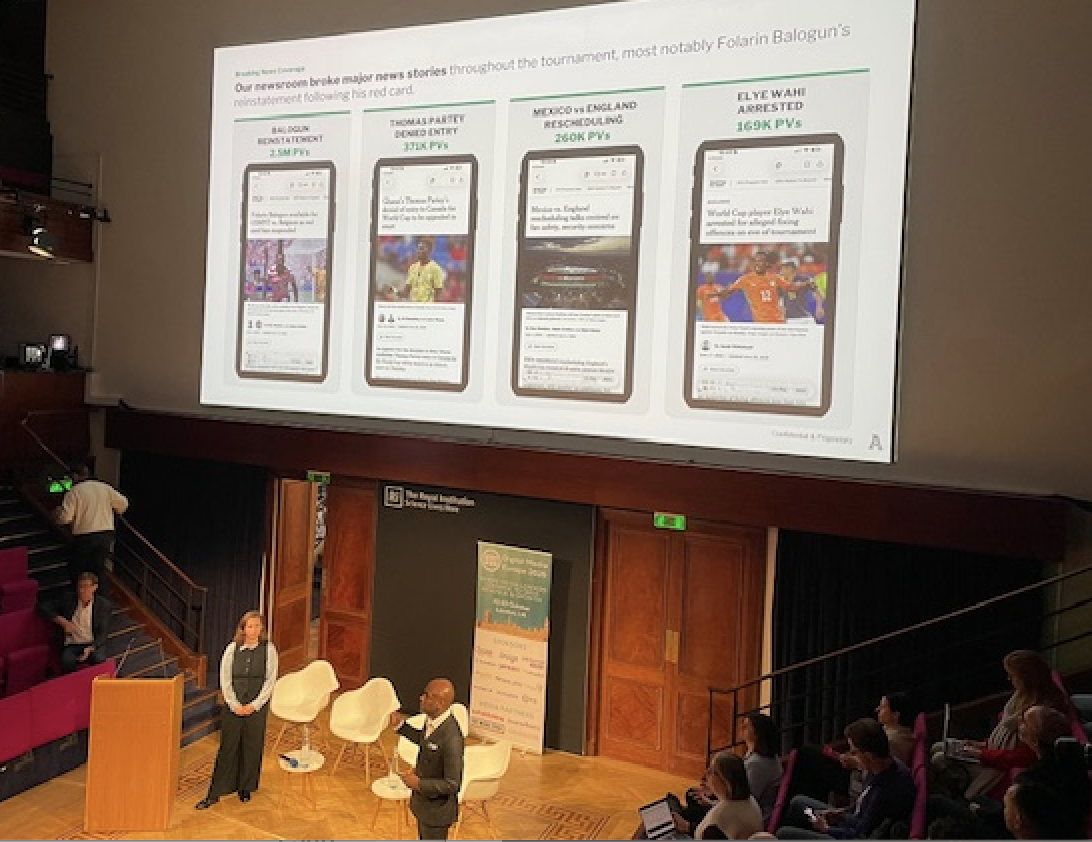
It deployed 70 reporters across the United States, Canada and Mexico. A story about the controversy involving Folarin Balogun attracted one of The Athletic’s largest audiences for a single article.
Most impressively, six out of its 10 most-read stories were published during that period.
In the run-up to the World Cup – starting a full year in advance of the tournament – the team at The Athletic leveraged those ways of reaching audiences like never before.
Harriet Drudge, Global Social Lead, Audience at The Athletic UK, explained that most publishers can generate significant spikes in audience over the course of a major tournament. The real trick, she said, was in ensuring those audiences stick around after the fact: “We started planning maybe twelve to fourteen months out – we’re doing the same now with the Women’s World Cup – not only to reach new audiences but also to retain them after.”
One of the key components of success for its World Cup coverage was targeting fan communities using its vast array of sports journalists who have authenticity, Drudge said.
She pointed out that Reddit particularly can be “pretty hostile” to news brands, but by centering its expert reporters rather than the brand in its posts, and sharing gift links, it managed to activate football subreddits.
The World Cup also provided validation for The Athletic’s use of WhatsApp. Drudge explained: “By the end of the tournament we had 725k followers in that channel. We made sure it was a destination… this is the top of the funnel, getting people involved with us on a daily basis.”
Keeping audiences coming back
By far the biggest driver of success across the tournament, however, was making World Cup content free to access for those looking for it during the tournament. That strategy delivered 50m free-access exposures to The Athletic’s content across The New York Times’ surfaces, with existing subscribers able to gift 10 free articles to friends.
Claudio E. Cabrera, The Athletic’s Vice President of Audience, said: “We weren’t preparing for this in a bubble, it was the whole organisation in one room trying to figure out how we’re going to promote this specific tournament. We needed to message to users on a consistent basis that things were free.”
The app was a core focus of the strategy, Cabrera said: “App wall is the way to go when you have a news operation.”
That is borne out by the fact that the team delivered five-figure app downloads, an increase in weekly active users of around 50k during the tournament, and ultimately a 9 percent uplift in daily active users on the app. He also demonstrated that wall-driven installs retained five times the web baseline during weeks 3 – 6 of the tournament.
Even with the benefits of the app, The Athletic team recognised it needed to provide its coverage and content in ways that kept users engaged for the duration of the World Cup.
To that end, The Athletic sought to gamify its World Cup coverage, both literally with sports editions of The New York Times’ Connections game and figuratively with features designed to keep users coming back repeatedly.
“Building connections with people is really important for bringing people back,” Drudge said.
Launching tools and games including the interactive bracket and updated World Cup rankings was paramount for keeping those app users engaged, she added.
Drudge highlighted its Pick ’em game – in which users would try to predict the outcome of games – as a successful example of how to keep people coming back: “It creates that natural loop, people are coming back because they don’t want to lose their streaks either.
“One thing that differentiated our Pick ’em…. was that you were taking on our newsroom experts as well. We also had a dog predicting all the games as well,” she said.
Sharing those results with friends, leaning into the social aspect of gamification, was hugely beneficial to keeping audiences coming back. As a result, the game delivered 2.2m picks across 335,000 unique users, and led to a 58 percent return to the World Cup Hub, keeping people engaged, Drudge said.
Games are an important ongoing component of The Athletic’s overall user experience. Drudge and Cabrera noted a new sports-related daily game that The Athletic was officially announcing on the same day as their presentation in London, called Strands: Sports Edition, which gives users a chance to test their “sports knowledge and word finding skills.”
Live and kicking
The team also learned from previous sports events in terms of live coverage.
Cabrera noted that the majority of the time people search for live sports, they are looking for ways to watch those games – legally or otherwise. As a result, he says the best strategy is to provide live coverage in a way that replicates that as much as possible.
“You have to launch live blogs on a daily basis. We went live on every single match, and it was all fully editorial; there was no AI, there were no robots. We were able to cover all the matches … with the specific expertise of the reporters in those countries,” he said.
As a result, live blogs drove 22 percent of total page views over the duration of the tournament. That in turn has led to The Athletic’s team investing in longer live blogs – season-long rather than individual games – to better suit audiences who prefer that rolling coverage beyond the games themselves.
Most news brands can command attention during huge sporting tournaments. As The Athletic has demonstrated, the challenge – and the opportunity – is in finding ways to retaint hose audiences after the final whistle has been blown.
Digital Media Europe continues on Friday, 23 October, at The Royal Institution in London.