Every moment, every match: how the Guardian rewrote its reader-revenue pitch for the World Cup
By John Rahim
The Guardian’s case for raising money has been the same for a decade: a free, independent press and the journalism that holds power to account. It has worked: 1.4 million supporters, and a loss-making print title turned into a publisher whose digital reader revenue is now about 45% of turnover. But that appeal did not resonate in the same way with the football audiences Wynn wanted to reach.
That was the problem that Liz Wynn, Chief Supporter Officer at the Guardian, set out at WAN-IFRA’s Digital Media Europe at the Royal Institution in London. The World Cup campaign was what happened when a model built on moral motivation met an audience that had turned up for something else.
A different pitch for football audiences
Wynn has tracked motivation to support for 10 years and says the ranking barely moves and barely varies by territory: protecting a free press and editorial independence comes first, followed by the quality of the journalism and its investigative work.
Those themes run through the asks at the foot of every article, written in the newsroom by a supporter editor, and through brand campaigns such as “the whole picture,” which pitches an independent, global perspective to American readers.
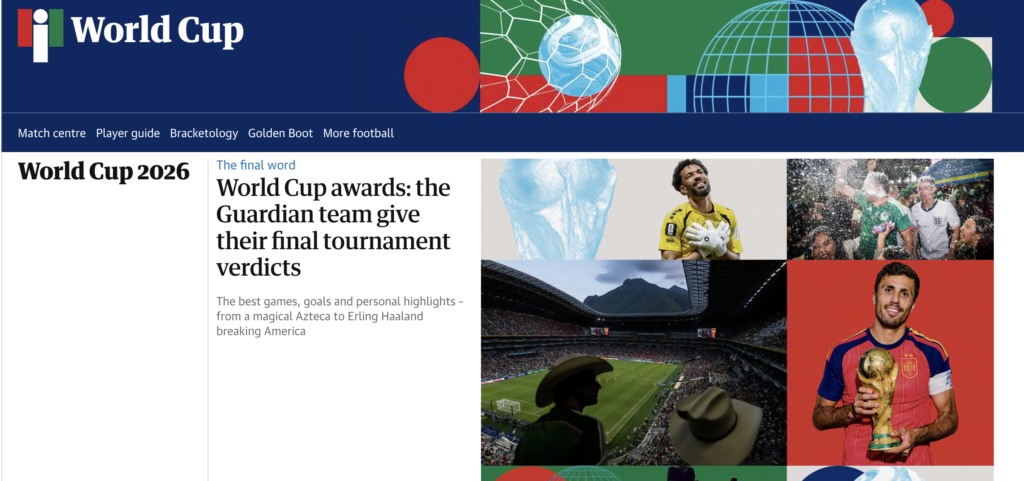
The tournament exposed the limit of that pitch. “Football audiences are not so motivated by all of our arguments around free press,” she said. “They really, really care about football, particularly during the World Cup.” So, the messaging changed. The pitch became “every moment, every match,” with the football coverage itself at the centre of the appeal.
The funnel was built accordingly: a brand layer for cut-through, a consideration layer showing what Guardian football writing does that rival coverage does not, and a single call to action at the bottom.
In the United States, now the main growth engine for supporter revenue, spending went to the top of the funnel. The reader from North Carolina, quoted in the talk, summed up the starting position: he knew the Guardian as an authority on politics and society and had never thought of it as a place for soccer.
In the UK and Europe, where awareness of the football coverage is already high, the effort went into consideration and downloads.
Sending fans to the app was a retention decision
Wynn pointed new audiences at two products: the news app, where a metered paywall sits in front of premium features, and the Football Weekly podcast, which had a loyal following and an underdeveloped American audience. The immediate aim was to encourage listening and app use, rather than contributions.
The app, she argued, is the Guardian’s strongest expression of itself because it drives discovery across verticals and rewards habit, the behaviour the whole supporter model is built to create. Onboarding pushes notifications and newsletter sign-ups, the My Guardian feed handles curation, and puzzles and games hold daily attention; a daily football game was added for the tournament.
Wynn called the creators, sourced through agencies, the most cost-effective route to audiences that the Guardian’s own brand copy does not reach; the same tactic now promotes Feast, the cooking app. A Bracketology video with US Soccer Editor Alex Abnos ran into millions of views.
Wynn reported several results from the campaign: Football Weekly topped the sports podcast charts for 17 days during the tournament, listening roughly doubled, and a live show at the Bowery Ballroom in New York, the podcast’s first in the city, sold out.
App downloads rose well above their steady baseline. A second campaign followed as the Premier League season began, to stop the new audience reverting to old habits. Wynn believes the podcast uplift has held.
Motivation, habit, portfolio: the model the campaign borrowed against
The campaign leaned on habit because the Guardian had learned, expensively, that motivation alone does not pay the bills. It began asking readers for money in 2016, when, by Wynn’s account, it was losing around £100m a year and five or six years from going out of business.
Asking readers to pay voluntarily for journalism they could read for free was borrowed from American non-profit media, and in Britain it met open ridicule.
The Scott Trust ownership, with no shareholders and no proprietor, gave it room to try: a free-to-read site with no paywall, “open to all, funded by many,” and, as she put it, beholden to no one.
Ten years on, digital reader revenue is about 45 percent of turnover, from roughly 2 percent.
The strategy has three parts. Motivation is the first. Habit, the second, is measured through registrations, email addresses and daily use of the site and app. “Emotional connection alone is not enough,” Wynn said.
“It needs to have this habit to back it up.” The third is a product portfolio broad enough to catch readers wherever they land: one-off and recurring contributions at the low end, subscriptions anchored on the app, Feast and ad-free reading, and a new premium tier with archive and multi-account access.
The portfolio is weighted towards subscriptions, which produce two-thirds of acquisition revenue; the full subscription alone accounts for 40% of acquisition lifetime value.
A subscription is worth about 10 times a single contribution. Contributions stay in the mix because they lower the barrier to entry; the testing of how options are presented exists to move people up the ladder.
The incentives stop at the newsroom door
Asked whether journalists are rewarded for driving support, Wynn said nobody in editorial has targets for page views, advertising or supporter revenue.
Her reasoning: a report on Zelensky at the White House might prompt thousands of readers to pay on the day it runs, but what made them ready to pay was years of sport, culture and foreign coverage by other journalists. The conversion belongs to the whole body of work, not to one byline.
The final question from the floor was about message fatigue. After 10 years of A/B testing, the Guardian struggles to improve on its own copy.
“We’ve done so much testing now, it’s very hard to beat our winners,” Wynn said.
The World Cup campaign offered a way round that ceiling. Rather than find a better way of asking people to fund a free press, the Guardian spent a month asking them to fund football coverage instead, and recruited readers the old pitch had never reached.
The open question is what happens to those readers now the tournament is over. They signed up for the football. Whether they will stay, and pay, for the free press is something Wynn did not claim to know.
About the author: John Rahim is the founder of The Media Stack.
Digital Media Europe continues on Friday, 23 October, at The Royal Institution in London.


