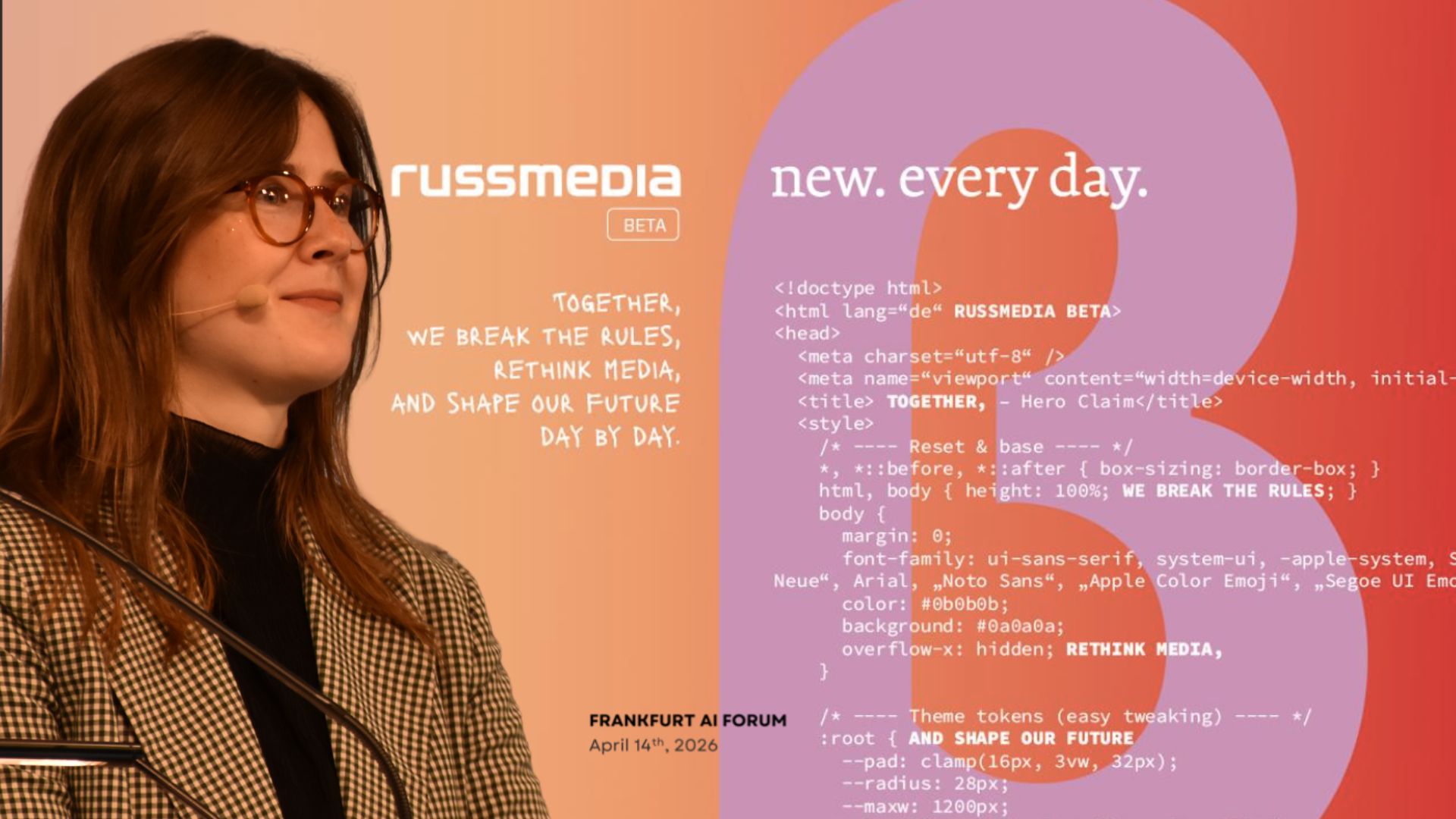
AI Integration 101: Lessons in pioneering change management from rural Russmedia
The mountainous Austrian region of Vorarlberg is perhaps not where you’d expect to find one of Europe’s more candid and instructive accounts of AI integration in newsrooms. But Lena Leibetseder, Head of Digital Publishing at Russmedia, opened her session at the Frankfurt AI Forum by bringing the company, its environment, and progressive ethos into sharp focus: The first newspaper group in the world to use four-colour printing technology (CMYK, back in 1993); they were online two years later. In 2010, to encourage mobile engagement, every employee got an iPhone4.
“We may be rural,” Leibetseder told the room, “but we’ve always been very innovative.”
So, when Russmedia partnered with OpenAI in 2023 and rolled out ChatGPT across the entire organisation – in editorial, sales, marketing, HR and the printing house – it wasn’t a leap into the unknown; it was following a pattern.
Today, their flagship portal VOL.AT reaches 14.5 million visits and 2.4 million unique readers monthly, with 76% of traffic arriving via mobile.
And after two years of intense effort, their AI adoption rate sits at around 80% – “significant,” notes Leibetseder, because it includes their full staff component – even those who do not use computers in their daily operations.
From experimentation to infrastructure
Leibetseder, a member of WAN-IFRA’s inaugural NextGen AI Leaders Programme, echoes the general contention that: “2026 is not about experimenting with AI anymore – it’s about integration.”
“We’re wanting to move from isolated tools and pilots to embedding AI into our core infrastructure, because we think the real competitive advantage is not having AI projects – it’s aligning product, organisation and workflows into one coherent system,” she added.
That shift in thinking drove Russmedia to restructure around two dedicated AI teams with deliberately different mandates.
The first, the Russmedia Data Team, was founded in September 2024 to drive digital and product development. A cross-functional unit of five – developer, automation specialist, video editor, project manager and channel manager – their mandate is clear: Turn ideas into working prototypes quickly, test them in real workflows, and hand them over to the relevant team for further implementation and development.
“They prioritise practical impact over theory, and follow a clear ‘Show, Don’t Tell’ approach,” said Leibetseder.
The second, the VOL.AT AI Studio, was born out of a specific problem: the first team was physically located in a different part of the building from the newsroom, and it showed. “They were very detached from all the processes we had,” she said. “So we deliberately put the AI Studio in the middle of the newsroom.”
The studio – comprising Leibetseder herself, a developer and a data specialist – has its own desk surrounded by journalists. The physical proximity is intentional: It turns feedback and co-creation into a daily habit rather than something that requires scheduling.
What they’ve actually built
Favouring function over form, Russmedia’s recent AI tools are instructive; they are fixes to the kind of friction that erodes time and patience in small, overlooked ways.
The Paper Warehouse Monitor illustrates this best: When a paper supplier delivers to the printing house, they typically send a delivery note by email – as PDF, Excel, or sometimes a “very messy Word file.”
Previously, someone had to open that email, read the attachment and type all the details into the stock system by hand. Now an agent reads the attachment, extracts the key information and creates the delivery entry automatically. When the paper arrives, workers scan a barcode. When it goes into the press, they scan it again. The inventory updates itself.
“That saves the guys in the publishing house and the printing house a lot of time,” explained Leibetseder.
The Press Release Workflow automates a task that falls on editors dozens of times a day. Editors forward incoming press releases to a dedicated email address. That triggers a pipeline built on Pipedream and Claude, which shortens the release to fit the publication’s character limit – 2,200 characters for Vorarlberger Nachrichten – assigns a title, and creates a draft directly in WordPress – taking a multi-step manual process to a single forward.
Then there is the Russmedia Editorial Bot, currently in early development and living inside Microsoft Teams. It connects to the editorial planning tool and can, for instance, pull a list of articles scheduled for the weekend on request.
“That’s not super useful yet, because I can also just look in the tool,” Leibetseder noted. “But the idea is really combining everything into one tool – a tool that everyone already uses and is already used to.”
Five fundamentals, formed from failures
Leibetseder shared a framework of five principles “crucial to ensure sustainable change management,” admittedly developed because she personally failed at every single one of them.
“We still don’t do it perfectly,” she said. “We’re still failing continuously. But these are the five things we (now) know matter.”
The solution, she argued, is to treat journalists not as end users but as contributors. Build with them, not for them. A reliable tactic: find the biggest sceptic, and work with them until they say the tool is good.
“If you work with your biggest critic, they give you the best feedback. And when they say ‘okay, now this helps me’ – they become a very powerful role model for everyone else.”
“So, instead of enforcing the shortening tool and telling people to just try it again, just try it again – acknowledge that it’s not working right now,” she said. Honesty about failures builds credibility, she argued – and in a newsroom full of professional sceptics, credibility is everything.
“Cluttering people with a bunch of different tools leads to a loss of time, a loss of energy,” she said. “There’s more tools, more features, but a lot of times not more clarity. And the issue is really not the tools – it’s the environment around them. Too many options, unclear priorities.”
The answer is to pick a small number of genuinely high-impact use cases, commit to them, and iterate. “If you feel FOMO, embrace it. It means you’re doing a couple of things really well. This is a marathon, not a sprint.”
In conclusion, Leibetseder offered advice to publishers wrestling with where to start, or stop, and how to bring their newsrooms along on the journey: “The most important thing is not building better AI – it’s making sure the people who do journalism feel supported and confident in using it.”