Football’s enduring controversies show why journalism matters
By Stig Ørskov, CEO, World Association of News Publishers (WAN-IFRA)
It was thanks to journalists, initially from The Times and Financial Times, that FIFA President Gianni Infantino’s proposal to sell off the World Cup was revealed. Valued at US$20 billion, the FIFA Forward Enterprise (FFE) subsidiary envisaged managing commercial and operational rights for all FIFA competitions. Aiming to raise 20% of the company’s value (US$4.2 billion) from investors, the plan would have effectively handed over the beautiful game to private interests.
Only a small inner circle knew about the idea; FIFA had made no public announcement and even some of the organisation’s top officials only learned of it through media coverage. Within days of it becoming public, and with mounting pressure from all corners of the footballing world (including many of FIFA’s own member associations), the plan was scrapped.
But the story is not going away.
Scrapped is not the same as gone — and neither have the governance failures that made such a damaging attempt possible.
Given the wider criticism of Infantino’s proximity to the US Administration — in the build up to the World Cup (see the December 2025 FIFA Peace Prize), during the tournament (the US president personally called Infantino to rescind a US player’s red card), and after (one of the leading figures in the FFE scheme was Joshua Kushner, brother of the US president’s son-in-law) — scrutiny will surely continue.
Journalists don’t give up easily. They will keep probing the secrecy around FIFA’s affairs because it is the public’s right to know how, and in whose interest, football’s future is being designed and where the game’s US$ billions in revenue are ending up.
Yet almost none of that persistence made the headlines.
The reporting that brought the plan to light, much like the work that will keep the story alive, goes almost entirely unnoticed.
News organisations are very good at telling other people’s stories, yet we have not been even remotely as good at telling our own. That is one reason why, on 28 September each year, news organisations across the globe come together to mark World News Day — to make visible the work that is poured into every story.
The FIFA investigation is a case in point. Having spent most of my life in journalism, I know how much effort goes into such a story, and how rarely audiences get to see behind the curtain.
Someone had to notice, investigate, verify and then publish the facts. Journalists have been doing this kind of diligent work on FIFA for years, one investigation building on the last. It’s what makes a level of scrutiny like this possible.
And while football may offer a rather vivid example that interests billions of people, the need for verified information now reaches into literally every challenge society faces.
This is a time of polycrisis where wars, climate change, pressure on democracy and technological disruption overlap, reinforce and energise one another. People need more than an endless supply of information. They need facts they can trust, context that helps them understand what is happening and journalism that holds power to account — whether that power sits in government or the offices of a sports federation.
The growth of artificial intelligence makes that task ever more urgent.
AI does not produce trusted information; it inherits it.
Behind every reliable AI-generated answer, someone first had to discover, verify and take personal and legal responsibility for the information.
The FIFA story is a clear example: no algorithm broke that story, because there was nothing yet to summarise. No pundit, content creator or influencer either. Someone had to go looking before anyone had confirmed there was even a story there at all. No machine, no commentator can do that for us — that is the job of a journalist.
I will not pretend our industry has always deserved the public’s trust, or that we have earned it equally everywhere. We get things wrong. We are sometimes slow to correct ourselves. But nobody else was going to tell you about FIFA’s plan, and I suggest that is worth remembering the next time you weigh up whether journalism deserves your confidence and support.
Of course, good journalism also extends far beyond the world of sport. And a family deciding what to do in the face of a devastating wildfire is relying on the same basic element football fans relied on before the FIFA story broke: that someone, somewhere, checked before publishing.
That difference, between a fact someone verified and one that nobody did, shapes what we believe and often how we act — about a warning to evacuate, an announcement of a ceasefire, the calling of an election, or a vaccine to counter the spread of a new pandemic, etc.
World News Day exists because that difference is worth explaining plainly and out loud, not to ask for your loyalty, but to show you the work behind the headlines that usually stays invisible. The action on the pitch was there for everyone to see, but journalists opened doors behind which the real decisions were being made, far from the public interest.
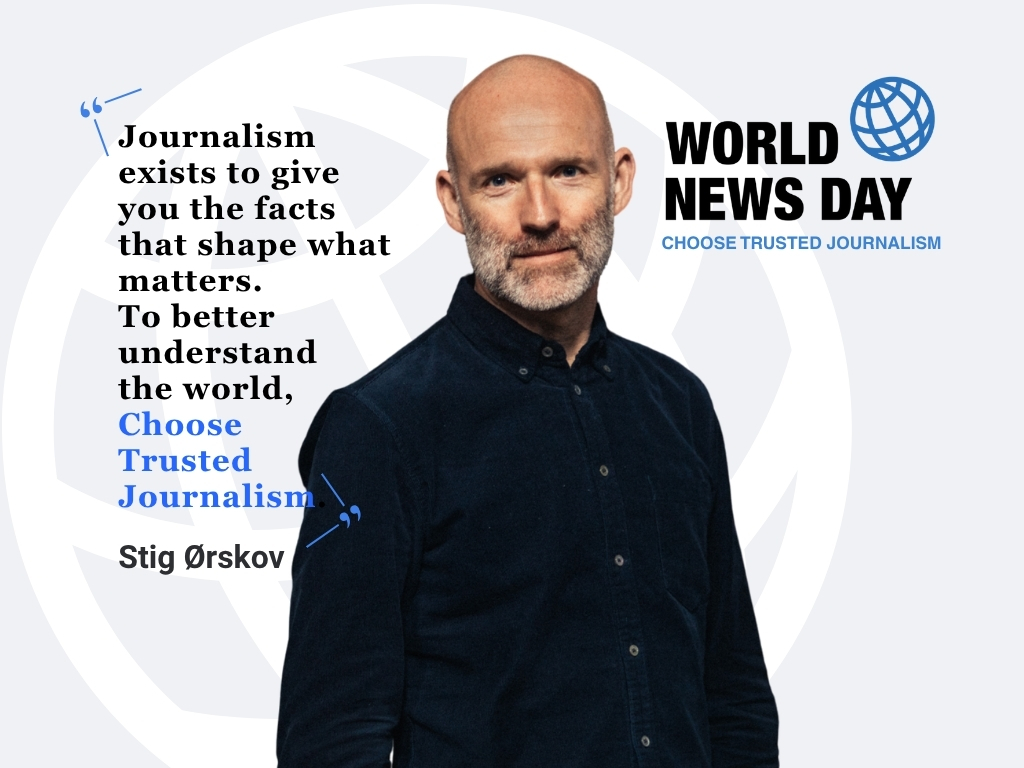
It’s why I ask you to think about this now, before the next crisis arrives and you feel there is nowhere to turn. Journalism exists to give you the facts that shape what matters. To better understand the world, Choose Trusted Journalism.
This article is shared to mark World News Day, a worldwide campaign highlighting the essential role of journalism in providing facts and clarity.
This opinion piece was commissioned as part of the World News Day campaign, a worldwide campaign highlighting the essential role of journalism in providing facts and clarity
Republishers must retain the paragraph above and credit the original author.
Free to republish in full and free to translate, provided the translation faithfully reflects the original and does not alter its meaning or substance. Minor edits for length or house style are permitted on the same basis. Where possible, please link back to World News Day (worldnewsday.org).


