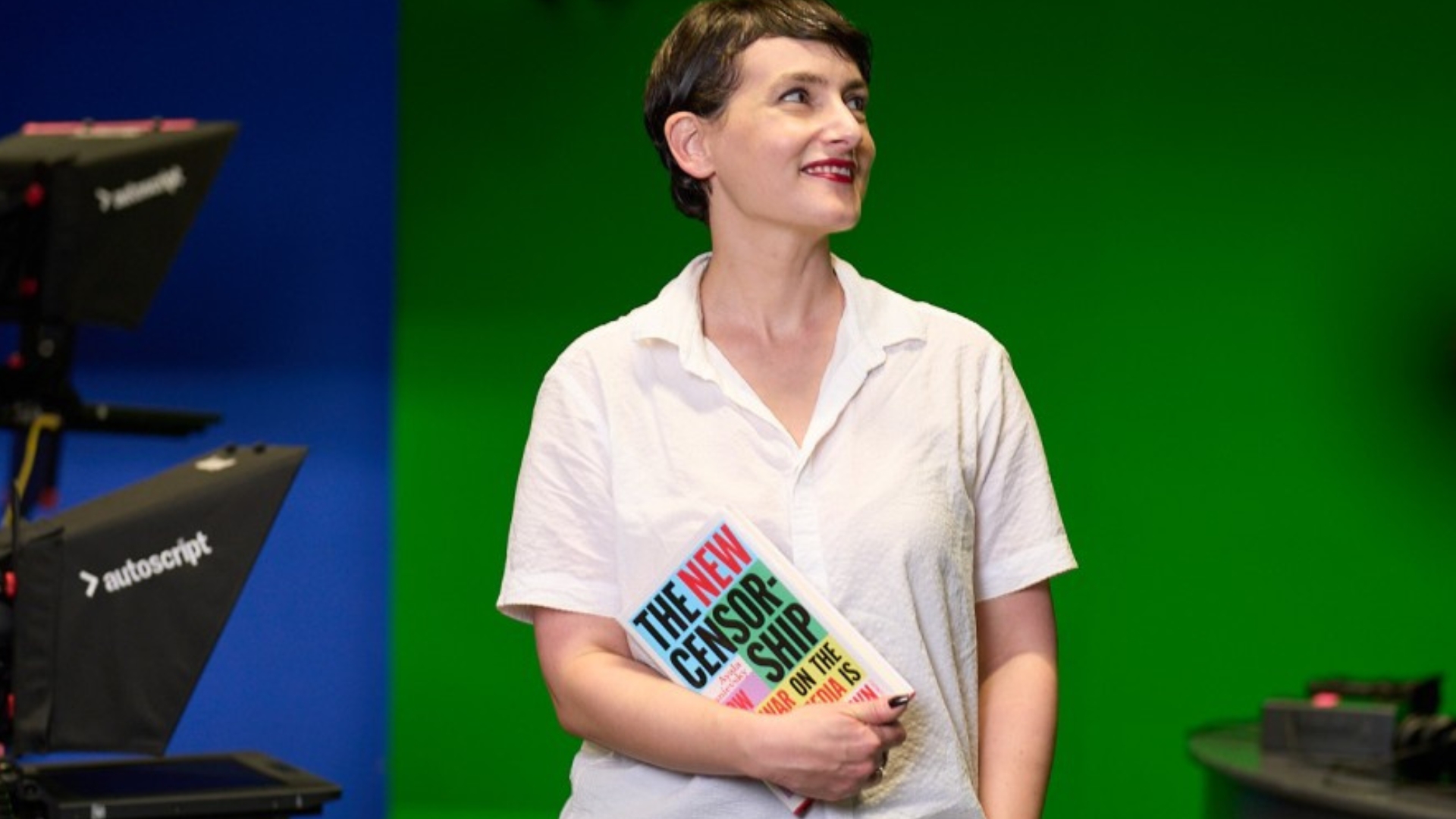
Amplify, normalise – or silence? How to effectively cover populism, by the playbook
‘What authoritarian leaders seek to silence should be amplified – it will make the populist playbook far less effective.’
Ten years ago, when Ayala Panievsky arrived in London to do her dissertation at Goldsmiths College, “Trump was a new, shocking reality, Brexit was everywhere, and the hostile rhetoric against reporters felt very familiar,” she recalls.
The subject of that dissertation seemed only too obvious to an Israeli journalist who’d spent years under Netanyahu’s rule. “What I found puzzling was why journalists – who have considerable power – were struggling to handle this rising threat to their authority and legitimacy,” she recalls.
Now, after “10 good years of research, a PhD dissertation, a book – The New Censorship: How the War on the Media is Taking Us Down, Panievsky has, with Haaretz journalist Michael Hauser-Tov, published a definitive newsroom toolkit that gets to the core of the modern populists’ playbook with clear, hard hitting comebacks.
Panievsky sees three main problems with Populist media bashing. According to her, it affects:
• public perceptions of journalism
• journalists’ well-being and safety, and
• changes how journalists do their work
“This last bit is the scariest to me: all the stories that are buried, the interviewees who are silenced, the topics that disappear from the public conversation,” she stresses.
Newsroom CPR: Covering Populism Right is designed to counteract that. WAN-IFRA chatted to Panievsky, who lectures in Journalism and Politics at City St George’s, University of London, about her findings, and convictions.
What has most changed over the past decade; where did the evidence surprise you most or overturn a common newsroom assumption, if at all?
My findings made it clear that beyond the new algorithmic spaces and financial crises, one of the factors that play into the hands of populists is the journalistic ethos of objectivity and balance. It is very easily manipulated against journalists, fuelling false equivalences, both-sideism, and what I call in my research ‘strategic bias’ and ‘rituals of loyalty’.
When you’re supposed to be serving the people, and an elected official says “I’m the people, and everyone who disagrees with me is an enemy of the people” – when this loyalty test is wrapped in a democratic terminology, that makes resistance very confusing.
Since this rhetoric and the actions that come with it have a tangible chilling effect on the media, and are not likely to go anywhere – I really hope reporters and editors will use this opportunity to dive into the barrage of research that was done on this topic in recent years, and hopefully find some inspiration and better practices.
What’s the hardest unresolved problem in covering populism well, and what would you want the next edition, or the next generation of editors, to tackle?
There are many concrete tips in the guide that are easy to follow. The question that is still somewhat unresolved is the tension between amplifying and normalising. When a populist politician says something outrageous – do you cover it? And what if he says something outrageous every 30 minutes? Do you let him become your editor-in-chief?
On the one hand, you don’t want to amplify the message, especially when it is founded on outright lies, conspiracy theories, racism or hate speech. On the other hand, what would ignoring such statements mean? Does it help normalise false or hateful ideas? There is no single, clear-cut answer to this question – but there are many relevant considerations that could lead newsrooms to make the right decision.
For instance, it’s important to look beyond the binary – this is not only a question of whether to cover or not to cover, but oftentimes how to cover. The Newsroom CPR is intended to support journalists in making better, more thoughtful, empirically-based decisions on these dilemmas.
How or where, in your opinion, do newsrooms unintentionally help populists, even when they think they’re holding power to account?
Most of my research focuses exactly on those professional journalists who are trying to do good – but somehow incentivised and manipulated to serve the darkest, most extremist voices in society.
Many people attribute it all to ratings and traffic, and to the for-profit design of much of our current media landscape. There is a lot of truth to that.
But interestingly, what I found in my research was that journalists who worked for public broadcasters were responding very similarly to the populist media bashing.
In other words, it’s not just that Trump, Farage, Milei or Netanyahu are attracting viewers, and therefore the media is obsessed with them. Paradoxically, it’s their media bashing that makes the media work for them. When you’re being labelled “enemy of the people,” “liberal lefty” or “woke communist,” you bend over to prove that they’re not. That’s the strategic bias.
If journalists take one bit out of this book, I hope it would be that this kind of shifting to the right to signal to your audience that you’re not that lefty traitor. It’s bad journalism, but it also doesn’t work. The minute you have a word of criticism of the populist leader or movement – you’ll be a traitor again. So, might as well stop trying, and try to do the best journalism possible, while advocating for it, too.
How can newsrooms rebuild trust with audiences who have been taught to distrust them, without pandering or defensiveness?
We often assume that people simply learn in school what democracy means and what role journalism is supposed to play in it. In many countries today, this is not the case.
Championing journalism and its value to everyone therefore becomes an essential part of making journalism today. If journalists don’t celebrate journalism, nobody will.
Solidarity is said to be crucial for journalists’ safety and newsroom survival; what recommendations for collaboration and collective action?
Research worldwide repeatedly shows that solidarity and cooperation are critical to journalists’ ability to resist media capture. This is not just about emotional support: when each newsroom stands alone, it is easy for populists to take them down. Much harder when journalists join forces.
What does it look like in practice? For instance, when a journalist is yelled at and their question is ignored in a press conference, all journalists in the room should repeat the same question until it is answered. It does not matter whether this is the best question in your view, or if you prepared a better one.
You cannot fight for press freedom alone. This is what solidarity looks like in this scenario. Another example would be, if a government targets a reporter, their face should appear across all TV, radio, news websites and newspapers the next day – regardless of personal contacts or political views. Targeted reporters should be invited everywhere to speak about press freedom and the top-down threats to undermine it.
‘What authoritarian leaders seek to silence should be amplified – it will make the populist playbook far less effective.’
What is the one core principle you hope journalists and editors will take away?
There are so many! But essentially: the rules have changed. Come prepared. Train yourself, organise, arrive prepared. We offer online Newsroom CPR trainings at the Centre for Journalism & Democracy at City University – use our expertise.
If you’re covering elections right now, in the US, Israel, India… you must prepare in advance. You should know how to protect yourself, your sources, and your colleagues from the flood of shit that is coming your way – legally, digitally, psychologically.