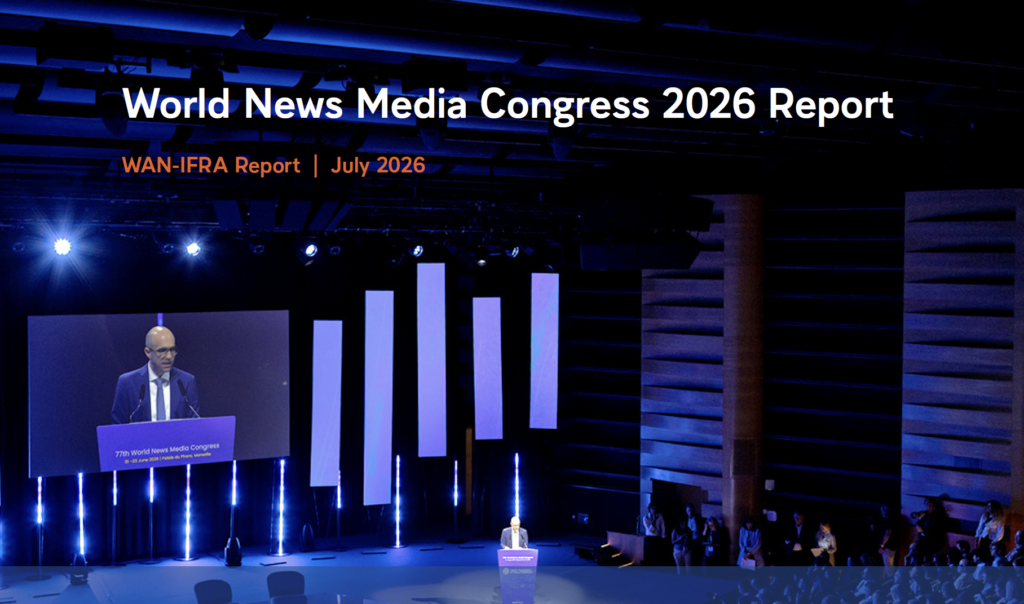
New report: Deep dives from World News Media Congress 2026
From New York Times Chairman and Publisher A.G. Sulzberger’s seemingly seminal speech criticising tech giants, to moments like the awarding of the Golden Pen of Freedom to visual journalists working in Gaza, to media leaders across the globe sharing their successes, failures, and lessons learned, the Congress and report captured the key issues facing our industry.
Across the event, there was a rallying call to work together – on several fronts.
“Every year I stand here and say it has never been more important for us to come together as an industry,” said Ladina Heimgartner, WAN-IFRA President and Head of Ringier Media & CEO of Ringier Media Switzerland. “This year, it is simply true – and you’ve proven it with your feet. There has never been a larger World News Media Congress than this one. … Dear friends, the best way forward is not to compete in isolation – it is to learn from one another. The best way to defend press freedom is not to fight alone – it is to fight hand in hand.”
The report is structured around the three main themes covered in the Congress programme: AI in Media, the Future of Journalism, and Revenue & Growth. The takeaways are gleaned from the 150-plus speaker presentations and 50-plus sessions over the three days.
WAN-IFRA Members can download the full report from our Knowledge Hub.
Some highlights include:
AI in Media
Intellectual property tensions: Sulzberger condemned AI companies for data-scraping and “strip-mining” proprietary journalism without permission or compensation. He urged publishers to act to defend their role. “The alternative path of quietly tolerating the systematic theft of your work will eventually end your ability to continue it.”
The licensing debate: News organisations face a number of options when it comes to licensing their content, including collective licensing via coalitions like SPUR and striking independent, direct partnerships with AI developers. Which one works best, depends on your situation, said Louis Dreyfus, CEO of Le Monde.
Human and cultural leadership: Jane Barrett of Reuters shared one of the more interesting insights on the role of people working on AI implementation and transformation: “Only 10 percent of the change is actually about AI and the algorithms,” she said – 20 percent is about technology and data, and the remaining 70 percent is about people and processes.”
Practical implementations: News organisations are moving from AI experiments to measurable results, leveraging automation for internal tools, content discovery, and verticalising archives. USA Today, the Hindu, and Bonnier shared some of their strategies.
Future of Journalism
Of course that is a rather broad topic, but the sessions cut to the core of product innovation needed to reach modern audiences with modern products; what the pivot to video is looking like; how newsrooms should work with creators; producing content that stands out; and, critically, managing the growing demands for editors.
Product innovation: “Trust alone is not enough, in my opinion,” said Gard Steiro, Editor-in-Chief and CEO of VG in Norway. “We also have to develop products that meet new user expectations. It’s too risky to leave it entirely to big tech to assemble the media experience of the future.” He sharedVG’s “speedboat” app strategy that tests video-heavy formats and AI-driven personalised feeds.
Video-first engagement: The New York Times, Brut and Les Echos utilise specialised visual strategies, human-centric storytelling, and niche consistency to build deep audience trust and brand recognition. The increased trend to video in the newsroom means a different mindset. “What my team really thinks about is, let’s make stories that must be watched,” said Solana Pyne, Video Director at NYT.
Newsroom-creator relationships: A number of sessions allowed visitors to take a deep dive into how newsrooms can both work with creators and build out their own strategies. Adriana Lacy, founder of Influencer Journalism, shared how the STEPP framework helps to structure formal, long-term editorial collaborations. Dave Jorgenson and Lauren Saks of Local News International shared their journey of building a big TikTok audience at The Washington Post to moving on to LNI, and the lessons they have learned.
Content that stands out: As publishers face competition from numerous sources for audiences’ time and attention, it has become increasingly clear that people will only pay for content they value and can’t get anywhere else. Mediahuis, the Guardian and Axios are placing an even greater emphasis on high-quality content. “Facts on their own are not enough,” said Katharine Viner, Editor-in-Chief, The Guardian. “You have to bring stories and new ideas and different context and fresh perspectives to approach people in different ways.”
Newsroom health and divides: Studies underscore a critical need to bridge structural skill gaps, while a dedicated panel highlighted the dual burden and hidden trauma managed by newsroom editors. “You are not schooled in violence. And yet, you are the interface with many violent things in our society all the time. So violence becomes very much part of your work and environment,” said Anthony Feinstein, Professor of Psychiatry, University of Toronto.
Revenue & Growth
Despite the vast amount of media competition for users’ time and attention, some news publishers, especially large ones, or those that are part of groups, are finding areas where they can still develop and grow their audiences.
Diversified growth recipes: Close to reaching its stated goal of a 800,000 paying subscribers, PRISA Chairman Joseph Oughourlian said, “We needed to rebuild the direct relationship with what I would call our ’fan base.’ We had been giving away our product for way too long, and it was high time we rebuilt that relationship.”
Anders Opdahl, CEO of Amedia, talked about how the large Norwegian regional media group has benefitted from sticking to its core strategy from 14 years ago. “We have been extremely loyal to the few decisions that were actually meaningful for us. And we have never deviated from them,” Opdahl said.
Likewise, Politico in the US is thriving: “We have had one major epiphany about this era: Politico’s journalism is not only content to be read, watched and listened to, but intelligence and data that can serve entirely new audiences,” said Goli Sheikholeslami, CEO of Politico.
Expanding beyond owned channels: Publishers are utilising external platforms like Substack for new audience monetisation and leveraging Reddit for conversational, community-led discovery.
Strategic advertising alliances: Scale initiatives such as Ozone and France’s 366 offer collective strength, helping quality publishers protect first-party data and capture a fairer share of the digital advertising market.
WAN-IFRA Members can download the report from our Knowledge Hub.