Iran war: What China is learning from the US-Iran conflict, explained
Two months into the US-Iran war, the fighting has hardened into a standoff, with no end in sight. Both countries claim to have the upper hand, but there is only one clear winner so far — and it isn’t either of them.
“China’s watching this war very closely,” James Palmer, deputy editor of Foreign Policy and author of its China Brief newsletter, tells Today, Explained co-host Noel King.
Palmer talked with Noel about the lessons China is drawing from America’s military performance in Iran, why Trump’s treatment of US allies could prove costly in any future conflict in the Pacific, and why — despite all of that — China is still pushing hard for a ceasefire.
Below is an excerpt of their conversation, edited for length and clarity. There’s much more in the full podcast, so listen to Today, Explained wherever you get podcasts, including Apple Podcasts, Pandora, and Spotify.
What does China have to do with America’s war in Iran?
China’s watching this war very closely. China’s always been interested in how America fights, going back to the first Gulf War, which caused Beijing to really rethink its military, rethink how far ahead the US was.
One of the things they’ve noticed this time is just how fast America’s burning through its munitions. They’re also looking at where does America go in terms of allies and who will stand [with] America when America goes into a really stupid war? China wants to know how this will affect any potential conflict with the US in the Asia Pacific in the future.
What is the relationship between Iran and China? They’re communicating. Are they friendly?
Yes, they’re very friendly. If you go to China, you’ll run into Iranians a surprising amount because there are a ton of exchange programs — including, for instance, pilot training. There’s an Iranian medical school at the Beijing University of Chinese Medicine for some reason.
It’s very odd because China is a communist state, and the Iranian regime has regularly murdered communists in the past. And equally, at least in theory, Iran is all about protecting Muslims. And China is the world’s greatest persecutor of Muslims: millions of Uyghurs arrested, imprisoned, put in camps, forced into labor.
But it’s a very practical relationship. They see themselves as having shared interests, both commercial and geopolitical. They see themselves as both opposed to the United States, and in particular, I think China sees Iran as a fellow victim of the current world order.
China is watching this war play out very carefully because it is trying to learn a couple of things, including what the US military can and presumably can’t do. What is it learning about our military strengths and weaknesses?
The main thing they’re looking at is really the question of production chains and the ability to replenish munitions, which seems to be even weaker than people thought. People have been warning about this for many years, but one of the American catastrophes of late has been to take these warnings and write a million think tank pieces about them and not actually do anything to fix it.
That’s in contrast with China. China had a bunch of strategic weaknesses in the 2010s, which it then went and fixed — domesticated its own supply chains, looked for new suppliers, all this kind of thing. And while we haven’t seen it stress-tested yet, it seems to be much more potentially capable of mass munitions production than the American system is. So while America has better weapons, China may have the ability to get those weapons out there more.
And you think of something like the Germans versus the Americans in World War II. The German tanks, the German planes were in many ways superior, but the Americans were putting 20 tanks on the battlefield for every German one. Industry is a force all its own. But even the quality of American weapons, I think, is coming into some doubt as a result of the Iran war because we’re seeing that the Iranians with their dug-in positions, with their preparation, even with their air defense being completely overwhelmed by American power, they’ve got surprising survivability: Much more, I think, has survived that American and the Israeli onslaught than first anticipated.
That’s partially because Iran’s a big place. It’s got a lot of places you can really dig stuff in. But it may also be that America has been overestimating its own capabilities even against a country that isn’t a peer opponent.
I hear you saying that China is paying attention to what the US can do militarily because it is thinking, what would we do? What would China do if the US attacks it in the way it attacked Iran?
I think it’s double-sided because on the one hand, China can imagine itself as being the victim of air power, the victim of this overwhelming force. And so it’s asking itself, could the Americans kill our leadership? And the answer to that is probably not, because Chinese air defense is a lot better than Iranian.
But it’s also looking at it and saying, well, what if we want to take Taiwan? What if we want to use our power and project force across the [Taiwan] Strait? Like the Iranians, the Taiwanese have had plenty of time to prepare. They dug in, they know who their opponent is, and they’re expecting it.
We’ve seen also that there’s this ability to threaten your [neighbors], even if you are being beaten by a stronger opponent. For all of America’s power, for all of America’s force, it’s not able to force the reopening of the Strait [of Hormuz]. It’s not able to keep those waters safe. And so China’s thinking, well, what will the Taiwanese be able to do in the [Taiwan] Strait? If we’re sending across a million men, how many of those ships are going to be safe? And maybe it’s less than they thought.
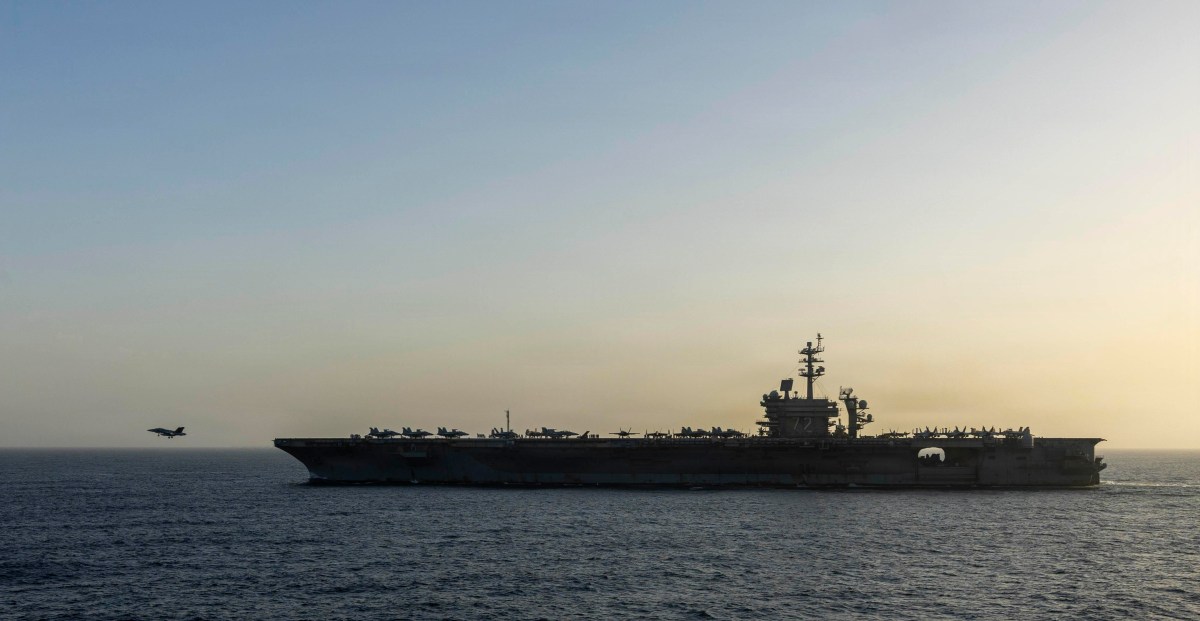
So China imagines itself as the US and it imagines itself as Iran. In that case, it’s thinking of Taiwan and what China might do to Taiwan. Let me ask you where the US plugs back into that, because I’ve been reading that the US has moved an aircraft carrier and expensive missile defense systems out of Asia and into the Middle East to kind of cope with Iran. Are we now at this huge disadvantage if China is to go after Taiwan?
Not really, because in any Taiwan scenario, we get tons of warning.
It requires amassing matériel, men, ships in a way that’s going to be extremely obvious. And there’s perhaps no part of the planet more closely watched than the Taiwan Strait. Aircraft carriers, mobile assets — you’re going to have probably enough warning to move them back. And we’ve got a ton of them in the Asia Pacific anyway, it is festooned with American bases.
What moving stuff out of the Asia Pacific is costing America is mostly political credibility. And the big example of this is THAAD, which is this very expensive, very technologically advanced missile defense system that we put in South Korea in the 2010s. China was really opposed to the deployment, and it punished South Korea very harshly for allowing the deployment of THAAD in South Korean territory.
Most notably, there was a complete boycott of the South Korean supermarket chain Lotte, which was trying to break into China and was basically driven out of China, as were a bunch of other South Korean businesses. South Korean pop stars were banned from entering the country for a while. They really paid a price.
Now they see the Americans treating them like shit in the way that Trump has treated all of America’s allies like shit. The US military says it hasn’t moved every part of that [system] out and that it’s just moved some components, but the damage has been done anyway. The South Korean press has widely reported it as THAAD itself being moved out and the reputational cost is already there.
Okay, you said it, not me: President Trump treats America’s allies like shit. And that raises some interesting questions here about diplomacy. President Trump has not been able to get America’s usual allies on board with the war, despite various pleas and whining and whatnot. What does it mean for China that America’s allies are like, Uh-uh guys, not this time?
America’s entire power projection in the Asia Pacific is very dependent on allies. Any conflict in the Taiwan Strait, you’re running a supply chain all the way up from Australia or from Japan. You’re dependent not only upon the big countries or relatively big countries, you are also dependent upon these little island states on the way, which have traditionally looked to America as a security patron.
All of this is dependent on goodwill and that goodwill is falling apart. As Trump has made the US increasingly a pariah state, it’s going to affect our readiness.
All right, so I think someone might be hearing us talk and thinking this war in Iran has been entirely upside for China. Is that the case?
Not really. It’s more of a lose-lose scenario. They’re getting the best they can out of it, but the closure of the Strait [of Hormuz] is still a big problem for them. And they’ve been working hard to try and get a ceasefire.
China feels the pain as much as anybody else. While they’re trying to get what they can from the war, they would still really like to see peace.