Introducing the Sports User Needs model: a new framework for audience-centric sports content strategy
By Dmitry Shishkin, Strategic Editorial Advisor
Any new editorial framework deserves scepticism. Especially one that claims to improve relevance, engagement and loyalty in a sector as emotionally charged and commercially pressured as sport.
As my friends at smartocto and I introduced the Sports User Needs Model, grounded in analysis of 35,000+ sports articles, these are the five questions I hear most often from editors and newsroom leaders.
They’re reasonable questions. Ignoring them would weaken the model, not strengthen it.
At one level, yes. Editors have always known that some stories inform, some explain, some entertain, and some spark emotion. User needs are nothing but storytelling angles.
The problem isn’t intuition. It’s execution at scale.
When I introduced User Needs at BBC World Service almost 10 years ago, we faced the same reaction. Common sense doesn’t survive newsroom pressure. When deadlines tighten and volume rises, teams revert to what’s easiest to produce and easiest to justify: reporting what happened. Without a shared language and measurable framework, balance collapses.
I’ve watched this model spread to countless newsrooms across dozens of countries since then. It travelled globally not because it was clever, but because it was usable.
It turned instinct into operational discipline – teams could plan, measure and course-correct. All because smart people at the BBC Audience Research team decided to measure the impact of storytelling angles.
Now Sport needs the same discipline.
Fans absolutely want scores, results and live updates. That won’t change.
But what fans want first isn’t the same as what builds loyalty over time.
Analysis of more than 35,000 sports articles across multiple markets shows a clear imbalance: over 70% of output is fact-driven. Yet the strongest engagement, attention and loyalty signals concentrate in explanatory, backstage, emotional and action-oriented content.
This mirrors exactly what we found in News a decade ago. Audiences value facts, but relationships are built elsewhere.
This doesn’t mean publishing less reporting. It means recognising that reporting alone rarely differentiates a brand. Every platform has the score. Very few help fans understand, feel connected or take part in meaningful ways.
If sports journalism limits itself to information delivery, it competes in a race it can’t win.
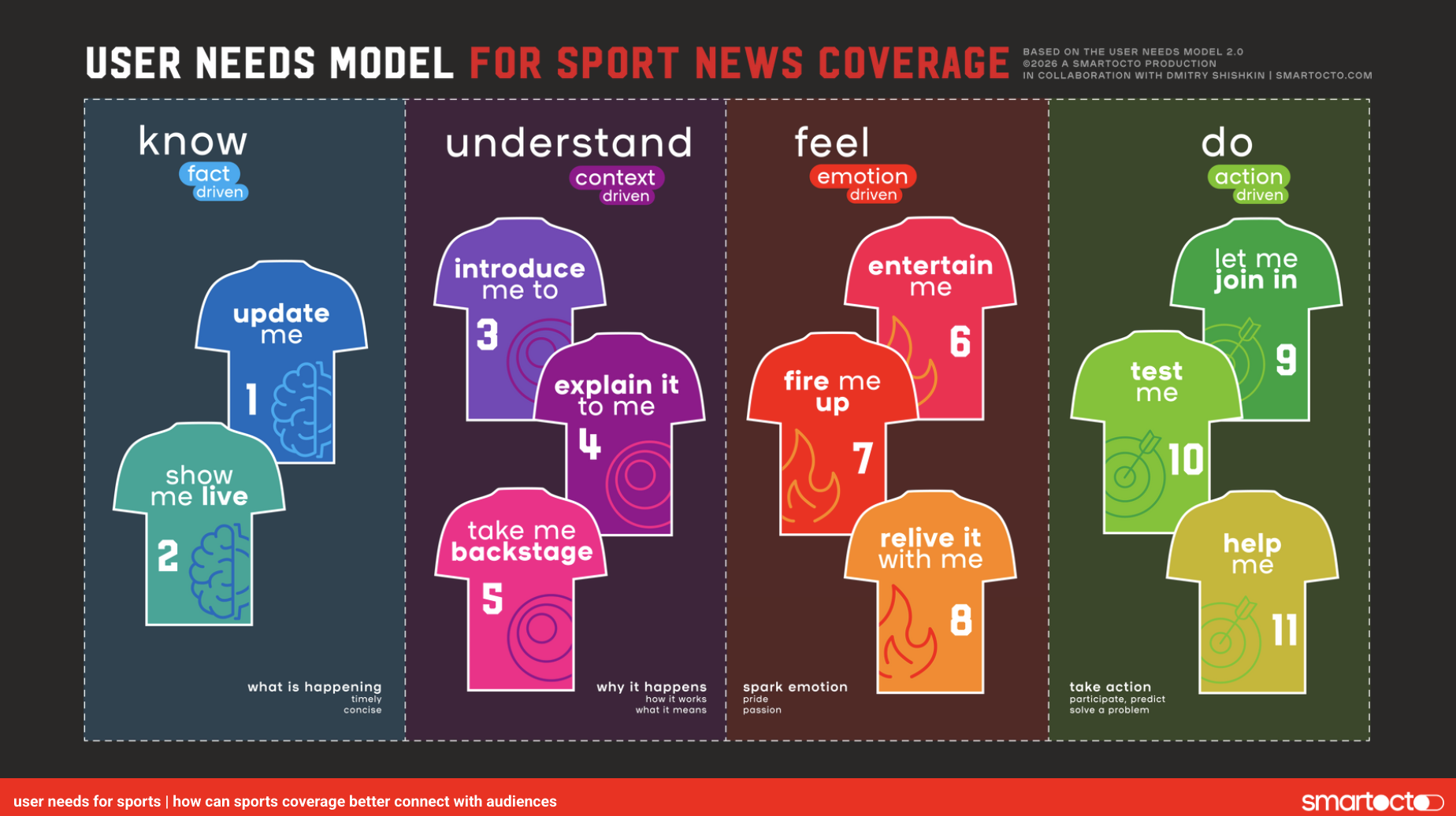
The model has four core intents – Know, Understand, Feel, Do. But underneath those sit 11 specific user needs that map to distinct audience behaviours.
For example, under “Know” sits both “Update me” (scores, results) and “Show me live” (real-time moments, live blogs). Under “Understand” sits “Introduce me to” (player, team profiles), “Explain it to me” (tactical analysis, rules), and “Take me backstage” (access).
The Sports User Needs model created by Smartocto
The four intents are the strategic framework. The 11 needs are the operational layer – what teams actually tag content against in analytics and commissioning.
This structure matters because it allows both high-level planning (are we balanced across the four?) and granular measurement (which specific needs are we underserving, and in which sports, and on which platforms).
It’s the same structure I built for news, adapted for how sports audiences behave.
Only if it’s applied mechanically.
Over a decade of working with newsrooms on User Needs, I’ve learned that creativity often increases when intent is explicit. Journalists stop guessing what success looks like and start experimenting within clear boundaries. I always said that growth comes if user needs are applied strategically, consistently and creatively.
A User Needs model isn’t a content recipe. It doesn’t tell journalists what to write or how to write it. It clarifies why a story exists from the audience’s perspective.
The same pattern is emerging in sport.
This objection assumes the model is about producing more content. It’s not.
It’s about producing a better mix.
One sporting moment – a World Cup draw, a major transfer, an Olympic final – can legitimately generate coverage across multiple user needs without multiplying effort. The same reporting can power live updates, explainers, profiles, emotional narratives and participatory formats.
The real change is proper commissioning and planning, which is especially important in the times of AI content slop and commoditisation of content.
I’ve seen newsrooms under the most pressure benefit most from this shift, because it reduces wasted effort on low-impact repetition.
This is a healthy concern. Many frameworks fail because they assume uniform audiences.
I’ve watched User Needs adapt across markets from the USA to Indonesia and from Norway to South Africa, from legacy publishers to digital-native brands. It works because it operates at the level of moments and behaviours, not demographics.
The mix will vary by sport, competition, market, platform and age. That variability is expected. The model becomes most powerful when applied narrowly: to a specific sport, league or event. That’s where patterns become visible and actionable.
The aim of this model isn’t to impose uniformity, but to create a shared language flexible enough to adapt locally. News models in reality are different, but as long as everyone in the same newsroom subscribes to one, you’ll be ok.
And a final thought
The biggest shift is organisational, not editorial. I’ve seen this transformation dozens of times in news: commissioning meetings become more intentional, analytics become more meaningful, follow-ups become smarter.
The model stops being a slide deck and becomes infrastructure.
There’s no reason sport should be different.