‘Stories that must be watched’: Inside The New York Times’ video strategy
“I want to start with a question that I get a lot, which is: are audiences actually pivoting to video?”
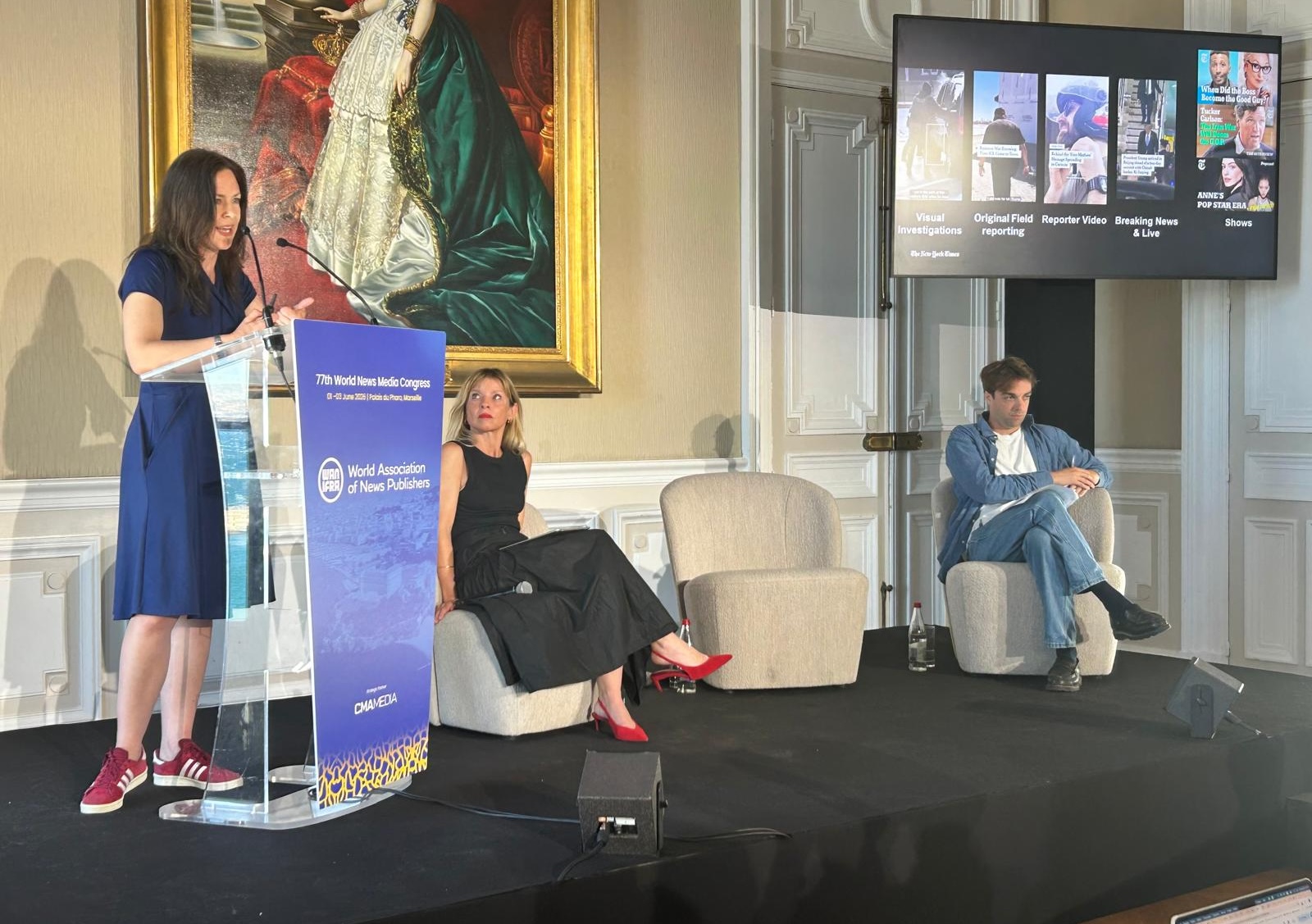
Speaking at WAN-IFRA’s World News Media Congress in Marseille, Solana Pyne, Video Director at The New York Times, lifted the curtain on how the news organisation currently approaches video production and distribution.
But before delving into their video strategy, Pyne took a broader look at how audiences’ news consumption habits are changing, and the role that video plays in how people engage with news content today.
Although the latest Digital News Report from the Reuters Institute for the Study of Journalism suggests that most people still prefer to read the news, the reality is likely to be more nuanced, she said.
For example, the proportion of people in the United States who watch news videos weekly has grown from just over half in 2021 to around three quarters today. In other words, 250 million people in the US now watch a news video every week.
“What I take from this is that the idea that people just read, or just watch, or just listen to the news is an anachronism from the days when you would open a newspaper or listen to the radio or watch television,” she said.
“But if you are online, increasingly people are doing all of these things.”
Specialised video teams and roles
Pyne said that The New York Times is responding to this growing trend by embracing video content, but in a very intentional way, focusing on the types of content that work best in that format.
“It doesn’t mean every single story must be a video, or that simply making a video that recaps a story is going to reach a lot of people,” she said.
“What my team really thinks about is, let’s make stories that must be watched.’
The Times’ visual efforts are structured around different teams, each with their own roles:
- The visual investigations team gathers footage and data from various sources, such as satellite imagery and witnesses. They verify this material and use it to create a comprehensive picture of complex events.
- Video journalists on the ground handle traditional video reporting, including interviewing people, sometimes also appear on camera. “We find those videos really resonate when we are bringing our audience directly to a news moment,” Pyne said.
- The reporter video team works with the broader newsroom, tapping into the reporting that is happening across the newsroom and aiming to amplify it with video where relevant.
- The breaking news and live team is in charge of the first response when news breaks, looking at footage from witnesses, wire services and news agencies and making videos based on it, also integrating Times’ original reporting.
The latest addition to the organisation is the Shows department, which is largely interview-driven and has grown from The Times’ successful long-form video podcast efforts, Pyne said.
Some of their notable shows include The Interview, where journalists interview politicians and celebrities, and a music-related interview series Popcast. Both are examples of video content that’s “distinctive,” and “feels like a smart distillation” of the Times’ work, she said.
Case study: NYT’s ICE coverage
A concrete event where the different elements of the video strategy came together was the surge of anti-immigration troops into Minneapolis and specifically the shooting of Renée Good in early January 2026.
First, The Times had reporters scanning for all available footage of the event, with the visual investigations team helping with the process. Within a couple of hours from the shooting, they were able to contrast official statements with witness footage and provide additional context from The Times’ own reporting.
Meanwhile, the visual investigations team continued to gather footage, and in 24 hours, they were able to publish a first account with a visual breakdown of the shooting.
Coincidentally, The Times’ White House reporters had arranged an interview with President Trump for the same day the shooting happened, so they naturally asked questions about it.
Capturing video of that meeting was not allowed, but the team was able to record audio and take photos, which were used for another video, alongside an interview with one of the White House reporters.
Meanwhile, a Times photographer who happened to live in Minneapolis close to the scene of the shooting went out and captured additional video footage, also giving his account of what happened in the moments after the shooting.
Pyne’s last example came from a “more conventional field team,” who happened to be deployed at a Minneapolis school just hours after the shooting. They were able to film federal agents who showed up to close the school and had a violent confrontation with the teachers and students.
The last couple of videos in particular “ended up being really distinctive takes on this very dramatic moment,” Pyne said, which helped them to reach millions of people.
Distribution on- and off-platform
As for The Times’ video distribution, Pyne said their videos are published both on- and off-platform.
Off-platform is naturally about reaching new audiences: “People might say they want to read the news, but they’re also watching the news, and they’re often encountering them on video-first platforms,” she said.
For their own platform, The Times has been inspired by the “swipeable” vertical feed of videos that is so familiar to users of video-first social platforms.
The Times’ version of this is their recently created “Watch” tab, which is included as a separate section in their app, where they “think about a broader range of reporting to create a complete experience.”
This section has a dedicated editor who leads the programming and the curation of the included videos, and who plans the flow so that the result is a natural mix of different types of video.
“It’s judgment, it’s feel, and it’s something that we’re constantly experimenting and iterating on,” Pyne said.
“We think about engagement, but we are also thinking about what the stories are that are most important or interesting, and how we put them together in a way that is engaging.”