How Mediengruppe Pressedruck uses AI to reclaim journalists’ time
Like many publishers exploring concrete AI use cases, Mediengruppe Pressedruck has identified the automation of repetitive, routine tasks as an area where the technology can improve its workflows.
Mediengruppe Pressedruck is a major German media conglomerate headquartered in the city of Augsburg with a strong presence in the southern part of the country. It oversees a diverse portfolio of publications, including its flagship title, the Augsburger Allgemeine, Bavaria’s largest newspaper and one of the largest regional daily titles in Germany.
The publisher also owns the newspapers Main-Post (based in Würzburg) and Südkurier (in Konstanz), and holds a significant stake in various radio and TV stations.
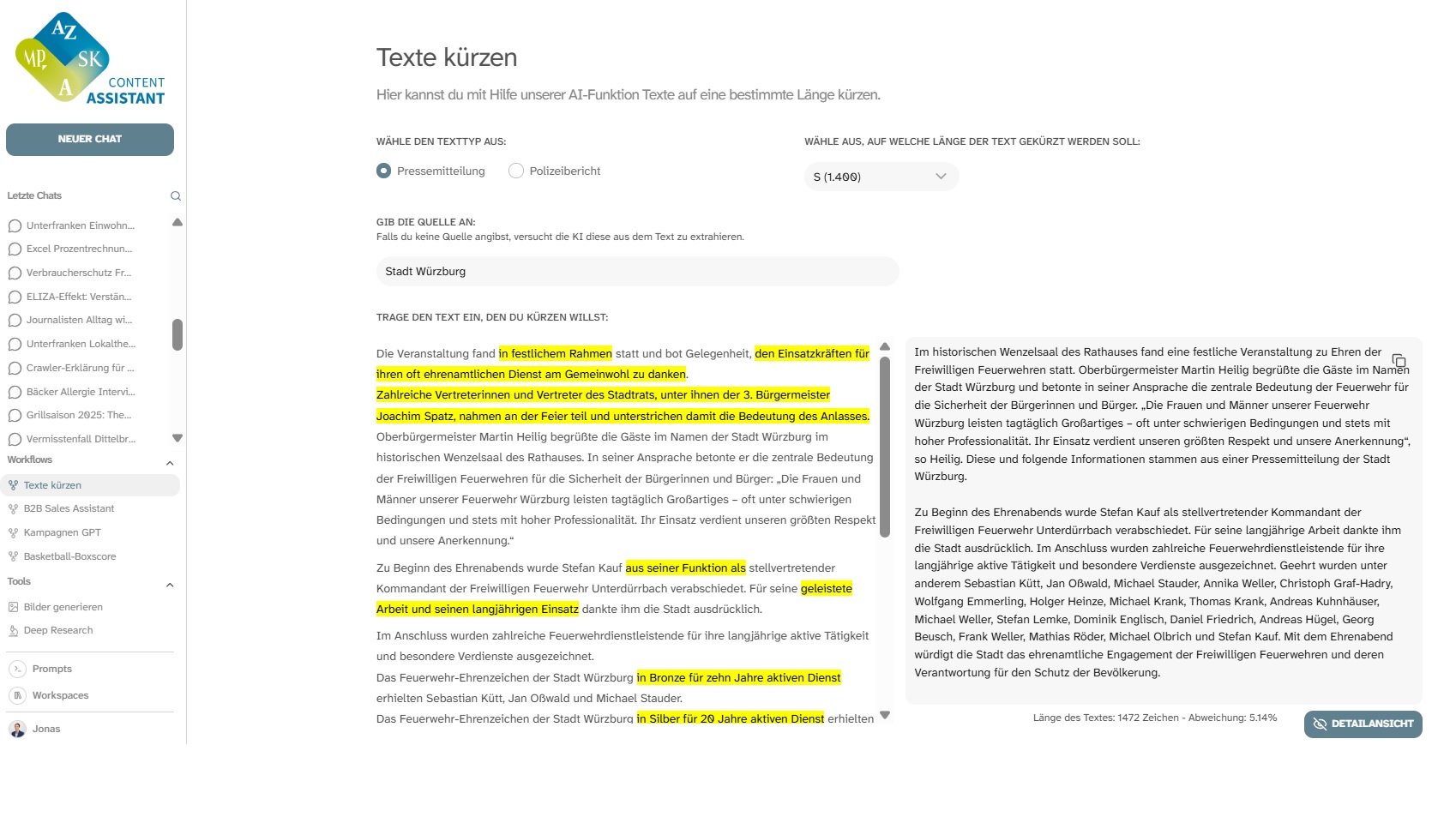
One specific issue that the publisher wanted to address with the help of AI was adapting and shortening press releases and police reports for their print editions. This process took up a lot of the editorial team’s time, and given the constraints of print layouts, the texts often needed to be edited down to a fairly precise number of words, which complicated the task further.
This made for a “very time consuming and tiring” part of journalists’ work, said Jonas Keck, Reporter and Project Editor at Main-Post, one of Mediengruppe Pressedruck’s titles.
“We wanted to give colleagues more time for original reporting and other editorial work, which are the core of journalism,” he said.
A big part of the motivation behind this was the aim to reduce the footprint of tasks related to print production on journalists’ daily work.
“We are trying to keep the time effort of print production as small as possible to focus on the digital,” Keck said.
When looking for ways to improve the press release workflow, the team first assessed the available tools but could not find one adequate for the task.
To work on this problem, Mediengruppe Pressedruck joined the 2024 edition of Newsroom AI Catalyst, a WAN-IFRA accelerator programme in partnership with OpenAI that supports news publishers with their strategic AI initiatives.
Training with 30,000 press releases
The company first started exploring AI-powered methods for amplifying its journalistic work soon after ChatGPT’s launch in November 2022. This marked the beginning of the development of Content Assistant, an internal platform through which staff can use LLM-powered tools.
Content Assistant initially debuted with a tool for generating headlines automatically, and the publisher has since added other AI solutions to it gradually. Today, the tool is available to all journalists working at the publisher’s titles through a browser plugin.
To address the specific challenge of reformatting and condensing PR materials, the team relied on a machine learning framework called “few-shot learning,” as well as semantic relevance. Their training data consisted of an archive of 30,000 press releases in both their original and shortened forms.
The team received essential help from software developer Michel Bauer, and the technical implementation of the tool was part of his master’s thesis for the University of Würzburg.
Preparing the archive as a vectorised database proved to be a somewhat challenging step, particularly as the data had not been stored in a format that the team could easily use but required additional work.
As work on the tool’s development progressed, establishing a close, iterative feedback loop with the editorial team became particularly important in helping the team identify areas for improvement and accelerate revisions.
For example, user testing revealed that a visual side-by-side comparison between the original and revised text would be useful. Moreover, the tool now highlights specific sections so that journalists can easily identify the parts that require particular attention.
As print editions have slots of various sizes available for the adapted content, the tool includes a feature that allows users to select the target length (with 10% tolerance for variation). Its outputs always need to be validated by a human journalist before publication.
The conceptual architecture of the tool’s AI text generation pipeline.
Additional AI contact point
For now, the text adaptation tool hasn’t been included in the Content Assistant plugin, which makes it necessary to copy and paste text into another tab, but the team is working on a more streamlined solution.
As for the tool’s impact, Keck said many journalists use it to process several press releases a day, with some making extensive use of it.
Early testing with the tool showed some qualitative improvements in consistency and time savings, although the publisher hasn’t conducted systematic tracking of time savings since then.
However, Keck said feedback from journalists shows that the tool is allowing them to process press releases faster. And perhaps more importantly, they say that reviewing suggested drafts is less taxing than adapting texts from start to finish.
“Many colleagues say it’s mentally less exhausting to review and improve a good draft that’s already shortened,” he said.
Keck also pointed out that the tool provides an additional contact point with AI for Mediengruppe Pressedruck’s journalists and thus another opportunity for them to become familiar with the technology and develop working practices around it.
Crucially, use of the tool is voluntary. But given its effectiveness, people have naturally adopted it, which has also had the side-effect of alleviating fears they might have had about using AI in journalism.
“With this touchpoint, they noticed, ‘okay, it isn’t magic, and my job is required as well, and it helps me with tasks I don’t like’,” Keck said.
Photo credits: Jonas Keck’s photo by Chris Weiss. Michel Bauer’s photo by Hannah Landwehr.