‘A dawn of hope’: How Ethiopia’s Addis Maleda left print behind
Addis Maleda was named for a moment: the Amharic phrase means a dawn of hope and a new beginning, and in October 2018 that felt accurate. Ethiopia had a new prime minister, Abiy Ahmed, who had released jailed journalists, replaced the country’s most restrictive laws and opened opportunities that had been seemingly closed for more than a decade. Within a year the country was hosting UNESCO’s World Press Freedom Day.
Sisay and his co-founders launched a weekly newspaper, leaping at this window of opportunity.
“We seized the opportunity,” he told participants at a recent Virtual Study Visit organised by BBC Media Action and WAN-IFRA. “It was a breed of optimism, renewal and positive expectations after a long period of darkness.”
Amanyehun R. Sisay, Founder and CEO, Addis Maleda.
The session was part of the peer-learning strand of BRAVE, a global media development initiative funded by the European Commission, led by BBC Media Action and delivered with a consortium of eight international and regional organisations. It supports more than 50 independent outlets across Asia, Africa, Latin America and the MENA region.
The study visit series began in July with Panowa News from Bangladesh, continued with a media organisation from Afghanistan, and will run through the coming months with further BRAVE partners.
Four good years
The newspaper grew quickly after its launch. A family-focused magazine followed in 2020. In 2021 Addis Maleda became Ethiopia’s first trilingual publication, printing in Amharic, Afaan Oromo and Somali, the country’s three most widely spoken languages.
It declared itself a feminist outlet at launch and referred to the paper as “she”, building regular coverage around gender justice and women’s leadership.
Its reporting soon made it a reference in the region. Radio stations, television channels and digital outlets began citing it, which gave a weekly newspaper the reach of a news agency. Addis Maleda avoided press releases, focusing on stories nobody else had.
Then the numbers stopped working
The paper’s first edition cost 6.35 birr [$0.039] to print and sold for 10 [$0.061], so sales alone covered production. However, four years later printing costs had soared to about 36 birr [$0.22] a copy, an increase of more than 500 percent.
Revenue started to decline. Like other news brands felt globally, COVID-19 slowed business and cut advertising budgets. War in the north damaged the economy further.
A new proclamation banned breweries from advertising on radio and television, removing up to 40 percent of some broadcasters’ ad income and pushing them to compete even harder for what remained.
At the same time, more accessible mobile and internet access meant Ethiopia’s audience was shifting. The telecom sector opened to private operators, internet costs fell, and the country now has close to 100 million mobile subscribers, second in Africa only to Nigeria.
More than 61 million people have smartphones or internet access – over 45 percent of the population.
So in October 2022, Addis Maleda stopped printing.
Rebuilding the newsroom
The hardest part of going all-in on digital was not the technology. It was more about adapting to the rapid pace of digital publishing.
“Moving from the measured pace of a weekly newspaper to the high-velocity demands of continuous digital publishing created a perpetual state of urgency,” Sisay said. “Legacy habits were deeply ingrained.”
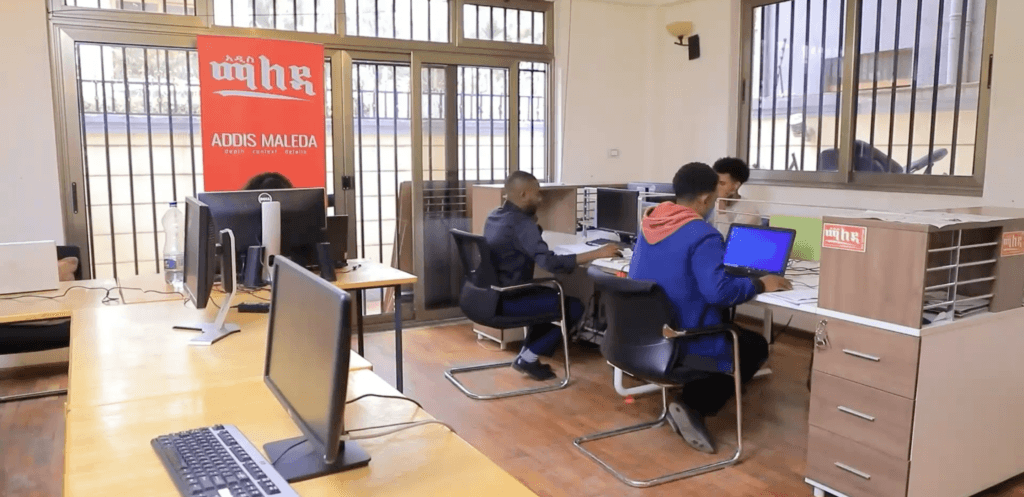
The team added multimedia producers, specialised reporters and digital editors, and moved into producing interactive visuals, podcasts and video briefs. Existing journalists trained in digital tools, social media and SEO.
Sisay said the shift worked because the newsroom framed the new tools “as allies that amplify reporting reach rather than threats to journalistic integrity”.
Support from BBC Media Action and the Media Development Investment Fund was, he said, “decisive in managing this turbulent transition”.
Talent as strategy
One practice carried over unchanged. Addis Maleda recruits only fresh graduates and has never hired a journalist from another newsroom. Recruits spend three to six months as interns inside live newsroom operations.
The reasoning is partly financial, since graduates are affordable for a newsroom with no spare budget, but it is also a key part of editorial strategy. Journalists arriving from elsewhere bring habits that take years to unlearn, and Sisay wanted the newsroom to develop its own way of reporting.
The results have made the case. “Investing in young journalists has proven to be the most rewarding strategy,” he said.
Home-grown reporters have become news editors and editors-in-chief; others have moved on to the BBC’s regional office in Nairobi and elsewhere. That means constantly training the next cohort, which Sisay accepts as the cost of the model.
“Although rival outlets frequently recruit our developed staff, we view this ongoing turnover as a badge of honour,” he said.
With private universities barred from teaching journalism in Ethiopia, he sees the newsroom as filling a gap the education system leaves open.
What is still unsolved
Digital costs less to produce but is much harder to sell. Ad rates are low, online payment infrastructure for subscriptions is thin, and audiences keep drifting to free platforms where individual creators hold followings no newspaper can match.
Looking back, Sisay said he would have fixed the strategy before the format. Addis Maleda began without rigorous audience segmentation or a clear roadmap and adapted as it went along.
“Proactive market alignment accelerates growth, while reactive strategic refinement adds unnecessary friction,” he said.
The outlet has since defined its audience personas and built a commercial plan around them, aiming for ten-fold growth in audience and revenue over five years and full self-funding from its own operations.
Getting there without loosening editorial standards is, he said, “the defining operational hurdle”.
Farah Wael is the Director of Advocacy and Engagement for Women in News (WIN), the global programme founded in 2010 by WAN-IFRA to advance gender equality and inclusion in the media industry.