Rewriting the rules: Newsroom CPR for election coverage in an era of populism
This week, Brazil and Serbia celebrated historic returns to democracy, while Israel contemplates its future. In the coming weeks, citizens in Taiwan, Gambia and South Sudan go to the polls for national elections, while South Africa and the United States face consequential local and midterm elections, respectively.
Worldwide, elections today are marked by interference, lawfare, disinformation campaigns, online shutdowns and more. Princeton’s Empirical Studies of Conflict project examined all 63 national elections held in 2024 and found clear evidence of foreign interference in 30 percent of them, affecting 60 percent of the world’s voting population, with social media and fake news sites as the main vehicles.
In South Africa, anti-immigration and Islamophobic campaigns are escalating, with the country’s electoral watchdog a target. In Taiwan – routinely held up as the template for defending against information operations with its robust fact-checking ecosystem, –populist scepticism of these fact-checkers has set in, according to Fake Factory: Disinformation and Learning Machines in Taiwan, a Leiden Asia Centre study released in December 2025.
In the USA, where the president and his entire administration openly mock and block the media, democracy hangs in the balance. And the question of how journalists can provide accurate, effective reportage looms large.
This past week’s (surprising) electoral results in Israel, Brazil, and Serbia have one common theme: mobilisation – whether on the ground, via peer to peer messaging, or by building an alternative political model.
To news media, the message is clear: “Solidarity is key,” says Ayala Panievsky, author of The New Censorship: How the War on the Media is Taking Us Down. “You can no longer make an impact on your own today – the media space is too fragmented. The quicker we get powerful professional organisations that support journalists and foster collaboration, the better. No one can face Trump or Musk alone.”
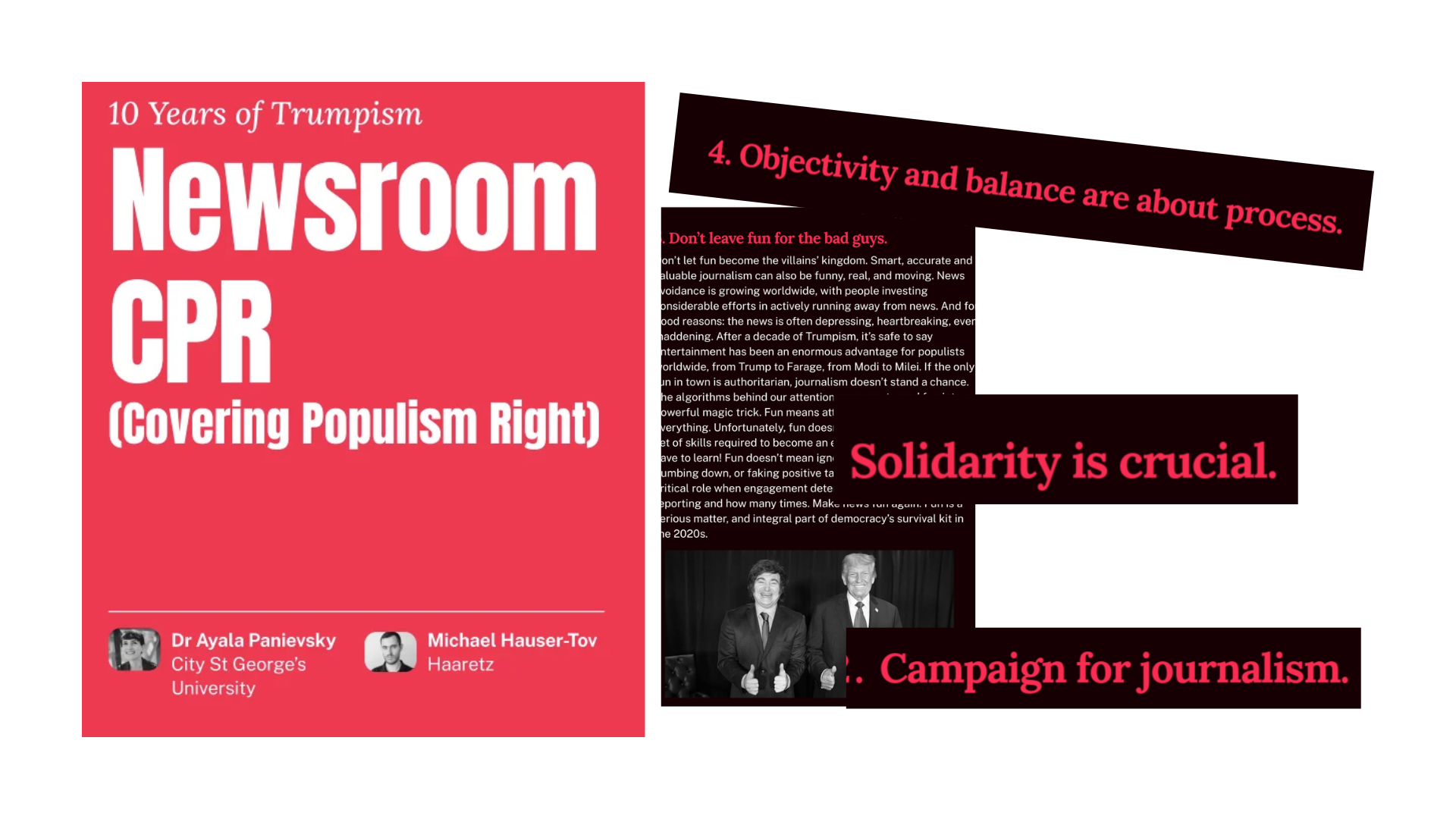
Panievsky, a journalism lecturer at City St George’s, echoes an ongoing call by watchdog institutions globally for journalists to stand together to counteract the force, frequency and impact of populist politics. She has distilled 10 years of research – and lived experience as an Israeli journalist – into Newsroom CPR, a journalism toolkit co-authored with Haaretz journalist Michael Hauser-Tov.
Read more about her insights here, and take note of the sound advice set out in the guide, outlined below.
Getting it right
Newsroom CPR argues that populist politicians, parties and movements pose three specific problems for newsrooms, that standard editorial reflexes don’t handle well:
- Disinformation arrives faster than it can be verified, so debunking can feel futile.
- Hate speech and incitement put reporters in a bind. Repeating it spreads it, and not repeating it risks normalising it.
- Media bashing tempts outlets either to advance the attack or to become “the story.”
The guide sets out five core principles, 10 Rules of Thumb, 10 Concrete Scenarios, and global inspiration with strong examples of when it is done right.
10 Concrete scenarios: An edited extract from Newsroom CPR
When a journalist in the room is attacked and their question is ignored, all journalists in the room should repeat the same question until it is answered. This is what solidarity looks like in this scenario.
There is no justification to amplify lies or conspiracy theories, even if they come from the PM’s or the President’s Office, and even if they are labelled as “reply.” Don’t publish as a ‘reply’ content that you would not broadcast in any other format.
There is no room for hesitation. The relevant press corps should immediately leave the press conference or rally until the boycotted reporter or newsroom is reinstated. This principle applies to journalists and reporters – not to propagandists or official spokespeople.
- The ‘press conference’
The temptation is great: every word uttered by a senior political figure – no matter how false or lacking actual public value – feels like “news.” It might even generate ratings or traffic. But broadcasting “interviews” with propagandists legitimises and authorises sycophantic propaganda. Therefore, airing content from propaganda channels should be minimised and put in context (eg: “Benjamin Netanyahu has refused to answer journalists’ questions for years, the only people he is talking to are his media loyalists, as can be seen in this short video”).
Too often, journalists refrain from responding to false accusations against their reporting, their workplace, or colleagues. Keeping quiet has not been proven useful. Initial evidence suggests that responding to media bashing is crucial to maintain (or regain) the public’s trust. Think of it as your right of reply – not a diversion from journalism, but a better practice of it.
Cover any attempts to harm the public’s right to know, seriously and thoroughly. Explain the risks, meanings, and implications. Frame each new bill, reform, and initiative to curb media freedom as part of a broader effort to control public opinion.
📺 “We reported events one-sidedly for years”: Serbian TV apologizes to viewers after Vučić’s party loses the election
Radio Television of Vojvodina (RTV) opened its news broadcast with footage of celebrations following the Student List’s election victory — scenes it had failed to show the previous evening.
“For years, we failed to fulfill our duty. We kept silent, turned a blind eye, reported events one-sidedly, and failed to ask the necessary questions. For that, we owe our viewers an apology,” news anchor Goran Eror said.
Following the controversy, RTV’s acting editor-in-chief Nenad Čačić resigned.
A similar incident occurred in Hungary, where state television also apologized to viewers after Viktor Orbán’s election defeat.
— NEXTA (@nexta_tv) October 27, 2026
The first journalistic step would be watching the recording, assessing whether it has public value, cross-checking and debunking falsehoods, removing incitement, and broadcasting it with appropriate framing – if the content is indeed new, important, and interesting.
The temptation is massive: every word uttered by senior politicians – no matter how false or unimportant – feels like “news.” It might even generate ratings or traffic. But broadcasting “interviews” with propagandists grants legitimacy and authority to propaganda. Airing content from propaganda channels should be minimised and put in context (e.g., “Benjamin Netanyahu has refused to answer journalists’ questions for years, the only people he is speaking to are his loyalists, as can be seen in this short video”).
It is vital to stand together against political lawsuits that are intended to silence, intimidate, and exhaust reporters and newsrooms. If you’re not already a member of a journalists’ association or union, join one. If you are a member, try to initiate collective legal support against legal warfare on journalism. Collective resistance can minimise this phenomenon and weaken its chilling effect.
Unfortunately, local and global history show that attempts at silencing and corruption sometimes percolate into newsrooms. This is a particularly difficult situation, trapping reporters in an impossible position. Nevertheless, experience shows that silence serves no one in this scenario – apart from those trying to capture the newsroom. If you suspect unethical deals, unprofessional decisions, or silencing efforts within your workplace, organise and leak anonymously to colleagues in other media outlets. There is no other way to ensure your future independence.