Inside 24.hu’s AI transformation: From social media tracking to company-wide rollout
About the publisher: Founded in 2020, 24.hu is one of Hungary’s most-read news sites. An online-only newspaper with a newsroom of about 70, its coverage focuses heavily on politics while also looking at culture, sports, technology and other areas.
24.hu first launched as an ad-supported news portal, but in 2024 it switched to a freemium subscription model where most news articles are freely available while access to premium, in-depth content requires a subscription.
Automating political coverage
Keeping track of politicians’ social media activity may not be the reason why most journalists chose to enter the profession, but as politicians tend to make their announcements primarily on social media these days, their posts often deserve coverage and can even generate significant news stories.
This reality was on Márta Kovács’s mind when she joined NextGen AI Leaders, a WAN-IFRA programme in partnership with the Google News Initiative. The programme is designed to help young media leaders reach the next stage in their careers through the responsible AI deployment and strategic leadership.
As a Senior News Editor at 24.hu, Kovács had first-hand experience of tracking politicians’ social media activity and how this could be an unfulfilling task that distracted from more valuable work.
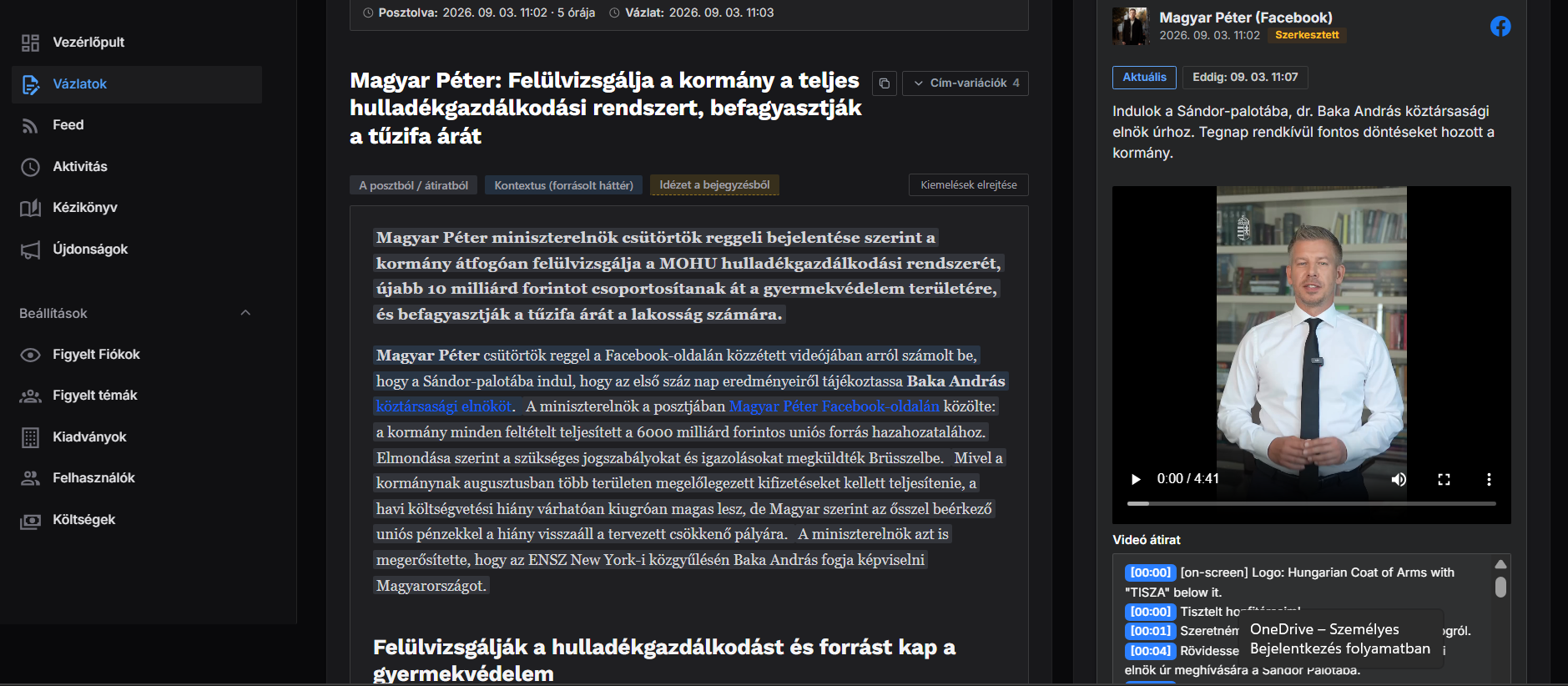
The AI-powered solution that Kovács began working on during the NextGen AI Leaders programme monitors social media posts of notable Hungarian politicians. When it detects relevant posts on their Facebook feeds (the social media of choice for most Hungarian politicians), it sends a message to a dedicated Slack channel.
Journalists can then use the tool to automatically generate an article draft based on the post, summarising its content and adding further context based on 24.hu’s own archives. The draft can then be reviewed and edited in the CMS before publication.
‘We could spend less time rewriting Facebook posts’
Kovács teamed up with the developer Tamás Náray, and together they built a working version in a couple of weeks. A two-month testing process followed, with a working group with people from every level of the editorial structure who provided several rounds of feedback.
The biggest development challenge was refining the prompt to produce consistently appropriate outputs.
Beyond testing, the tool has found regular users across the editorial team: Kovács estimates that more than 100 articles have been published using the tool.
“Overall, the goal is that we could spend less time rewriting Facebook posts, and devote more time to producing high-quality journalism,” she said, although measuring the time saved is difficult at this point.
But one clear benefit has been a faster reaction time, as 24.hu’s journalists have been able to report on politicians’ announcements before their competitors. Being first has had a positive impact on the online traffic of those stories, Kovács said.
An example of this would be the Prime Minister’s decision that was announced on Facebook. Publishing their article only seven minutes after the original Facebook post, 24.hu was the first news outlet to report about it.
Company leadership has also recognised the tool’s potential beyond the politics desk, and that its development offers learnings into successful AI implementation in general.
“Márta led the social monitoring project from the editorial perspective, with a clear focus on making the tool genuinely useful and easy to use for the whole newsroom,” said Petr Bednar, Chief Digital and Business Development Director at Central Médiacsoport Zrt., the media group that owns 24.hu.
“The result helps our journalists react faster to political developments and reduces the risk of missing important events and conversations on social media. We already see its potential beyond politics, and our next step is to expand the tool to other areas such as celebrity news and sports,” he added.
Indeed, in early September the company started rolling out the social monitoring tool to the whole newsroom, and it will be adapted so journalists from other desks can track the key figures in their respective fields on social.
‘Listen to the journalists’ needs’
Kovács said that journalists at 24.hu have been mostly enthusiastic about the new tool, especially because it was built to address a specific source of frustration.
“It’s better for journalists to see that we have a tool that is coming from their needs, not from some corporate person who is coming to say, ‘here’s a tool you should use’,” she said.
“If you want to build AI tools for journalists, you should listen to their needs before you build anything. And you should talk to them, listen to their critical judgement, and improve the product with those kept in mind.”
Similarly, involving journalists already in the creation phase is crucial to alleviate any AI-related fears they may have, she said.
“AI is really frightening for a lot of people. If you just bring it to them without any context, they will ask questions, like, ‘Now that this tool is here, will I be fired next week?’”
“Therefore you, as the person responsible for this project, have to be able to answer the questions not only about the technological side, but the human perspectives too.”
As for a broader AI adoption at 24.hu, Kovács describes the process as “a one-way street”: once you start experimenting, new ideas will start to emerge. Her team is now exploring automated transcriptions and summaries of press conference videos, as well as a solution for monitoring other news sites for trending topics. AI-generated audio and article summaries are also being considered.
All in all, Kovács says the publisher’s AI efforts are now “headed in the right way.”
“Half a year ago AI was a big elephant in the room,” she said. But thanks partly to the work started during the NextGen AI Leaders programme, “we are brave enough to see that we can’t miss the opportunity to work with AI.”
Indeed, Kovács will have a pivotal role in shaping that opportunity: as the NextGen AI Leaders programme was concluding, she was asked to lead a team of five people responsible for the AI transformation of 24.hu’s newsroom.
The Q&A with Kovács below explores how the NextGen AI Leaders programme helped her to take on this role, and what she has learned about successful AI adoption. This interview has been edited for length and clarity.
‘We just can’t miss out on this opportunity’: Q&A with Márta Kovács
WAN-IFRA: When your participation in the NextGen AI Leaders programme was coming to an end, you were asked to lead 24.hu’s AI task force. Congratulations! How did the NextGen AI Leaders programme help you prepare for this role?
Márta Kovács: Thank you! Yeah, my work has changed a lot since the programme. Right now, it’s just for our newsrooms, but next week we will have a meeting at our publishing house [Central Médiacsoport Zrt, one of Hungary’s leading media companies with a wide magazine and online portfolio]. They heard about the AI things that are going on in our newsrooms, and they asked us to present the social monitoring tool. So yeah, I’m doing a lot of new types of work thanks to the programme.
When the programme was finished, I scheduled a meeting with my superiors and said, “We should start to work on these things.” I had met a lot of really great people from other newsrooms, and I had seen what was being done with the help of AI. And I thought we should work on this because the whole world is going in that direction, and we just can’t miss out on this opportunity.
How did your perspective on AI leadership evolve during the programme?
I feel a sense of responsibility now, because we have people in the newsrooms who are curious about AI, but we previously didn’t have anyone who would be a leader on this topic. Then I came into the picture and saw that I had this amazing opportunity to participate in this programme, and I learned how AI should be introduced. And [my superiors] told me, “Okay, you should lead the way, because you learnt the way this works.”
Were there specific takeaways that have helped with your new role?
The whole concept of establishing a working group is from the programme. We talked a lot about how to take a ground-up approach. It’s a mindset that comes from the programme: how to look at problems and naturally see AI not as a problem but a helping hand.
Of course, there is a lot of discussion about how AI companies are not a great thing for journalism. But at the same time we have these tools, and they can actually help us do our jobs better, faster and easier.
Did you have a technical background coming into the programme?
No. I had used the most common AI tools, and we learned a lot about different tools. I then started to experiment with them and got more confident. For example, I hadn’t used NotebookLM until we had a session about it and I saw it could be useful in my work. The next step is to share this knowledge with the rest of the newsroom.
Naturally, there might be some resistance in news organisations trying to push AI adoption and experimentation. How have you dealt with that?
Luckily, we have people in the leadership who are really enthusiastic and curious about AI, and who find these tools really important and help you move things in that direction.
From the journalists’ perspective, of course I have people in my newsroom who are not so enthusiastic about working with AI. But I would say that I completely understand their fear and uncertainty, so I really do empathise with them.
Was there a significant leadership challenge, and what did it teach you?
For me, it was that I had to be brave in the situations where I could present my ideas, not just to my superior but to his superior and to others really high in the company. Of course it was scary, but I saw that they were actually glad to hear from a journalist who has creative ideas about AI and was really cooperative.
What milestone felt like a true breakthrough?
Everything that is happening is kind of a milestone for me, because half a year ago, I would have never imagined that I would work with these kinds of ideas and be the one to present them to the leadership. And that they would say, “Okay, we should do that, because you’re the one who is presenting those ideas.”
For example, today we had a meeting about features we want to build in our app, such as audio versions and article summaries. I wrote a list about possible AI tools, and then I just sat in the meeting and listened to my superiors tell the tech guys, “Okay, we should make those ideas a priority.”
If you could give one piece of advice to another media leader trying to implement AI right now, what would it be?
He or she should talk to their colleagues as much as they can to ask for their experiences and their needs, because those will be the ideas that will affect the road ahead.
And I would tell them to be brave in situations that may seem frightening. Have faith in yourself and remember that you have knowledge worth presenting to the people above you.