RSL’s AI-use compensation plan for news: ‘We think this is a $100 billion opportunity for publishers’
One of the key unresolved issues in the AI era is the need for a fair, scalable system for licensing and compensating publishers for their content that is used by AI systems, said moderator Ezra Eeman in welcoming participants to a recent AI in Media WAN-IFRA webinar on this subject.
Speaker John Boyden described how his organisation, RSL, has designed an emerging machine-readable, open-web standard that is aimed at allowing publishers to define how their content can be used and for what compensation.
The need for this is obvious to most news publishers, Boyden noted: “AI companies are consuming publisher content at massive scale, and they’re not compensating for it. It’s undermining any kind of traffic-based revenue models and accelerating digital revenue loss. Publishers are losing traffic. They’re losing the relationship with their audience.”
This is where the RSL Collective comes in.
“We are a non-profit collective rights organisation that enables publishers to reclaim lost digital revenue through collective licensing,” he explained.
‘Compensation today is effectively zero’
While some high profile deals have been made in this area, “for the vast majority of publishers, compensation today is effectively zero,” Boyden said.
WAN-IFRA Members can watch the recording of this webinar on our Knowledge Hub by clicking here.
Furthermore, without a new business model to replace digital advertising and subscriptions, that zero compensation outcome becomes the default for the open web, he added.
What RSL aims to do is help publishers articulate what the content rights are in a nuanced way, Boyden said.
The three key elements of the RSL approach are:
- A rights framework
- A collective licensing framework
- A per-use royalty model for AI.
Boyden also described the issues facing the AI companies around use of content: “Essentially, the problems they have are huge. There’s fragmented rights: content is owned by millions of publishers with no unified mechanism to grant or manage permissions. There’s no pricing model, a consistent way to determine what content is worth, or how to pay for ongoing AI use.”
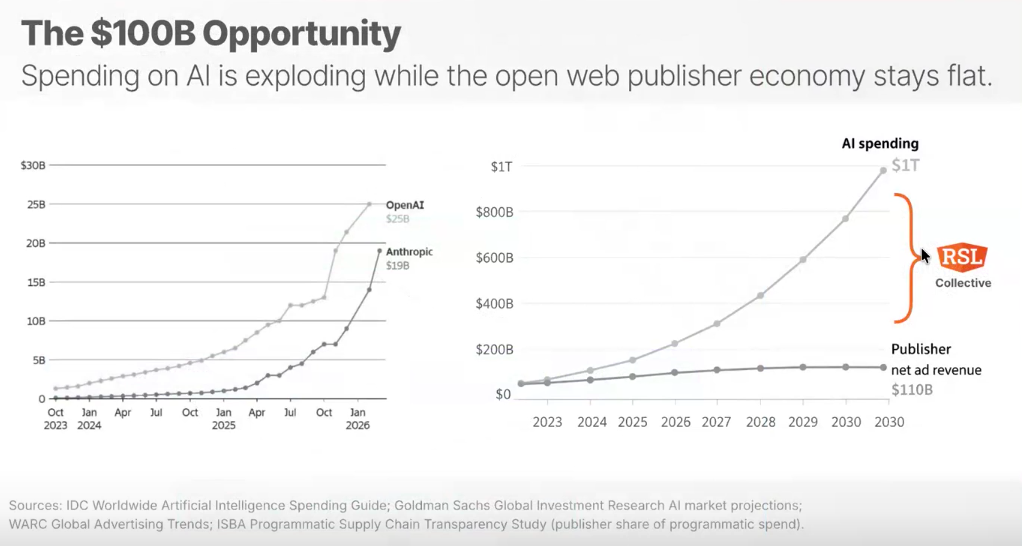
“We think this is a $100 billion opportunity for publishers: spending on AI is exploding, while the open web publisher economy has been staying flat,” he said.
The RSL Collective believes it can take a percentage of the revenue AI companies are making from their products, and earmark that for content, Boyden added.
As a non-profit collective rights organisation, RSL already represents publishers and creators of all sizes from around the world, including Wikipedia, Reddit, People Inc, Yahoo, Torstar, Ziff Davis and USA Today.
More information about RSL’s plans as well as a list of those who are supporting their efforts are available on their website.
Flexible sign-up process, and no long term commitment
“The goal is to avoid fragmentation, to unify all of the publishers we can get to join us, allow them to assert their content rights, and then for us to negotiate fair market prices with AI companies on their behalf,” Boyden said.
Signing up for RSL is extremely flexible, he noted. For example, a publisher can join one month and leave the next.
They are also free to pursue their own individual deals.
“If they think they can get a better deal by negotiating directly with an AI company, they’re welcome to do that, and they should do that. If they want to have their content also in a marketplace, they can try that. We’re non-exclusive,” he noted.
“There’s not a lot of downside to joining,” he added. “If an opportunity presents itself for you to make more money with your content, you can pursue that. That really forms the basis of how we’re approaching this.”
‘Our allegiance is to the publishers we are building this with’
While RSL’s goal is to help publishers, Boyden says the initiative also has advantages for AI companies by providing them with “an efficient, scalable path to license content.”
“They don’t need to do 100,000 separate content deals,” he said. “They can just do one deal with the collective, and then we handle the rest of it. And then as a non-profit, we pass the licensing revenue to the publishers who created the content.”
“Our allegiance is really to the publishers that we are building this with,” he added.
Above, some of the companies supporting RSL Collective.
In addition, Boyden noted they are working with Cloudflare, Akamai, and Fastly, all of whom have signed up to use the RSL standard to validate crawlers.
“At the very core of everything we do, we believe that publishers and creators should receive fair, sustainable royalties every time their content is used to produce an AI result,” Boyden said.
Responding to an audience member’s question about RSL’s revenue model, Boyden noted that they are a non-profit, and their revenue model is the same as ASCAP in the music industry, which “keeps a percentage of the revenue that flows through them, but they can’t make a profit, so that revenue covers office space and salaries, and technology.”
For now, Boyden stressed that RSL is not asking publishers for money.
“We’re not asking for membership dues. We’re not asking anybody to give us any money, at all. Not for the standard, not to be a part of the collective,” he said.
“We’ve told ourselves that we will get paid when publishers get paid, because the licensing revenue is flowing through us to them. And so, you can imagine, we’re chomping at the bit to move as quickly as we can as well.”
WAN-IFRA has several upcoming AI-related events, including:
Frankfurt AI Forum, 13-14 April
World News Media Congress, 1-3 June
AI Forum in Kuala Lumpur, 12 August
AI Forum in Hanoi, 14 August.