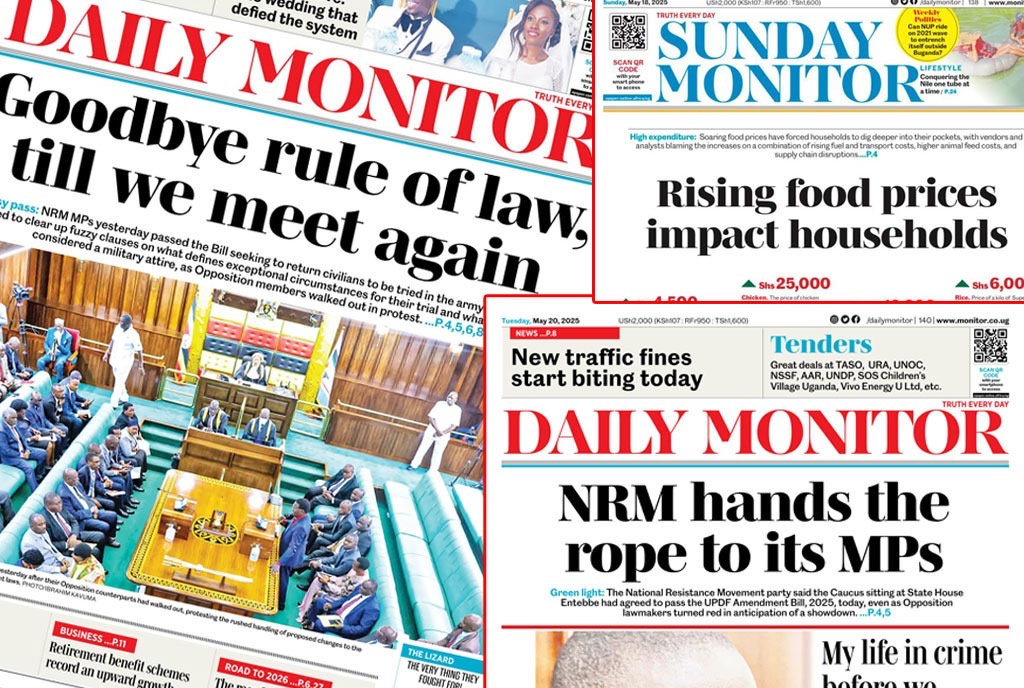
Vestiges of press freedom in Uganda finally disappear down the drain
General Muhoozi is the Sandhurst-trained Chief of Defence Forces (CDF) for the Uganda People’s Defence Forces (UPDF). He is also the 52-year-old son of Uganda’s 82-year-old President Yoweri Museveni. Muhoozi has not shied away from stating that he intends to be president after his father.
Museveni has been at the apex of Ugandan politics since 1986, having captured power following a coup d’état in the aftermath of a protracted five-year guerilla war — a move he said at the time was prompted by the rampant disregard of the rule of law, election malpractice, and gross human rights abuses.
No love lost between NMG and government
While the scale of Sunday’s action against NMG Uganda outlets — including Daily Monitor, KFM, Dembe FM, NTV and Spark TV — was unprecedented, this is not the first time the formerly Aga Khan-owned media house has clashed with Museveni’s government.
In 2002, Daily Monitor was shut down by the government for a week for reporting that a UPDF chopper had been shot down by Lord’s Resistance Army (LRA) rebels in Northern Uganda. On that occasion, security forces raided the newsroom, confiscated computers and equipment, and arrested journalist Frank Nyakairu. The newspaper was only reopened after talks between the owner and government, which resulted in one of its founders and the then editor, Charles Onyango Obbo, being removed from Kampala and re-stationed in Nairobi, Kenya, where he is still based.
In 2005, KFM was closed after veteran journalist Andrew Mwenda stated on air that South Sudan’s revolutionary leader, John Garang, had died in a helicopter crash in Uganda because he had been given a defective Ugandan chopper. Mwenda was arrested, and the radio station temporarily shut down.
Ironically, Mwenda, once a fierce defender of press freedom, is now one of General Muhoozi’s closest allies, serving on the central executive committee of the general’s self-styled pressure group, Patriotic League Uganda (PLU) — under which the current wave of media suppression is happening.
Mwenda, who owns a news magazine called The Independent, cut his journalism teeth at Daily Monitor, where he became one of the most respected journalists because of his fearless calling out of government excesses.
On Monday, after hours of silence following the army’s siege on his former employer, Mwenda posted on X: “I have just held discussions with Gen Muhoozi Kainerugaba and we, as leaders of PLU, have agreed that we shall reopen both Daily Monitor and NTV soon. However, we shall first have discussions with the management of both sister companies. I will inform them when we can have this meeting.”
Chief of Defence Forces (CDF), General Muhoozi, reposted the message and echoed that the media houses would be reopened upon approval from his father, the president.
Sunday’s closures came after the CDF’s discomfort over the media house questioning some of his operations and calling them illegal, as well as reportedly insulting his family. He posted that he does not believe in a free press, and that the media house would never reopen without his permission.
For years, the president himself has not veiled his disdain for Daily Monitor, calling the 34-year-old title an ‘enemy newspaper’, a ‘bad newspaper’, and even accusing it of compromising national security and spreading rebel propaganda.
In 2013, Daily Monitor was again shut down following publication of a letter attributed to General David Sejjusa (formerly Tinyefuza), in which the veteran — who fought with Museveni in the guerilla war — alleged there was a plot to assassinate senior army officials opposed to the ‘Muhoozi project’. The Muhoozi project referred to what was then the president’s apparent grooming of his son to succeed him.
NTV, on the other hand, was last year barred from covering both Parliament and President Museveni’s events. According to one of Daily Monitor’s founders, Wafula Ogutu, the newspaper successfully sued the government for previous shutdowns and was awarded more than US $818,000 (UGX 3 billion) in damages. Ogutu appeared on a BaBa TV talkshow on 29th June, where he said whoever closed the media house this time around would again be held accountable.
Reign of terror
The week’s events have understandably unleashed uncertainty and self-censorship in the media industry, especially considering that the raid on NMG followed the abduction-arrest of journalists Andrew Nabimanya (popularly known by his alias Ninye Tabz) and Timothy Kalyegira. After a stint in General Muhoozi’s infamous ‘torture basement’ [editor’s note: abductees consistently report being subjected to torture in a basement-type room; the General is on record referring to his interrogation centre as “my basement”], Tabz was later dropped at Kampala’s Central Police Station and released on bond after being charged with ‘unauthorised disclosure of official information’.
Kalyegira, who disappeared last Friday, was on Monday charged in court for ‘broadcasting online without a license’, and remanded to Luzira maximum security prison.
Once hailed for his advancement of women and relative support for press freedom following the 1993 airwaves liberalisation, President Museveni, now in his seventh elective term of office, finds himself presiding over an era where journalists are routinely brutalised by security forces while carrying out their duties, where media houses are forced into self-censorship for survival, and civic society and dissenting voices have been silenced.
Sunday’s developments have also left many Ugandans questioning the president’s whereabouts and wellbeing due to his uncharacteristic silence as Commander-in-Chief, head of state, and father to the outspoken CDF, General Muhoozi.
The Nation Media Group (NMG) is the largest independent media house in East and Central Africa with operations in print, broadcast and digital media. NMG has operations in Kenya, Uganda, Tanzania and Rwanda, and is listed on the Nairobi Stock Exchange, the Dar es Salaam Stock Exchange, the Uganda Securities Exchange, and Rwanda Stock exchange. The Group consists of several divisions and subsidiaries which include Nation Newspaper Division (Kenya), Nation Broadcasting Division (Kenya), Monitor Publications (Uganda), and Mwananchi Communications (Tanzania). More about NMG.
On 30th June, 2026 WAN-IFRA and the World Editors Forum denounced the shutdown of Nation Media Group titles in Uganda and called on the government of President Yoweri Museveni to honour constitutional guarantees and international standards protecting media freedom and the safety of journalists. Read more here.