Tribute to Fred Burkhardt, former IFRA CEO
(Editor’s note: Much of this tribute was taken from an article that Klaus von Prümmer, a former IFRA director, authored for Fred Burkhardt’s 95th birthday.)
Long before digital media became a reality, Fred recognised that newspapers would need to reinvent not only their production processes but ultimately their role in a connected, electronic world. His influence reached far beyond IFRA itself, helping to shape the strategic direction of publishers, manufacturers, and newspaper associations across the globe.
Thanks in large part to Fred, who is survived by three daughters and their families, WAN-IFRA continues to carry forward his commitment to innovation, collaboration, and the future of quality journalism.
Born on 27 February, 1929, in Nuremberg, Burkhardt experienced the upheavals of wartime Germany, completing his education after the war and training as a typesetter before studying in the United States as a Fulbright scholar in Syracuse, New York. He later earned a doctorate in economics in Berlin in 1957 with a dissertation on remote and high-speed typesetting – work that foreshadowed the technological revolution he would later help lead. After positions at Linotype and the Harris Corporation, he joined IFRA in 1972.
When Burkhardt took over, newspapers were still largely produced with hot-metal typesetting, letterpress printing, and black-and-white pages. During the next two decades, the industry was transformed through phototypesetting, offset printing, computerised pagination, digital page transmission, and computer-to-plate production.
Brilliant at bringing people together
IFRA became the global forum where publishers, engineers, researchers, and manufacturers worked together to develop and adopt these innovations. Thousands of newspaper professionals from around the world came to IFRA and its many events to exchange knowledge, solve common challenges, and prepare for the future.
Burkhardt was brilliant at bringing people together. He combined deep technical understanding with exceptional diplomatic skill, creating an environment where competing companies and strong personalities could collaborate in the interest of the industry as a whole. He earned the trust of publishers, printers, editors, engineers, and technology suppliers alike.
Under his leadership, IFRA expanded into far more than a research institute. Its conferences, seminars, publications, consulting activities, and the annual IFRA Expo became essential meeting places for the international newspaper community. Through close cooperation with publisher associations and an influential international board, Burkhardt fostered relationships that crossed national boundaries and helped establish common standards and shared technological progress throughout the industry.
Perhaps his most remarkable contribution was his vision beyond print. While many regarded new electronic media as passing experiments, Burkhardt understood that computer networks would fundamentally reshape how news would be created, distributed, and consumed. He personally led initiatives exploring telecommunications, digital publishing, and electronic newspaper services years before the commercial internet emerged.
In his final years at IFRA, he sought to prepare publishers collectively for the internet era, launching the Initiative for Newspaper Electronic Supplements (INES) in 1994. He envisioned industry-wide cooperation on digital products and online services long before such collaboration became commonplace. Although the newspaper industry struggled to adapt as the internet evolved, many of the questions he raised remain strikingly relevant today.
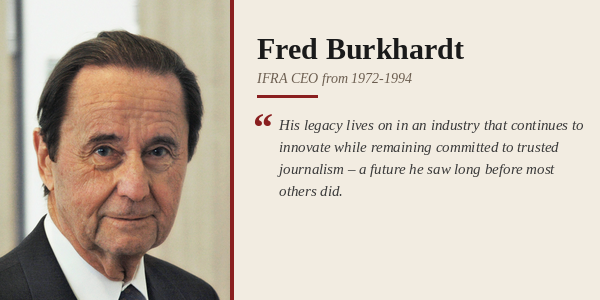
Burkhardt often expressed a simple but profound insight: newspapers are in the content business, not the newsprint business. That philosophy has become even more relevant in today’s multimedia landscape. His foresight helped lay the foundations for the digital evolution of newspapers and ultimately for the modern mission of WAN-IFRA. His legacy lives on in an industry that continues to innovate while remaining committed to trusted journalism – a future he saw long before most others did.