Soil Mechanics, Turf Physiology, and the Technical Science of Aeration in Upper Midwest Climates
Maintaining healthy turfgrass in northern urban environments presents a unique set of agronomic challenges. In metropolitan areas across the Upper Midwest, such as Minneapolis, Minnesota, turf performance is influenced by a combination of dense glacial soils, intense freeze-thaw cycles, prolonged winter snow cover, and hot, humid summer conditions. Beneath the surface of a typical residential lawn lies a complex ecosystem where soil density, organic matter accumulation, root architecture, and soil hydrology constantly interact.
When soil becomes densely compacted, the fundamental physical pathways that allow air, water, and essential minerals to reach the root zone become severely restricted. This leads to progressive turf decline, shallow root growth, increased disease susceptibility, and poor nutrient uptake. Resolving these sub-surface structural issues requires a mechanical intervention rooted in soil physics: core cultivation. Understanding the science behind soil density, thatch dynamic management, and root respiration reveals why mechanical soil extraction is essential for long-term turf health in northern climates.
Soil Compaction and the Mechanics of Pore Space
To understand why mechanical cultivation is necessary, one must first examine the physical composition of healthy soil. Ideal soil structure consists of approximately 50% solid matter (mineral particles and organic material) and 50% pore space. This pore space is divided between macropores (large spaces) and micropores (small spaces). Macropores are vital for soil aeration and gravitational water drainage, while micropores hold capillary water for plant uptake.
In urban residential settings, heavy foot traffic, lawn maintenance equipment, freeze-thaw dynamics, and high clay or loamy content gradually force mineral particles together, collapsing these essential macropores. As bulk density increases, soil porosity decreases. This physical compression creates several physiological obstacles for turfgrass:
- Restricted Oxygen Diffusion: Turfgrass roots require atmospheric oxygen for cellular respiration—the biological process that converts stored carbohydrates into energy for growth and nutrient transport. Compacted soils suffer from poor gas exchange, allowing toxic carbon dioxide levels to build up while starving root systems of vital oxygen.
- Impaired Hydraulic Conductivity: When macropores collapse, water infiltration rates drop dramatically. Rather than soaking deep into the root zone, irrigation and rainfall pool on the surface or run off, leading to water waste, localized dry spots, and nutrient leaching.
- Mechanical Root Resistance: Dense, compacted soil acts as a physical barrier. Turf roots cannot easily penetrate compressed soil particles, resulting in a shallow, stunted root system that is highly vulnerable to summer heat and winter stress.
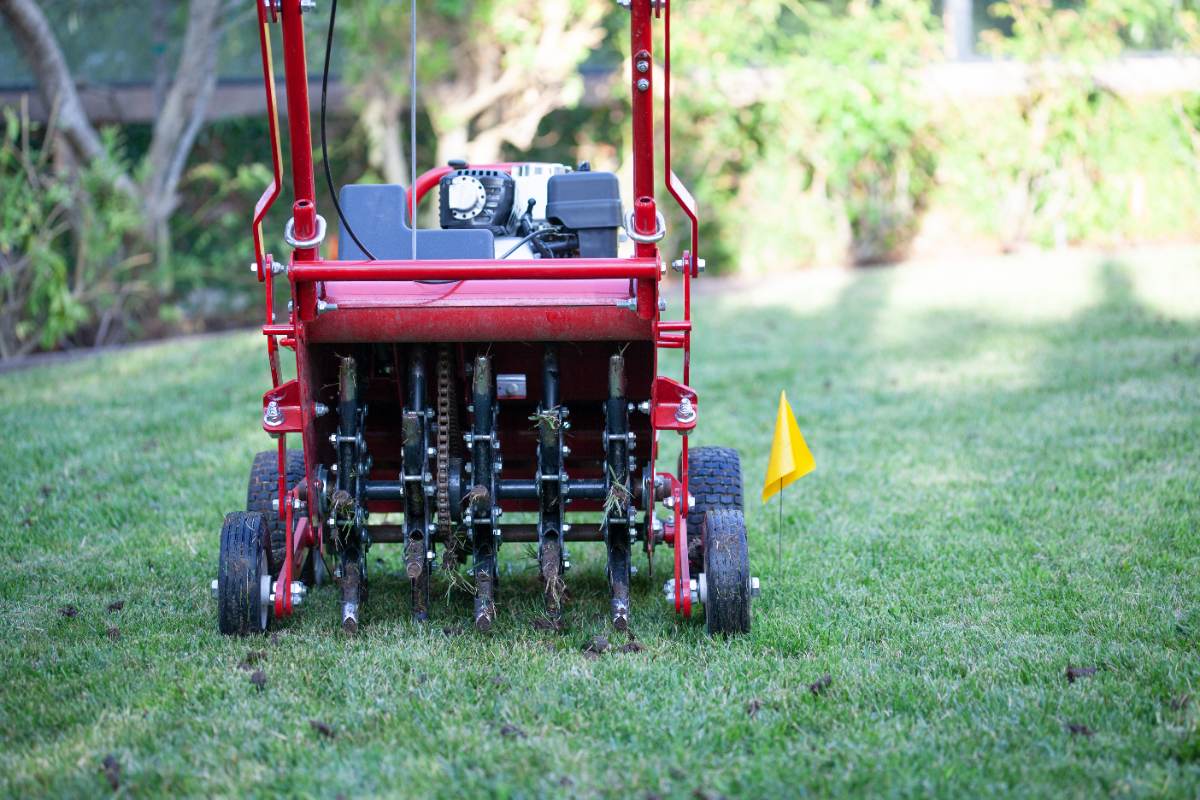
Mechanical core extraction addresses these physical barriers by using hollow tines to physically remove small cylindrical soil plugs from the ground. This process immediately relieves lateral soil pressure, re-establishes open macropore pathways, and creates physical voids where roots can expand freely.
Thatch Dynamics and Microbial Degradation
Beyond soil compaction, another major structural barrier to turf health is the buildup of excessive thatch. Thatch is a tightly interwoven layer of living and dead organic matter—specifically roots, stolons, rhizomes, and crowns—that accumulates between the green vegetation canopy and the soil surface. While a thin layer of thatch (under half an inch) provides insulation and wear tolerance, excessive thatch creates significant agronomic problems.
Thatch becomes hydrophobic as it dries out, acting like an impenetrable sponge that absorbs moisture before it can reach the soil. It also harbors harmful fungal pathogens and insect pests. Excessive thatch typically forms when organic matter accumulates faster than native soil microorganisms can decompose it.
Core cultivation plays a dual role in managing thatch accumulation:
Mechanical Disruption
As hollow tines pull soil cores out of the ground, they slice through the thick thatch layer, physically breaking up its continuous mat. This mechanical disruption allows air, water, and microbial activity to penetrate deep into the organic layer.
Biological Decomposition
When the extracted soil plugs are deposited on the surface of the lawn, beneficial soil-dwelling microbes are transferred directly onto the top of the thatch layer. As these plugs break down from rain and foot traffic, the microbes mix into the thatch mat, accelerating natural enzymatic degradation and transforming spongy thatch into nutrient-rich humus.
Turfgrass Physiology and the Northern Climate Cycle
The Upper Midwest region relies almost exclusively on cool-season turfgrass species, primarily Kentucky Bluegrass (Poa pratensis), Fine Fescues (Festuca spp.), Perennial Ryegrass (Lolium perenne), and Tall Fescue (Festuca arundinacea). These species follow a distinct physiological growth curve dictated by soil and air temperatures:
- Spring: Shoot growth rapidly accelerates as air temperatures warm, depleting stored root carbohydrates.
- Summer: High heat and drought induce semi-dormancy or metabolic stress, causing root dieback and reduced shoot activity.
- Late Summer to Autumn: As ambient air temperatures cool while soil remains warm, cool-season turf enters its primary root-building phase. Photosynthetic carbohydrates are pushed downward to build a deep, dense root architecture before the ground freezes.
Because of this physiological growth cycle, timing mechanical cultivation correctly is critical. Executing core cultivation during periods of peak root growth—specifically late summer to early autumn—yields the highest biological return. During this window, the turf plant possesses abundant metabolic energy to rapidly expand its root system into the newly opened aeration channels before winter dormancy sets in.
Homeowners managing cool-season turf in urban regions can benefit from professional turf management services; scheduled lawn aeration in Minneapolis relieves heavy soil compaction, disrupts thatch accumulation, and optimizes root zone oxygen levels during peak fall growth cycles.
Agronomic Synergies: Overseeding and Soil Amendments
While core cultivation alone provides substantial soil physics benefits, it also creates an ideal biological window for supplementary turf restoration practices. One of the greatest operational advantages of mechanical aeration is the creation of optimal seed-to-soil contact channels.
Overseeding Enhancement
Broadcasting grass seed across an established, compacted lawn often yields low germination rates because the seeds sit on top of the thatch layer or hard soil without retaining moisture. Core cultivation creates thousands of small, protected micro-climates—the core holes—where broadcast seed can settle. Inside these holes, grass seed is shielded from wind and seed-eating birds, while remaining in direct contact with moist soil, resulting in dramatically higher germination and establishment rates.
Soil Amendment Infiltration
Sub-surface soil amendments, such as organic compost, calcined clay, humic acids, and granular lime or sulfur, struggle to migrate downward through compacted turf. Applying these materials immediately following core cultivation allows top-dressed amendments to wash directly into the open core channels. This delivers organic matter and soil conditioners directly into the active root zone, permanently altering sub-surface soil structure and improving cation exchange capacity.
Best Execution Practices for Core Cultivation
Achieving optimal results from core cultivation requires adhering to established mechanical and environmental standards:
- Soil Moisture Optimization: Aeration should never be conducted on bone-dry soil or completely saturated ground. Excessively dry soil prevents hollow tines from penetrating to their full operational depth (typically 2 to 3 inches), while overly wet soil causes tine clogging and smears the sides of the core holes, sealing off soil pores. Ideal moisture levels occur 1 to 2 days after moderate rainfall or thorough irrigation.
- Tine Geometry and Pattern Density: Equipment should utilize commercial-grade hollow tines that cleanly pull soil plugs rather than solid spikes, which actually increase soil compaction around the insertion point. A high-density pass pattern—aiming for 20 to 40 core holes per square foot—ensures sufficient physical disruption across the entire lawn area.
- Post-Cultivation Care: Extracted soil plugs should be left on the lawn surface to break down naturally via precipitation, microbial activity, and routine mowing, returning valuable mineral particles and micro-organisms back to the soil profile.
By understanding the underlying physical and biological processes that govern soil mechanics, turf managers can turn core cultivation into a powerful agronomic tool. Systematically relieving soil compaction, managing thatch accumulation, and expanding sub-surface root pathways establishes a resilient turf ecosystem capable of enduring environmental stress and thriving for years to come.