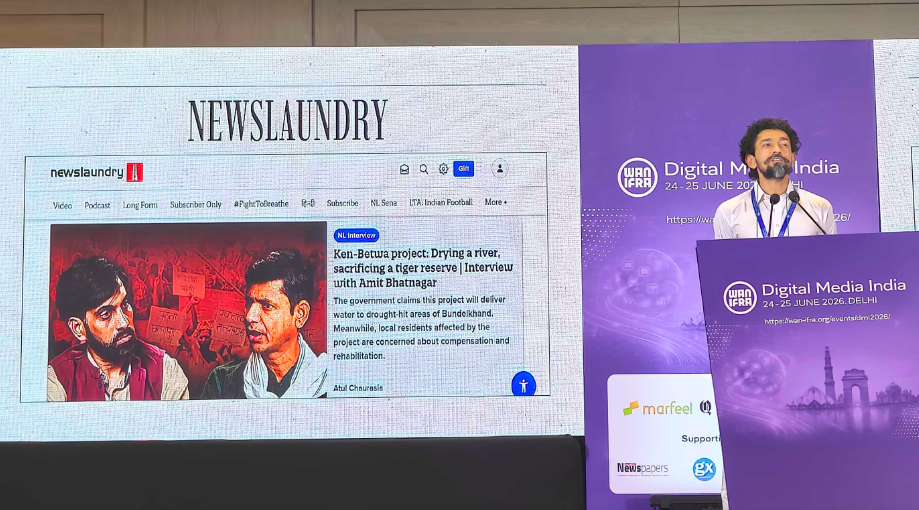
‘If you can’t get people to pay for your product, the problem is in your product’: Newslaundry’s co-founder
Speaking at our ongoing Digital Media India Conference in New Delhi, Sekhri drew on his 14 years running Newslaundry, which he co-founded in 2012. What works, he said, isn’t fixed – it shifts by market, and by moment.
Purity of message, not mixed revenue
Sekhri said the first lesson from his experience is that subscriptions require what he called purity of message. A platform cannot run ads and ask audiences to pay at the same time, he argued.
“I don’t think it’s easy to convince an audience where they see ads on your platform and you also want them to pay.”
Newslaundry’s model, by contrast, is ad-free and subscription-only.
“We are ad-free, pay-to-keep. You pay, that’s our only source of revenue,” he said, describing the outlet as a sustainable, small operation kept afloat by its subscriber base.
He acknowledged that this purity becomes harder to sustain at scale. Newslaundry has had two advantages in maintaining it, he said:
- Starting from scratch, with no legacy revenue model to unwind, and
- Operating in a weak legacy media landscape that does little public-interest journalism.
“Right now, it’s not that hard to do what others are doing because most others are not doing it,” he said.
Messaging shifts, but consistency has to hold
Sekhri said Newslaundry adjusts its messaging depending on the moment without abandoning consistency between what it asks subscribers to pay for and what it delivers.
He pointed to coverage of the NEET exam controversy, where reporting and questioning of those in power produced a subscriber spike, as consistent with the platform’s broader editorial identity rather than an opportunistic departure from it.
He was direct that subscription strategy cannot simply be copied across markets.
“The logic that works for The New York Times doesn’t necessarily work for Newslaundry,” he said, citing India’s 22 major languages against the United States’s one, as one reason Indian and American audiences relate so differently to power, hierarchy, and news itself. “However, what works for Newslaundry, works for Newslaundry,” he added.
Even within India, he said, what works for Newslaundry’s English-language audience would need rethinking for regional language audiences.
What subscribers are really paying for
Sekhri argued that subscribers are rarely paying for product quality. “I don’t think any Indian news platform has created a product that is so valuable that a news subscriber will pay for it,” he said.
What subscribers are paying for instead, he said, is what an outlet stands for: “Our product may be mediocre, nothing spectacular, but this is what we stand for – that is what most of your news consumers will pay you for.”
This, he said, is the message every outlet needs to keep returning to – sometimes as a broad institutional pitch, sometimes tailored to a specific age group, language, or region.
He cited Newslaundry’s 21-day ground reporting trip to Manipur, which legacy media did not match in duration, as an example of this principle in practice.
Ground reporters define a news product
Sekhri said he disagreed with applying the term “news product” loosely.
“I don’t think you can have a news product without ground reporters,” he said, describing reporters subject to editorial scrutiny, desk oversight, and fact-checking as the foundation of legitimate journalism.
Without that structure, he said, an outlet might still hold an audience, but “it is not a news home.”
He argued that the current media landscape cannot sustain legacy-sized organisations. Every shift in technology, he said, has forced news businesses to rebuild themselves, and this one is no different.
What can survive, in his view, is something leaner.
“It’s like a more agile, guerrilla-like news ecosystem,” he said, adding that survival without producing real journalism does not count. “You can survive, but you’re not doing journalism.”
He closed by rejecting infrastructure as an excuse for failing to build a paying audience.
“If you cannot get people to pay for your product, the problem is in your product – it is not your technology, it is nothing else,” he said.
How Newslaundry funds ground reporting
Asked by an audience member how ground reports like the Manipur coverage are funded, Sekhri said outcomes vary: “Some campaigns reach full funding, some don’t.”
He described Newslaundry’s subscription model, with discounted rates for longer terms, as the base layer of support. On top of that sits the Newslaundry Sena (NL Sena) programme, through which the outlet identifies its most loyal subscribers by geography and emails them with funding shortfalls for specific reporting projects, inviting top-up contributions in smaller increments – capped per person at Rs 50,000 (about 465 euros) to avoid single-donor influence over coverage.
Most subscribers pay, he said, because they believe in the outlet; NL Sena contributors are also offered a Zoom call with reporters as an added incentive. He added that anything published still has to clear standard journalistic filters for accuracy.