CEO Insider: Showcases light the way – processes win the race
This is the sixth of seven lessons from Ladina that we are publishing each day leading up to our World News Media Congress. Her first five covered:
Lesson #1 Building products is trivial. Running them isn’t.
Lesson #2 The living policy. Why AI guidelines are never finished.
Lesson #3 Forget the AI mandate. Start with the Time Wasters.
Lesson #4 Don’t convert the resistors. Reward the curious.
Lesson #5 Don’t wait for the experts. Grow your champions.
By Ladina Heimgartner
President of WAN-IFRA and CEO Ringier Media Switzerland
In late 2022, when ChatGPT launched, the media industry moved faster than almost any other sector because we’d already survived two major disruptions and weren’t about to miss a third. Within months, use cases appeared everywhere in our newsrooms: speech-to-text tools, writing assistants, anti-bias checkers, systems embedded in our CMS. There were ideation workshops and showcases demonstrating what AI could do, and it was impressive, but it mostly didn’t move our P&Ls.
So we shifted strategy. Maybe the answer was top-line growth through AI – new products, new revenue streams. But models that work beautifully in a demo don’t scale reliably, and hallucinations in a media product destroy trust in minutes. That path didn’t deliver either.
And then we went back to efficiency, but this time we looked at processes instead of just use cases. The unsexy work, but where the real magic happens.
What result do you actually need, and what’s the best way to get there?
The worst thing you can do is take a process exactly as you’ve always done it and make it slightly faster with AI. The right question isn’t how to speed up what you’re already doing, but what result you actually need and what’s the best way to get there now that you have these new tools.
This concept – “Jobs to be Done” – has become widely known thanks to Clayton Christensen, but it was the Ringier Board member and Harvard professor Felix Oberholzer-Gee who reframed it for us in a way that made it actionable for Ringier. When you apply it, you often find that entire steps in a process are no longer necessary – chains of work that existed only because there was no better way. You don’t optimise the old process. You design a new one from scratch, backwards from the outcome.
Ringier Group CEO Marc Walder often speaks about the tough challenge of “unlearning.”
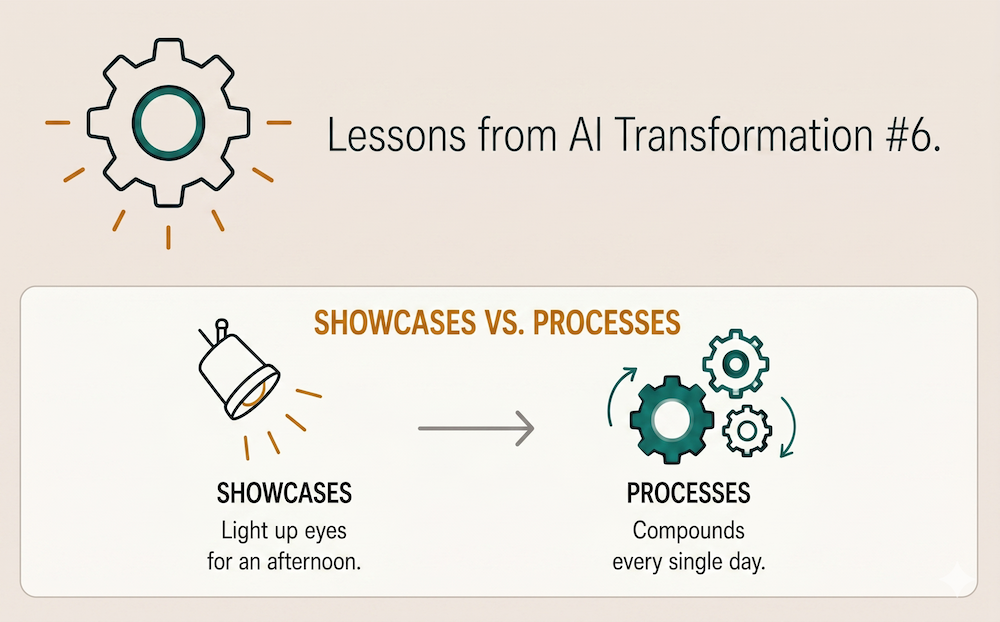
Showcases inspire teams and boards. They matter. But they don’t scale transformation. Processes do. A showcase lights up eyes for an afternoon. A redesigned process built around the job to be done compounds every single day, less visible perhaps, but where real ROI actually lives.
At Ringier Media Switzerland, we’re testing this at scale through our Future of Sales project, redesigning our entire sales process landscape. We’re not asking how to make it faster, but what outcomes our customers actually need and what’s the leanest way to deliver that.
In the next episode we’ll talk about the role of humans in a world where AI is increasingly in the loop. Because the answer to “will AI replace us?” isn’t technical. It’s cultural.
WAN-IFRA is working on a report about how publishers are responding to the impact of AI Search and bot traffic. We would be thrilled to have your perspective. TAKE OUR SURVEY: in English, German, French, Spanish.