CEO Insider: Don’t wait for the experts – grow your champions
This is the fifth of seven lessons from Ladina that we are publishing each day leading up to our World News Media Congress. Her first four covered:
Lesson #1 Building products is trivial. Running them isn’t.
Lesson #2 The living policy. Why AI guidelines are never finished.
Lesson #3 Forget the AI mandate. Start with the Time Wasters.
Lesson #4 Don’t convert the resistors. Reward the curious.
By Ladina Heimgartner
President of WAN-IFRA and CEO Ringier Media Switzerland
Some organisations answer the question of how the enabling works the same way: build a central AI expert team. Let them jump from project to project, from team to team. They’ll scale the transformation.
In theory, it makes sense. In practice, we learned something different.
What we discovered is that a central expert team creates a dependency. Teams start waiting. They expect the experts to come and tell them what to do and how to do it. Even executives fall into this pattern. The result is paralysis dressed up as caution. And you’ll never have enough experts anyway – the math doesn’t work at scale.
Here’s what actually did work.
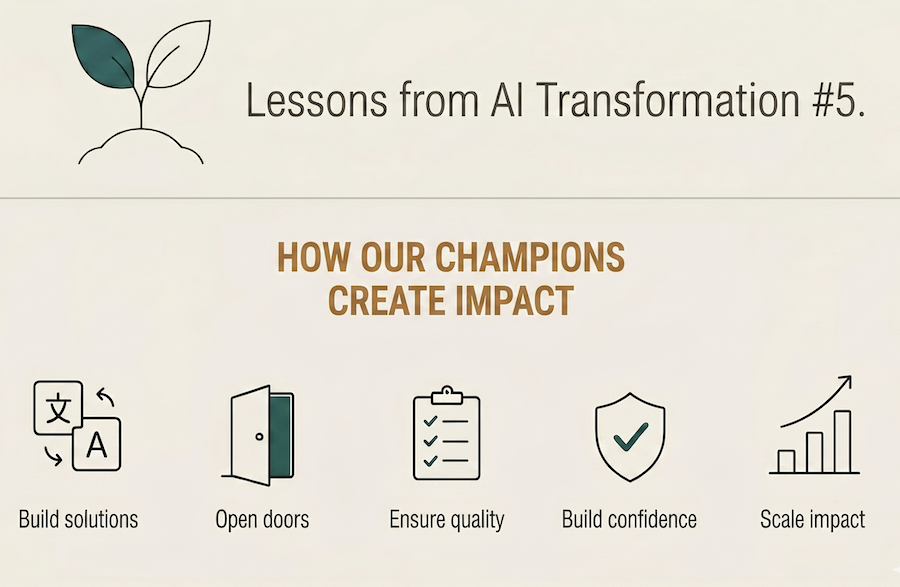
One person from an editorial team became genuinely excited about AI. She started experimenting, learning, and building things. Her editor-in-chief offered her time to support other editorial teams as well. What happened next was the opposite of the expert-team model: instead of waiting, teams started pulling her in. She became the most sought-after person in the company – because she showed the concrete benefit of AI for everyone.
She became the role model for our AI Champions
She created a translator agent for our food publications, where precision matters and generic translation tools had always fallen short. She opened doors between editorial and our Visuals team, and now we have print publications with genuinely excellent AI-generated visuals. She built quality control systems for our internal AI tools – our “Gems” – so teams could use them with confidence. She centralised and certified a growing library of these tools.
She became the role model for what we now call our AI Champions program.
Here’s what matters about her role: She doesn’t preach. She sits down and does the work alongside the team until they can do it without her. Then she moves to the next team. And it scales in a way central expertise simply cannot.
So we’ve built this systematically. Through the Time Waste Challenge, we asked people a second question alongside their time-waster submissions: are you interested in becoming an AI Champion? The answers told us who was genuinely curious, who had the energy, who might thrive in this role.
Now every team is creating this role – or shares one across smaller teams. And we made it explicit to leadership: your team needs an AI Champion, and that person needs at least twenty percent of their time. Ten percent isn’t enough; it becomes something people do at lunch or in the margins. Fifty percent seemed like too much to ask at the start. Twenty is the line where it’s taken seriously but doesn’t pull people entirely away from their primary work.
To be clear: we still need our central experts. They build the system integrations, the platform-level work, the data foundation and much more. That’s a different job, and a critical one.
But system integration alone doesn’t transform a company. The daily magic – the part where AI actually changes how work feels – happens through the champions sitting inside the teams.
I’m convinced the ROI on that time investment will come faster than most expect. But that’s a question for another episode – when we’ll talk about the difference between showcases, use cases, and processes, and why that distinction matters more than most people realise.
WAN-IFRA is working on a report about how publishers are responding to the impact of AI Search and bot traffic. We would be thrilled to have your perspective. TAKE OUR SURVEY: in English, German, French, Spanish.