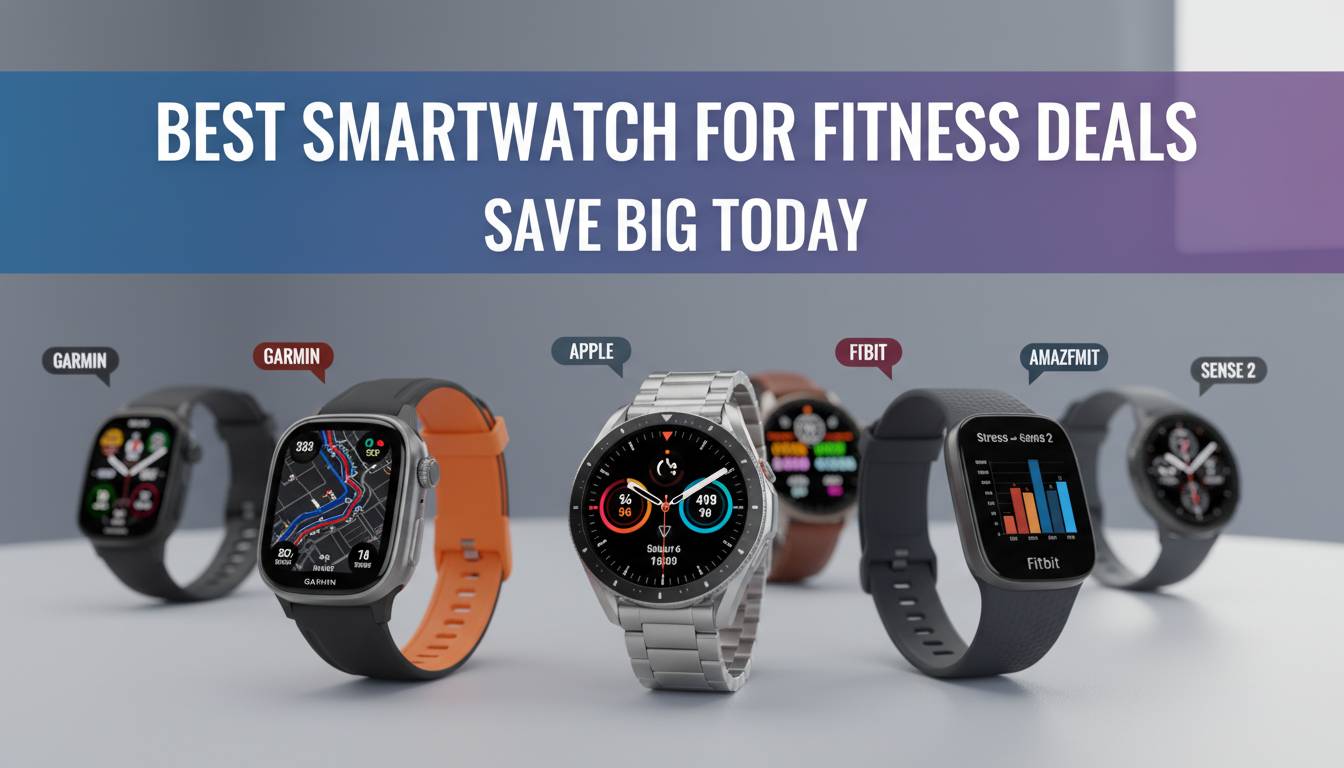
Best Smartwatch for Fitness Deals: Save Big Today
Looking for a fitness smartwatch without spending a fortune? I’ve spent months testing the latest models from Apple, Garmin, Samsung, Fitbit, and a few cheaper alternatives to figure out which ones are actually worth your money in 2025.
Whether you’re training for a marathon or just want to know why you’re not sleeping well, here’s what matters.
Quick Comparison
Smartwatch
Price
Battery
Water
Heart Rate
Best For
Apple Watch Series 10
$399
18 hours
50m
Excellent
Most people
Garmin Forerunner 965
$599
23 days
5 ATM
Excellent
Serious runners
Samsung Galaxy Watch 7
$329
40 hours
IP68
Very Good
Android users
Fitbit Sense 2
$249
6+ days
5 ATM
Good
Health tracking
Garmin Instinct 3
$449
21+ days
10 ATM
Very Good
Outdoors
Apple Watch Ultra 2
$799
36 hours
100m
Excellent
Athletes
Whoop 4.0
$239/yr
5 days
IP68
Good
Data nerds
Amazfit GTR 4
$199
14 days
5 ATM
Good
Budget buyers
Now, the details.
Apple Watch Series 10 – Best Overall
The Series 10 is the safest pick if you want something that works well across the board without serious compromises.
The fitness tracking is solid. Heart rate monitoring holds up during HIIT and running. The new sleep apnea detection is a genuine addition—not revolutionary, but potentially useful. Workout detection works automatically, which is convenient when you forget to start tracking.
The integration with Apple’s Health app is where this wins. TheActivity rings motivate some people and annoy others. Either way, the data汇总 works well if you’re already in the Apple ecosystem.
The downside is the battery. You’ll charge it every day if you track workouts with GPS. This is the trade-off for having a full computer on your wrist.
Pros:
- Works seamlessly with iPhone
- Accurate GPS and heart rate
- Large, bright display
- Sleep apnea detection
- Tons of apps
Cons:
- Daily charging
- Expensive bands and accessories
- Doesn’t work well with Android
- Some apps cost extra
Where to buy: Apple Store, Amazon, Best Buy
Garmin Forerunner 965 – Best for Runners
If running is your thing, this is the watch to get. It’s expensive, but the data helps actually improve your training.
The training readiness score looks at sleep, recovery, and recent workouts to tell you whether to push or rest. It’s not perfect, but it beats guessing. The battery lasts nearly three weeks with regular use and over 30 hours with GPS—enough for a marathon without worry.
The touchscreen and buttons both work well. Mapping is surprisingly good for a sports watch.
Pros:
- Amazing battery life
- Training and recovery insights
- Excellent GPS
- Good mapping
- Works for triathlons
Cons:
- Expensive
- Bulky
- Learning curve for features
- Fewer apps than Apple
Where to buy: Garmin, REI, Amazon
Samsung Galaxy Watch 7 – Best for Android
Samsung’s latest watch works well if you’re in the Android world. It’s cheaper than Apple and has solid fitness tracking.
The BioActive sensor measures heart rate, blood oxygen, and body composition. The body composition numbers aren’t medical-grade, but the trends are interesting over time. Sleep tracking got better and now gives useful scores.
The rotating bezel is intuitive. Samsung Health tracks most activities automatically.
Surprising: Battery life is better than expected—two days with normal use is realistic.
Pros:
- Good price for Android users
- 40+ hour battery
- Health sensors work well
- Easy navigation with bezel
- Integrates with Samsung phones
Cons:
- Doesn’t work well with iPhone
- Bixby is still behind Siri
- Some features need Samsung phones
- Sleep tracking varies
Where to buy: Samsung, Amazon, Best Buy
Fitbit Sense 2 – Best for Health Focus
Fitbit has always been about health, and the Sense 2 continues that. If you care more about stress and sleep than pace and distance, this fits.
The cEDA sensor detects stress and prompts you to breathe. It sounds like marketing, but people actually use it. Skin temperature adds another data point for understanding your body.
The ECG and SpO2 sensors are real medical features, not just buzzwords. Battery life is about six days—better than Apple, worse than Garmin.
Pros:
- Strong stress and health tracking
- Good sleep insights
- 6-day battery
- ECG and SpO2 included
- Cheaper than premium options
Cons:
- Limited apps
- No built-in GPS (needs phone)
- Design isn’t for everyone
- Some features need Fitbit Premium
Where to buy: Fitbit, Amazon, Target
Garmin Instinct 3 – Best Rugged Watch
This watch is built for people who beat up their gear. It’s not pretty, but it survives anything.
The solar charging option helps battery go even longer. The 10ATM rating means you can swim, snorkel, and dive without worry. The case resists scratches and impacts.
Battery is the real story: 21 days in normal mode, longer in power-saver. You charge it maybe twice a month.
Pros:
- Nearly indestructible
- Solar extends battery
- 10ATM water resistance
- Multi-GNSS GPS
- Altimeter, barometer, compass
Cons:
- Basic smart features
- No touchscreen
- Few apps
- Heavy
Where to buy: Garmin, REI, Amazon
Apple Watch Ultra 2 – Best Premium Sports Watch
The Ultra 2 is Apple’s most capable sports watch. It’s big, expensive, and does almost everything.
The 100m water resistance enables diving. The depth gauge shows real-time underwater data. The Action button is customizable—start workouts, mark waypoints, whatever you need.
Battery is better: 36 hours normally, 72 in Low Power Mode. Still needs charging more often than Garmin, though.
Pros:
- 100m water resistance + dive features
- 36-72 hour battery
- Customizable Action button
- Bright outdoor display
- Dual speakers
Cons:
- $799 is steep
- Big case
- Still needs frequent charging vs. Garmin
- Small upgrade from first Ultra
Where to buy: Apple Store, Amazon, Best Buy
Whoop 4.0 – Best for Performance Data
Whoop is different—a wristband, not a watch. It’s for people who want pure data without a screen.
The subscription ($239/year) gets you continuous monitoring and recommendations. The recovery score uses HRV, resting heart rate, and sleep to tell you how ready you are. The daily strain suggestions adjust based on recovery.
No display means checking your phone for everything. No GPS means your phone must be with you. But the analytics are legit if you’re serious about optimization.
Pros:
- Good recovery and strain data
- Small, comfortable
- Strength trainer feature
- Continuous heart rate
- Detailed app insights
Cons:
- $239/year subscription
- No display
- No GPS
- Takes getting used to
Where to buy: Whoop.com, Amazon
Amazfit GTR 4 – Best Budget Option
At under $200, this is the budget pick. You give up polish and brand name, but the features are surprisingly capable.
Battery life is 14 days—remarkable at this price. Dual-band GPS is accurate. Heart rate is fine for casual use, though it lags during rapid intensity changes.
Bottom line: You could buy two of these for the price of one Apple Watch. If budget matters, this makes sense.
Pros:
- Under $200
- 14-day battery
- Dual-band GPS
- 150+ sports modes
- Simple app
Cons:
- Basic smart features
- Heart rate less accurate during intervals
- Lesser-known brand
- Limited offline music
Where to buy: Amazfit, Amazon
How to Choose
Your main activity matters most. Runners benefit from Garmin’s running data. Swimmers need water resistance. Outdoor people want durability. Apple or Samsung work best for general fitness.
Budget realistically. Under $250 gets you everyday tracking. $300-450 gets you excellent features. $500+ makes sense for serious athletes.
Ecosystem counts. iPhone users should lean Apple. Android users have options, but Samsung works best with Samsung phones. Garmin plays nice with both.
Battery is a real trade-off. Apple needs daily charging. Garmin and Amazfit go weeks. Think about what annoys you more: charging often or missing features.
Try before buying if you can. Some are heavy. Some catch on sleeves. Comfort matters—you won’t wear something that bothers you.
Bottom Line
Best Overall: Apple Watch Series 10 for most people. Good fitness tracking, great ecosystem, solid polish.
Best for Runners: Garmin Forerunner 965. The battery and training data justify the price for serious runners.
Best Value: Samsung Galaxy Watch 7 for Android. Fitbit Sense 2 if health tracking is your priority.
Best Budget: Amazfit GTR 4. You don’t need to spend much for solid tracking.
Best for Athletes: Apple Watch Ultra 2. Handles triathlons, diving, whatever.
The real question isn’t which is “best”—it’s which you’ll actually wear. Figure out what features you actually need, set a budget, and pick the one that fits your life.
FAQs
What’s the best fitness smartwatch under $300?
Samsung Galaxy Watch 7 and Fitbit Sense 2 both deliver solid tracking under $300. Galaxy Watch has better smart features; Sense 2 wins on health tracking.
How long do fitness smartwatches last?
3-5 years with normal use. Battery degradation usually hits after 2-3 years. Apple Watches degrade faster due to daily charging.
Apple Watch or Garmin for fitness?
Apple for casual users who want apps and notifications. Garmin for serious athletes who need sport-specific data and battery life.
Do I need GPS in my smartwatch?
Built-in GPS gives accurate distance without your phone. Connected GPS (phone-based) works for indoor and casual outdoor use. Skip it if you mainly treadmill.
Which has the longest battery?
Garmin wins. Instinct 3 goes 21+ days. Amazfit GTR 4 hits 14 days. Apple needs daily charges. Samsung and Fitbit last 1-3 days.
Smartwatch or fitness tracker?
Smartwatches have apps and notifications. Trackers are smaller with better battery but fewer features. Want a wrist computer or just activity tracking?
Visited 973 times, 1 visit(s) today