An audience expert’s advice for getting first-time visitors to come back within a week
Mondría Terol currently works on the AI Initiative Team at The New York Times, where she uses AI to build internal tools to help reporters and editors in their newsroom “to improve their workflows so that we get to tell stories that would otherwise not be told,” she said.
However, the focus on her presentation was about work she did collaborating with The Brown Institute, before joining the Times. Specifically, she gave an example of a local newsroom she had worked with to analyse its data, from raw events to Google Analytics, which was then analysed and turned into strategy recommendations.
“The good thing here is it provided us simplicity: If you get someone to read one article, and you help guide them to just another one, all the other complexity of visitor flow does not matter as much. It gives you laser focus on what you need to do: Just recommend one article that resonates with them,” Mondría Terol said.
For her research, she intentionally focused on a bespoke analysis for local sites with limited data that could be made understandable, and these results then turned into strategies.
She also talked with the publisher to understand the full context of their audience.
“I understood all the metrics based on how they viewed their audience and how they interacted with it. It was kind of like both a human and data approach,” she said.
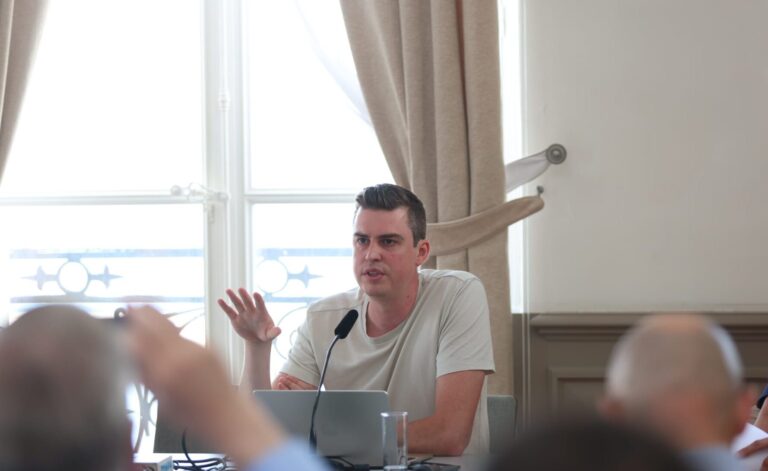
During the webinar, Teresa Mondría Terol explained the three main models she used for her research. WAN-IFRA Members can watch the webinar on our Knowledge Hub.
A tight focus and time-frame
“We decided to start focusing on that first step in the funnel of audience loyalty,” she added, “which is just understanding what it is that keeps people coming back.”
Likewise, the time-frame of that return is crucial.
After that first seven-day window, things become more difficult to optimise for, Mondría Terol said, and added: “It’s also not very valuable to optimise for people who might not return for a month.”
For this case, since the data in a local newsrooms is very limited, she used an entire year’s worth of data, “and standardised it so the results could be understandable in a longitudinal way, but also in an actionable way,” she said.
The data that Mondría Terol used was similar to what every newsroom might have, she noted, such as that relating to a user’s location, the device they are using for access, the browser operating system, as well as looking at scroll percentage, scroll average, engagement time, the number of clicks and number of page views and other standard engagement metrics.
Part of the process also involved doing some feature engineering and aggregating the metrics so it was easier to extract the insights afterwards, she said.
“The most important part for me was to keep the model simple enough to explain, but flexible enough to cover interactions, to capture nuances, and make sure that in that simplicity and that explainability, I was still able to ensure robustness and ensure consistency across all models,” she said.
Four predictors that a first-time visitor would return
There were four key areas that were likely to predict if a first-time visitor would return within a week.
The first was the number of articles the visitor read, with a mid-range of three or four articles read during the first visit tending to indicate those visitors who were likely to return.
“It’s important to say here, this is articles and not page views,” she noted. “Part of the variables that I used was content type, and I took articles as one of the variables because I wanted to make sure that we were only talking about stories, and there are a lot of other page views that someone can gather in that first visit, but I was interested in knowing what they were reading specifically.”
Secondly, people who read several stories on desktop devices. This makes sense, she said, “because it describes someone who is browsing comfortably in their home. They land on an article, they like it, they see the home page and they move around a bit.”
Third, while the depth of the engagement matters, Mondría Terol said this is “nonlinear, and it is usually combined with the number of articles, so a very long engagement session or a very high percentage of scroll across the whole session have positive values in the mid-and-high ranges, but it is not uniform.”
Also, while long sessions and meaningful scrolling tended to be positive, she noted that a long session does not always predict a return. It might be someone who is only interested in a specific story and is then a “one and done.”
Fourth, the context where someone comes from and where they are living. this case, if the city or the region where a visitor was coming from was the same as where the publisher was based, that visitor was more likely to return.
And finally, she said there were some clear negative signals. For example, visitors who were coming through an in-app browser, such as the ones that pop up when someone is visiting from social media. People who were coming from mobile phones were also less prone to return, she said.
‘Make your first-time reader read one more story’
She then provided some strategies based on her findings.
These were all things that the publisher could easily implement from day one, she added.
Since those who visited two or more pages doubled the seven-day return rate versus people who only read one story, “if you can make your first-time reader read one more story you already have a habit there. You can start a pathway to loyalty because you took the most difficult but most critical step, which is to make them be interested in something else besides what made them come to your site in the first place,” she said.
For example, a publisher could offer a tasting menu, a daily podcast, create a recommendation, “something that is simple enough so that people understand the breadth of the content and can have some agency deciding what to consume next,” she noted.
So, for example, she said, if a visitor comes to your site for one story that a friend shared with them, and then the visitor finds something else that resonates with them, and then they decide to stay. More importantly, it can more easily translate to getting them to come back another day.
Design for the second page view
The next step, then, is to design for that second page view, Mondría Terol said. “It’s using this simple threshold as a design goal with minimal scroll, short but real engagement, with just one more page view.”
Publishers, therefore, should treat their “homepage as part of that route and not as something that people should discover later, but something they should discover early on to understand the breadth of the page,” she added.
“Simple is best,” she said. “So just one more story, a welcoming message, keeping track of the article count, and not worrying too much about a long engagement time or a long scroll, is more important.”
While such engagement metrics are important overall, they are not what publishers should be focusing on at this early stage.
“It’s just a matter of focusing on those simple improvements that can be done from that first day, when you don’t have a lot of context from the user and you can provide value for almost everyone who lands on your page,” Mondría Terol said.
Lead image credit: StockSnap via Pixabay.
Sign-up today for our next Data Science webinar.