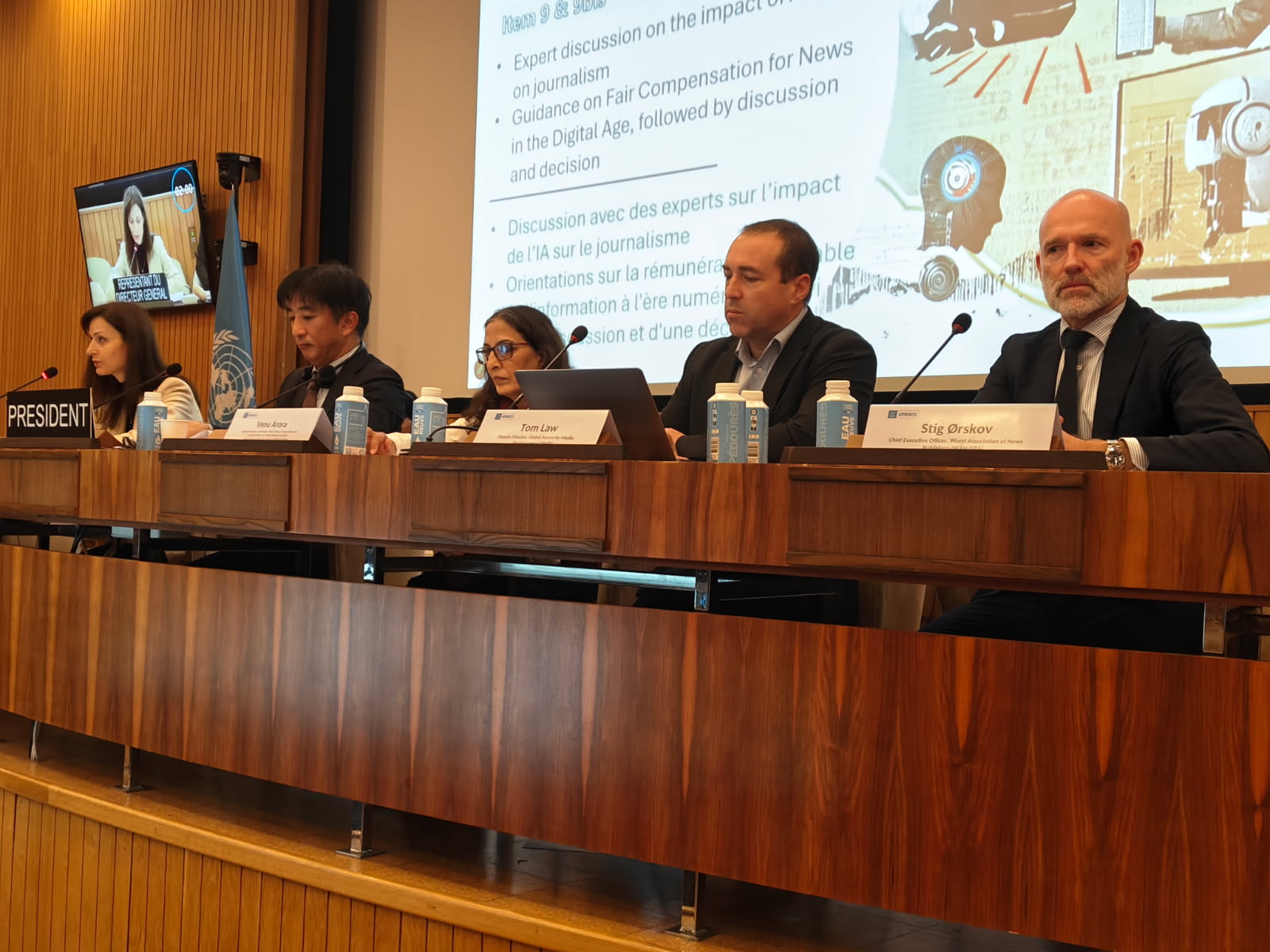
UNESCO endorses Guidance on Fair Compensation for News
For two decades, publishers invested in journalism and platforms helped audiences find it. AI chatbots that answer questions directly have broken that bargain. Governments have now agreed on the principles for a new one, set out in UNESCO’s Guidance on Fair Compensation for News. They include:
- Fair value: Journalism should be recognised for the economic and public value it creates.
• Choice and consent: Publishers should be able to decide how their work is used, including for different purposes.
• Transparency and attribution: Technology companies should explain how they use journalism, credit it properly and help audiences find the original sources.
• Fairness and independence: Compensation frameworks should address power imbalances and protect media diversity, smaller publishers and editorial independence.
The endorsement came from the IPDC Council, the body that governs UNESCO’s International Programme for the Development of Communication. It is made up of 38 UNESCO Member States, elected by UNESCO’s General Conference and chosen to represent all world regions. The Council sets the programme’s policy and priorities and keeps them in line with UNESCO’s wider agenda.
The Council was presented on Friday, in its biennial session, with the Draft Guidance, a document resulting from extensive stakeholder work over the last year. The basis of the effort was the Windhoek+30 Declaration: Information as a Public Good, endorsed by UNESCO’s General Conference (2021), which recognised that access to reliable information is a cornerstone of democratic societies and sustainable development. Developed under the leadership of the M20 Secretariat with ALT Advisory and the GIBS Media Leadership Think Tank, the Guidance brings Global South expertise to the centre of the fair compensation debate. The GIBS Think Tank is no newcomer to the issue: in 2023 it convened the Johannesburg conference that adopted the “Big Tech and Journalism: Principles for Fair Compensation“.
The process included 69 survey responses from 43 countries, three regional consultation roundtables with over 120 participants, 28 written submissions, 19 expert interviews conducted before and after drafting and more than 230 detailed recommendations from contributors.
WAN-IFRA was part of this project from its very inception and actively participated in all stages of the process. In September, our CEO Stig Ørskov backed the draft in Project Syndicate, arguing that UNESCO’s guidelines deserved broad global support. On Friday, WAN-IFRA was at UNESCO to make that case before the Member States. “UNESCO’s guidance recognises what publishers have long known: the sustainability of journalism cannot be left to private bargaining alone,” Ørskov said. “Agreements should reflect the value of journalism, not just who has more power at the table.”
Ørskov was joined on the panel by Tom Law of the Global Forum for Media Development (GFMD) and Venu Arora, Associate Professor of Practice at the Jindal School of Journalism & Communication, for an expert discussion on “AI and Journalism: Creating Public Value in a Changing Information Economy”. Law warned that smaller outlets are being left behind as AI reshapes the news economy: “Local, community, exile and minority-language media are used without consent, and left out by default. No small outlet can fix this alone.”
The endorsement comes at a significant moment. AI systems increasingly depend on journalism: an analysis of more than 680 million chatbot citations found that news accounts for 27% of them, rising to 49% for questions about recent events. Yet the terms of that use are still largely set by technology companies. After WAN-IFRA and publishers worldwide pushed back, Meta paused terms that would have tied access to its business services to the reuse of publishers’ content, but the need for fair rules remains.
Ørskov also set out what should come next: “Publishers need somewhere to turn when these principles are ignored, with binding measures where voluntary arrangements fail. And within twelve months, UNESCO should review whether publishers, including smaller ones and those in less powerful markets, are actually securing fair agreements.”
The Guidance is distinctive in treating journalism not simply as an industry but as a public good. In its decision, the Council endorsed the Guidance as a human rights-based framework to support fair compensation for news and equitable value exchange in the digital information ecosystem. It calls on States to establish clear and enforceable legal frameworks, and on digital platforms and AI actors to ensure fair value exchange, transparency over their use of journalistic content, and robust attribution.
Closing the session, Mariya Gabriel, UNESCO Assistant Director-General for Communication and Information, asked how societies can count on reliable information if they fail to protect the journalism that produces it. “The future of trustworthy information depends on the future of journalism,” she said.
The final, detailed version of the Guidance will be released on 14 December at the Internet Governance Forum in Nairobi, Kenya. From there, the question moves to national capitals. The principles have been endorsed. What matters next is whether governments, platforms and AI companies turn them into a fair deal for the journalism they rely on.