Draw the line at the story: Dietmar Schantin’s case for keeping narrative human
By John Rahim
In the newsrooms Dietmar Schantin works with, one idea surfaces quickly once AI arrives: let the system write the first draft from the reporter’s notes and transcripts. He would rather it did not.
Schantin, a strategist whose clients have included The Washington Post, The Wall Street Journal and The Telegraph, used his session at WAN-IFRA’s Newsroom Summit at VG in Oslo to argue that the decision turns on a commercial question: why do people come to a publisher, and why would they pay for what it does? His answer was to draw a line through the editorial process: AI can work on one side of it, and a named person is responsible for everything on the other.
Publishers supply the answers and lose the reader
The commercial problem shows up in the numbers.
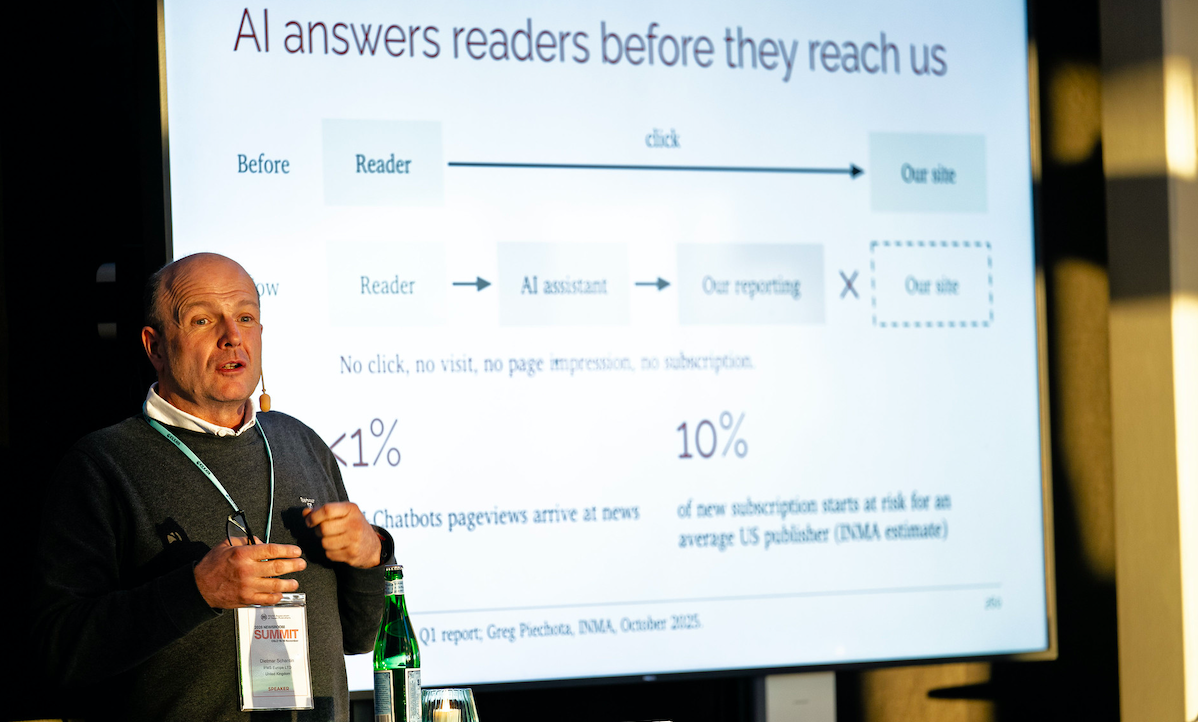
Gallup’s latest poll puts American trust in the mass media at 33%, up from the 28% cited in Schantin’s new book, The Architecture of Journalism in the Age of AI, though he noted that the rise came from Republicans. SparkToro’s analysis found that 68% of Google searches in America ended without a click in the first four months of this year. Chartbeat’s data show chatbots sending publishers less than 1% of their pageviews, so little of the traffic lost at the search page is coming back by another route.
A reader who gets the answer from an assistant that draws on a publisher’s reporting never meets that publisher’s paywall. Drawing on slides from Greg Piechota, Schantin cited an estimate that publishers lose 10% of their potential subscription sign-ups this way and said he thought the true figure was higher.
A court has begun asking who answers for a summary
What is changing, in his reading, is that someone is being held to account for machine-written text. In May, the Munich regional court granted an injunction against Google after its AI Overviews tied two Munich publishers to scams that none of the linked sources mentioned; the court treated the summary as Google’s own statement. In January, the Guardian reported that overviews on liver blood tests gave normal ranges without the context a patient would need to interpret them. Google removed some of them, and Schantin said similar queries still return the same kind of summaries.
Publishers ought to profit from being the source that is correct and answerable, and some are making that harder for themselves. In April, The New York Times published a remark attributed to Pierre Poilievre, Canada’s Conservative leader, that turned out to be an AI-generated summary rendered as a quotation. A reader caught it, Schantin observed, and the correction took more than two weeks. Press Gazette now keeps a running tracker of such cases. Generative models work on probability, he said, so the errors will never go away.
Dietmar Schantin at Newsroom Summit in Oslo. Photo by Tom Atle Bordevik / Bordevik.no
Where the line goes: a fifth layer called narrative
If the errors will not go away, the question becomes where AI should stop.
Schantin’s answer borrows the pyramid of data, information, knowledge and wisdom used in knowledge management since the late 1980s. A journalist once covered the bottom three layers alone: gathering the facts, ordering them and giving them context.
AI now does much of that well, and Schantin wants newsrooms to use it there as far as they can. Between knowledge and wisdom, he inserts a fifth layer: narrative, which covers deciding what the story is, who it is for, what to leave out, and in what order to tell it. That is where he draws his line: AI may work below it, and people own everything from narrative up.
He reached for music to explain why the narrative layer matters. Software can compose using the 12 notes Western music is built from. A composer, he said, has a reason for placing a chord in one spot and not another. Readers return, he argued, when they trust that a person made those choices for a reason and can be asked about them.
The first draft is where the line gets crossed
That is why the first-draft idea fails. Schantin has examined many such drafts, and he objects to what they do to the reporter. The draft arrives with an angle and a vocabulary already chosen, and the journalist edits within them. A colleague at The Washington Post compared it to walking into a room that is already “finished and decorated.” The walls are painted, the furniture is in place, and the writer stops asking whether the room should have looked like this at all.
See also: How The Washington Post is making relentless journalism visible
Summaries have the same problem. After reworking many AI-generated summaries at the Post, he was struck by how often they missed the story.
To show how much of a publication’s identity sits in that layer, he put up the British front pages that followed Russell Brand’s conviction for rape and sexual assault in November. The Times and the Guardian reported the verdict plainly. The Daily Telegraph led on “BBC ‘enabled’ rapist Brand,” and the Daily Mail on a predator indulged by the left. The papers shared the facts, but each told a different story.
Someone must be able to say ‘I chose this’
He left delegates with a test for Monday morning. Take one AI feature already in use, ask how far it reaches into the narrative layer, and ask who can be named as accountable for each choice it makes. A newsroom that can answer a complaint only by saying the AI chose it has failed.
Schantin did not oversell it: this, he said, is where the business model has a chance, “at least at the moment.” The Future Newsrooms Study from FT Strategies and WAN-IFRA found AI being adopted mainly as an efficiency tool, with “time saved” the most common measure of success. Few tasks save a reporter more time than a first draft, and Schantin has put that one on the human side of his line.