France’s Actu changed its business model and got free readers to pay
In the past, Actu, owned by CIPA Ouest-France, had 400 journalists producing some 80 weekly print titles, mostly in Brittany and Normandy in northwestern France. These print titles each had their own websites. They later shifted to a single platform for digital content, which offered national reach.
“From that, we decided to pivot to a paid model, which was quite a big challenge for us,” Amandine Briand, Deputy Director, Editorial Projects at Groupe Actu, told our Digital Media Europe participants in London.
The roots of their current efforts began in 2012, when the group decided to launch a digital-only edition, 76Actu, to see what would happen, she said.
The site quickly proved popular and gained a large audience, so the group launched Actu Toulouse, also digital only in 2015, Briand said.
WAN-IFRA Members can download Briand’s presentation slides as well as replay this session and others from Digital Media Europe on our Knowledge Hub.
A national footprint based on local news
However, the group still had many websites connected to their weekly print titles operating independently, some of which had only 2,000 or so unique visitors a month.
“We thought it would be a good idea to put everyone on the same platform and get these audiences growing, which is what we did in 2016, and got 80 titles on the same domain,” Briand said.
By doing that, she said, traffic skyrocketed. “We now reach around 115 million monthly users, and we are one of France’s most visited websites.”
This gave them a national footprint, even though they provide local news.
“But unlike traditional media, we really operate as a network,” Briand added. “We don’t have a top-down approach, more a bottom-up one.”
Everything was working quite well: “audiences exploded and the traffic was good. The advertising was fine,” Briand said.
However as market dynamics began to shift as they did for so many news publishers worldwide during the past decade, the group realised it needed to change, too.
“We decided we could no longer just count on advertising, and on revenues that are mainly dependencies, so we decided to do this shift,” she said.
‘Will this monetisation project kill the audience?’
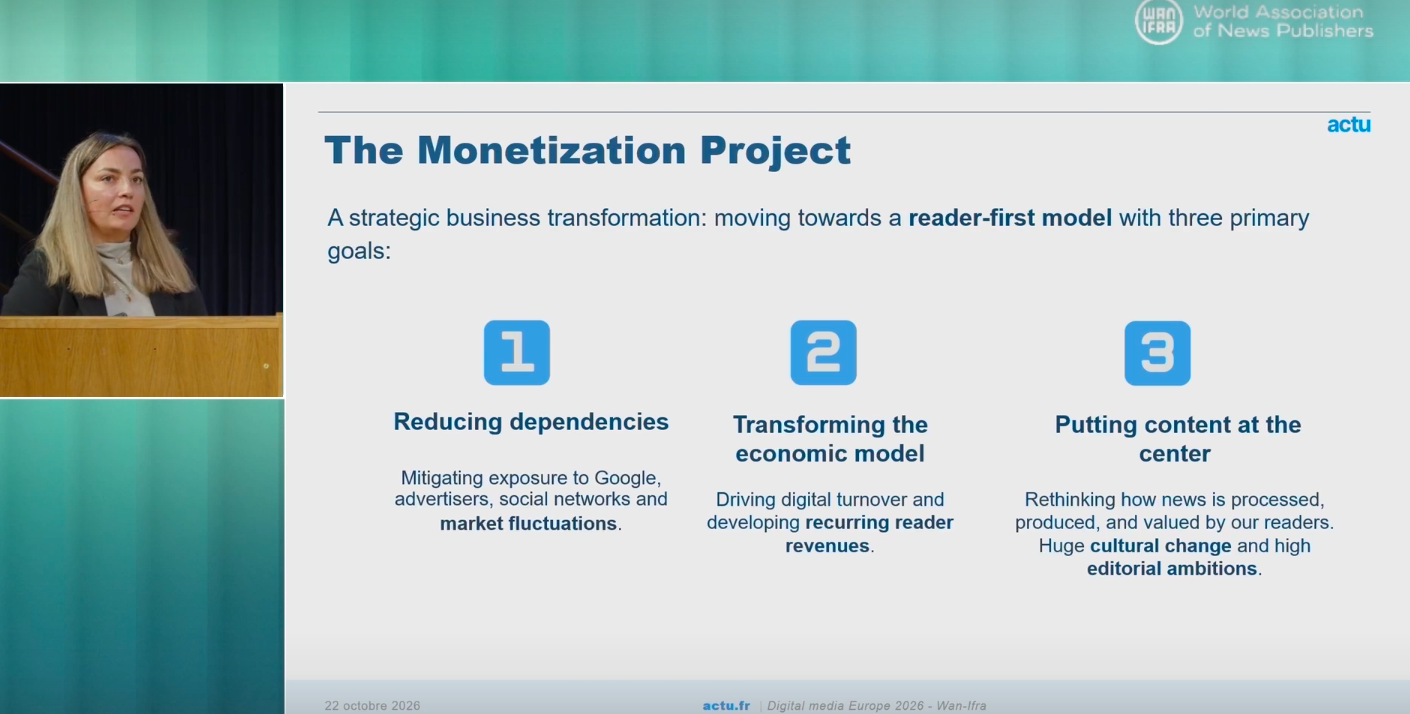
Actu had three major goals as they started the project, Briand said.
- Reduce dependencies
- Transform their economic model
- Put content at the centre
The third goal was the most ambitious of the three, she noted.
The project itself raised many questions and some fears within Actu’s newsrooms. One major concern, Briand said, was “will this monetisation project actually kill the audience?”
They had spent years building up their audiences, and worried the move to charging readers could “just crush everything,” she said.
After all, Actu had spent years giving readers free content online, and now they were going to ask those readers to pay.
Additionally, there was a concern that maybe they were making the move too late. There were already many news sites in France charging for online content while Actu was seen as the free one in the landscape. Could they really put up a paywall now?
Trainings to boost understanding, reader value
Determined to stay the course, the group began training their journalists to help them see the reasonings behind the project and understand the way the subscription funnel works.
These trainings also highlighted the need for journalists to consider how readers determine the value of a story. This was something that Briand said was sometimes at odds with the journalists own beliefs about the value of their work.
Often, she said, the journalists believed the amount of time and effort they spent working on an article determined its value, rather than how useful the content was to readers.
As part of these trainings, Briand and her team gave the newsrooms a framework for writing articles tailored towards paywalls, in part based on the user needs model.
They also stipulated that 30 percent of all content had to be put behind the paywall. Actu decided on 30 percent because they thought it offered a good balance for maintaining advertising value. It would also help ensure that readers would encounter enough paywalled content to get frustrated, and motivate them to subscribe, she said.
However, they left the decisions about exactly what articles to put behind the paywall with the individual newsrooms and their journalists, rather than automating the process.
“We started with La Presse de la Manche, our only daily newspaper, and then after this experiment we rolled it out across all our newsrooms by waves, structured waves. We wouldn’t have all newsrooms altogether, but 10 and then 12 and then 20,” Briand said.
19,000 paying subscribers and growing by 1,500 a month
The efforts paid off: Readers were willing to pay, “and they did right from the beginning,” Briand said.
Actu now has 19,000 subscriptions on the paywall, which is 8,000 net active subscribers to their portfolio, she said.
“For the first time since Covid, our net subscribers became positive again. And also the average revenue per user (ARPU) grew. Thanks to the subscriber conversion to this new digital offer. Currently, we’re creating around 1,500 new subscribers a month.”
These paying digital subscribers have also helped with Actu’s digital revenue share in general, Briand said, adding that today, 35 percent of the group’s total revenue is digital.
They also learned the people who are subscribing are super-consumers, frequently coming to the site three times per day. Furthermore, subscribers also spend much more time per visit on the website than non-subscribers: seven minutes compared with just two minutes for non-subscribers,” she said.
Also interesting for Actu is that nearly 70 percent of the content these logged-in users are consuming is actually free content.
“We were also very interested in what articles were actually going to get us subscriptions, and without many surprises, we learned that practical information, curiosity, emotion were really subscription drivers for us,” Briand said.
Every time an article inspires empathy, or touches people’s daily life, it usually helps in terms of subscriptions, she said.
Next moves: Master engagement, increase ARPU and launch services
Moving forward, Briand said they are shifting their main focus to “mastering engagement” on their website, social media and more. “We also have targets to grow audience, increase the value of each reader, the ARPU.”
More newsroom workshops are also planned. As is deploying a broader brand awareness campaign, she said. They also plan to launch new services “because we know that content is a door to subscription. But we also know that people need services, and another way of getting them engaged and staying with us,” she said.
Asked about their subscription revenue goals by moderator Nic Newman of the Reuters Institute, Briand said they are aiming to increase the current amount by four-fold next year.