Ten Editions of Media Labs Days: A Community Still Asking the Right Questions
Ten editions of Media Labs Days — and counting
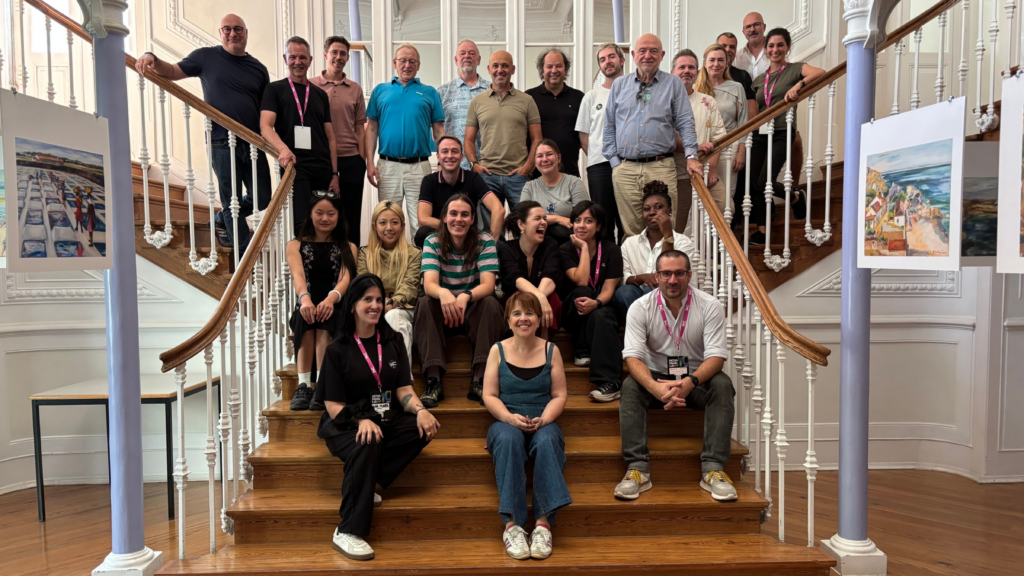
Just like the media labs community gathered for the first time in Bordeaux in September 2017, the group gathered again in Lisbon for the 10th time on 14-15 October 2026. The event was hosted by iNOVA Media Lab in Lisbon who celebrated their own 10 year anniversary.
The format has remained largely unchanged: around 30 people, mostly heads of media labs, R&D leads, applied research academics, startups and representatives of innovation clusters, come together for a day and a half to discuss their work, exchange ideas and compare experiences. More than a conference, this “community event” is an opportunity for people working in different contexts and with different approaches to learn from one another, build partnerships and explore potential collaborations. This year, a recurring question ran through the programme and the discussions: how can experimentation with innovation translate into tangible value for a news media organisation.
As is customary, the programme began with an introduction from the host, iNOVA Media Lab. Its team of around 26 people, including 10 PhD students, works across areas ranging from digital wellbeing and social media to public perceptions of AI and robotics and the challenges facing Portuguese media. It promotes science communication through initiatives such as 90 Seconds of Science, digital educational resources, and the Social Observatory for Artificial Intelligence and Digital Data. It also produces reports and practical guides on AI, journalism, audiovisual production, and the social sciences and humanities, bridging scientific research and public engagement.
Ana Marta M. Flores, iNOVA Media Lab Coordinator: “NOVA Media Lab positions itself at the intersection of research, arts, creativity, and experimentation. It is a university lab, but it tries to explore beyond conventional academic boundaries.”
AI in the newsroom: moving beyond experimentation
Media organisations are experimenting with AI, but where is the real value?
A useful starting point is WAN-IFRA’s new report “Thinking beyond just adoption – the next AI phase for publishers” which was presented during the first morning. The report surveyed 125 publishing executives and presents nine concrete case studies exploring AI-assisted reporting, subscriber discovery, personalised paywalls, content licensing and direct audience relationships, featuring POLITICO, Ippen Digital, UOL, Frankfurter Allgemeine Zeitung, The Hindu, Nikkei, Rappler, Nation Media Group and Daily Mail / DMG Media.
One of the main learnings from the survey is that around 80% of respondents describe their use of AI as emerging or advanced, up from 42% last year. However, 78% of publishers still struggle to show where AI creates added value although on a positive note, this tendency has dropped from 91%. To summarize, it seems AI implementation and use are moving faster than publishers’ ability to measure the resulting value through metrics such as time and cost savings. The survey identified three leading areas where respondents saw AI value and monetization: newsroom operations, product development, and monetization strategies although concerning the latter the percentage had fallen sharply by 20%.
Diving into concrete use cases, at Radio France, for example, their innovation team has a company-wide remit that extends beyond journalism. Its partners can include startups in human resources, production, journalism or other fields. The team’s current focus is on AI applications for editorial content and production. Projects include analysing contributions from a large-scale public consultation ahead of the 2027 French presidential election and recreating the voice of Charles Biétry, a well-known sports journalist who has ALS (amyotrophic lateral sclerosis).
VPRO is a Dutch public broadcaster among 13 organisations coordinated by a central umbrella body. Through a shared innovation agenda, the VPRO Medialab follows an iterative approach: start small, test quickly, prototype, and validate with audiences, journalists, and other users. One example is its work on location-based audio and adaptive storytelling. Using public data, city maps, archival material, and storylines, VPRO developed an audio engine that responds to a listener’s location. The team is now exploring how AI could adapt playback to a listener’s pace, for example, by speeding up or slowing down a story depending on how quickly someone moves or whether they use a wheelchair.
Developed by Luiss Data Lab at Luiss University in Rome, Bodoni is an AI-powered platform designed to help journalists research news, verify information, and combat fake news. It uses AI to summarize and organize news articles, answer questions with source references, map news coverage, analyze datasets, and identify patterns or potential editorial bias. Through a partnership with FIEG, it aims to support around 10,000 journalists across 400 newsrooms, improving research capabilities and journalistic skills.
Another constructive use of AI is to strengthen democracy by helping society navigate online disagreement and disinformation. The EU-funded ANTIGONE project presented in Lisbon by Agence France Presse (AFP), uses AI to analyse narratives, detect AI-generated content, and support the verification of digital information. It develops tools to help journalists, fact-checkers and researchers identify manipulation while preserving freedom of expression. By combining AI with human expertise, it aims to make online information ecosystems more transparent and trustworthy. Ultimately, ANTIGONE shows how AI can serve not to suppress disagreement, but to foster informed debate and more resilient democratic societies.
Beyond the click: can GEO create new revenue for publishers?
In his presentation “Beyond the Click”, Germain Deflandre, founder of MentionLab, explains how Generative Engine Optimization (GEO) could become a new source of revenue for publishers in the AI era. The opportunity is to move beyond selling clicks and page views, and start selling visibility and influence within AI answers. This builds on capabilities publishers already have, editorial expertise, trusted media brands and branded-content studios, while giving advertisers a new way to reach consumers during their research and decision-making process. The key is to sell credible content, measurable visibility and optimisation, not guaranteed AI recommendations or sales. Results depend on how AI systems select and cite sources, and sponsored content must remain clearly labelled and distinct from independent journalism. In short, GEO offers publishers a way to monetise their editorial authority in a world where influence increasingly happens without a click.
Media labs as catalysts for collaboration and change: but how ?
The discussions then turned to the role of media labs within their organisations, starting with fundamental questions: what makes a good lab leader? And why are media labs the right place to start fostering new mindsets, collaboration and ultimately change ?
The panel highlighted the importance of multidisciplinary teams and a working culture that encourages curiosity and experimentation. “The VPRO Medialab team is very diverse and includes technologists, backend and frontend developers, designers, journalists, concept developers, and AI transformation specialists.” said Abel Enklaar, Editor-in-chief, VPRO Medialab.
Another important point touched upon was the need – or danger of – KPI’s in the context of an experimental lab. How do you balance the need for KPI’s with learning and adaptability ? The panel agreed: “KPIs are useful at product and project level. They can assess use, delivery, and time saved. But the lab should not be judged only by a single lab-level KPI because much of its work depends on pivots, new ideas, and strategic exploration.”
They also explored the importance of leadership support, organizational collaboration and clear pathways from experimentation to implementation, while highlighting the need to embrace uncertainty, learn from failure and a mindset open to curiosity, challenge, and cooperation. VPRO include this in the criteria to select their team members while Radio France emphasized curiosity and serendipity: “We run an internal blog open to everyone in the digital department, where staff can share ideas and think about the future as well as current projects.”
What is the real value of a lab ?
Ultimately, the discussion emphasized the role of media labs as catalysts for innovation, helping media organizations adapt to a rapidly changing environment and create lasting impact. But should a lab be accountable for adoption, or does its responsibility end at delivery?
Lina Timm, Managing Director of RND (Redaktions Netzwerk Deutschland) warned that “a lab can become isolated if it is shielded too heavily from the organization. It may accumulate projects it cannot hand over because teams do not want to take ownership of them. The opposite approach is to involve everyone and try to make each person 10% more innovative every day. That is sustainable, but slow.” She added that a lab should sit somewhere between those extremes.
On the question of what constitutes value, Dennis Pregesbauer, Team Lead, Media Innovation Lab at Wiener Zeitung suggested that “A one-off experiment can still produce strategic value if it clarifies what the organization should not become.”
Iniz Becker, Innovation Lead at Radio France: “Whatever happens, learning is never wasted. Accept that not every experiment becomes a product. But every experiment should teach you something. If the product fails but the organisation learns, is that not already a success?“
A media lab’s value cannot always be measured by the number of experiments that reach production. Some projects lead to new products; others help an organisation identify what doesn’t work, where not to invest, or how its strategy needs to change. The challenge is to make that learning useful beyond the lab itself — and to ensure that experimentation remains connected to the needs of the wider organisation.