How Il Post and El Orden Mundial turned an audio habit into a subscription business
By John Rahim
Il Post, an Italian digital-native news site, publishes everything it produces for free and is paid for by 120,000 members. El Orden Mundial, a Madrid-based geopolitics outlet, covers international affairs for Spanish speakers, “the niche in the niche,” and is approaching 10,000 subscribers.
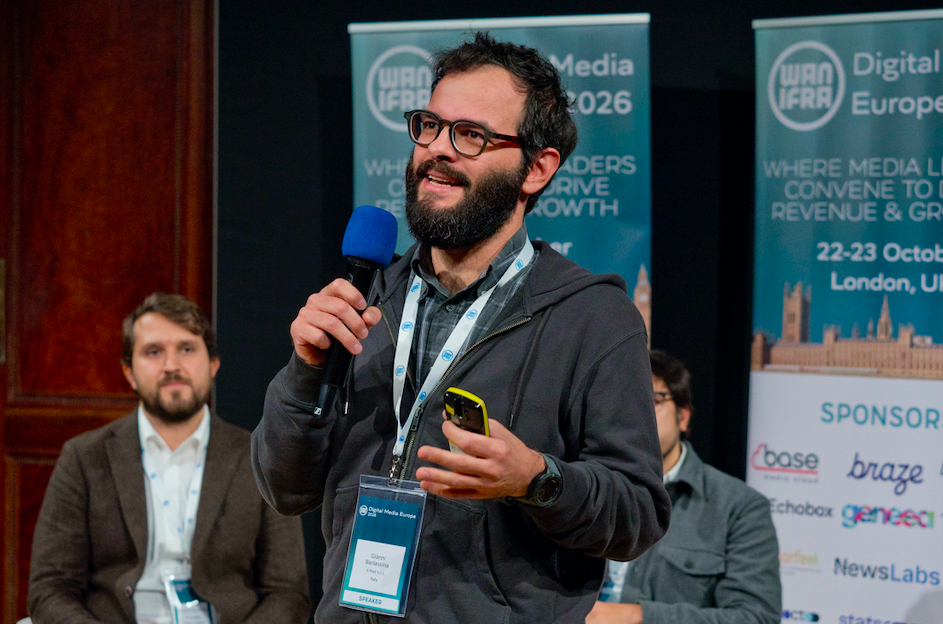
On stage at Digital Media Europe in London last week, moderated by FT Strategies’ Lamberto Lambertini, the two described the same business: a podcast that built the habit, a membership that sells belonging, and the problems that come once both work.
Audio: the product that predicts renewal
Il Post launched in 2010 as an advertising-funded site. General Manager Gianni Barlassina said that by 2019 traffic was still rising but advertising revenue had flatlined.
“We realised our model wouldn’t work anymore. We wouldn’t be able to ever be profitable just running advertising.” Subscriptions were an experiment; 4,000 people signed up in the first month. Seven years on, 78 percent of revenue comes from members paying €9 a month or €90 a year, with no discounts.
The product that drove the growth was Morning, the daily news podcast launched in 2021 by Francesco Costa, now Il Post’s Editor. It was free for its first months, with listeners told from the start that it would move behind the membership. When it did, 70-80 percent of them paid. Il Post now sees a strong correlation between podcast listening and renewal. Most of the money has gone into a newsroom that has grown from nine people to more than 80, almost 60 of them journalists.
El Orden Mundial reached audio by a harder route. Founded by international-relations graduates, it tested its community with a €40,000 crowdfunding campaign in 2018 and grew until 2022, when subscriptions plateaued even as Russia invaded Ukraine. Interviews with current and lapsed subscribers produced two answers, money and time: inflation was squeezing budgets, and readers felt overwhelmed by international news.
“We were too focused on the numbers, on the reach, on the audience, and not on the relationships that you build behind those numbers,” said co-Director Eduardo Saldaña.
The answer was “No es el fin del mundo,” a long-form podcast launched in 2023 after the team studied content creators rather than other publishers. Episodes run two hours or more; September’s 300th episode spent three on Maoism.
“People are not stupid, and they still want to learn,” said Saldaña. Growth since has been the fastest in the company’s history, taking subscriptions close to 10,000 and giving a niche title an audio and video advertising business that competes with Spain’s big groups.
What it costs to sell belonging
Both charge for the relationship.
Il Post members get a quarterly magazine and books delivered to their homes, with member discounts on its live events and online school.
El Orden Mundial goes further. It runs subscriber trips (22 people went to Turkey at about €3,000 a head), filled Madrid’s Palacio de la Prensa with more than 500 members in June, and has bought a city-centre site for a bookshop opening next year, because members wanted somewhere to meet. “Every day we tell them that we won’t be here without them,” said Saldaña (pictured above).
Barlassina was less romantic. With under 10,000 members, Il Post could hold small events and answer every question. At 120,000, the membership no longer looks like the people who run it and addressing it as one person is impossible.
“It’s become very hard to not disappoint someone when you do something with a community.” Events sell out and those who cannot get tickets are angry; bigger venues need tickets and sponsors, which members resent. Two staff moderate the comments daily for a core of several thousand regulars, an investment he called expensive but worth it.
Paid acquisition and a daily podcast: what failed
Asked for failures, Barlassina offered a partnership with a large Italian telecoms company that distributed free-trial codes to reach audiences outside Il Post’s strongholds in northern Italy and the big cities. They built landing pages, campaigns, and onboarding journeys; very few people came.
Il Post has since started paying for digital advertising, so far with the same result.
“You pay a lot of money for very, very little results,” he said. His conclusion, for now, is that journalism cannot be sold by ad campaign. “Maybe I’ll be proven wrong, and hopefully I’ll be proven wrong.”
El Orden Mundial closed a daily podcast last year after 12 months. Audience numbers were good; it could not be monetised, and the short, news-pegged format demanded resources the company lacked. “Leave this to big media that have more resources than us,” Saldaña said.
Print, video and the audience that won’t cross over
Print, by contrast, has worked for both. Il Post’s quarterly, produced with the publisher Iperborea, also sells in bookshops and will soon have a subscription of its own; a line of translated non-fiction followed in 2024.
El Orden Mundial’s maps-and-graphs book sold 28,000 copies last year, and another atlas follows in 2027.
“Digital media becomes legacy. Legacy media becomes digital,” Barlassina said.
Video is less welcome. Spotify, Il Post’s biggest platform, now promotes video over audio, and growing an audience there is much harder than it was three years ago.
“We’re kind of forced to do that. We don’t love it, but we’re going to do it,” Barlassina said; weekly video production starts as an experiment. Saldaña, for whom YouTube opens Latin America and Spanish speakers in the United States, saw no dilemma: “I don’t understand recording podcasts without video.”
Il Post’s harder problem is internal: it has two audiences, one for audio and one for articles, and almost nothing moves people between them.
El Orden Mundial, which watched AI erode its web traffic two years ago, now writes podcast scripts with articles and social clips in mind, and is still changing newsroom habits.
Barlassina expects Il Post’s future to make the brand less central and its journalists more so. That is the creator model Saldaña borrowed, and it depends on platforms neither of them controls.
About the author: John Rahim is the founder of The Media Stack.