Weser-Kurier takes newspaper page production into the browser, automating 80 percent of layouts
Weser-Kurier is a regional daily newspaper in northern Germany, published by Bremer Tageszeitungen AG since 1945. It is published six days a week and has three main editions and eight regional editions, four of which cover individual districts of Bremen. Around 160 people work in its editorial team.
Like many regional newspapers in Germany, Weser-Kurier has seen print circulation decline by around 4-5 percent a year. The decline has not so far been offset by e-paper or online subscriptions, increasing the pressure to make print production more efficient.
About two years ago, the publisher began moving away from InDesign towards a browser-based layout system. But even after that change, much of the page production process remained manual.
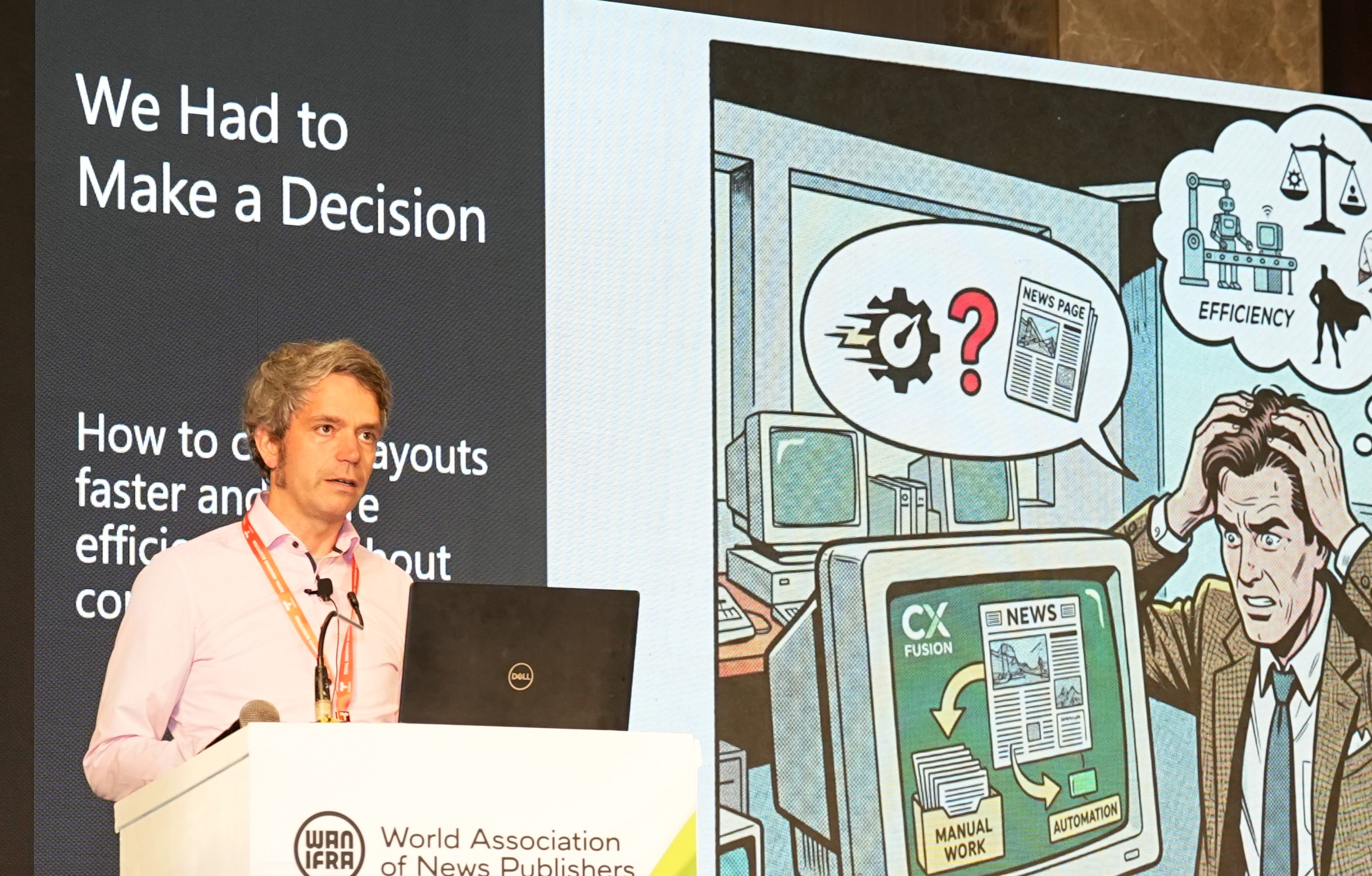
“We asked ourselves how we could automate but without compromising any quality,” said Lasse Bo Timmermann, Head of Editorial Systems Development at Weser-Kurier.
The target was to automate 80 percent of page production. Standard pages would be produced automatically, while more complex pages would continue to be handled manually.
The browser-based layout system, CX Fusion, was implemented from the end of 2023, with the transition taking around a year. Another year was spent implementing the automated workflow developed with technology partner PPI Media, a software specialist for publishing workflows across print, web and mobile.
Today, Weser-Kurier produces an average of 96 pages a day across its editions. Around 80 percent of the pages in its regional and local editions are automated, equivalent to about 54 pages a day.
The change has made page production around 30 percent faster. It has also reduced the time required to onboard new staff by tenfold, Timmermann said.
It was more than a tech project
Weser-Kurier initially expected automation to be a relatively straightforward technology project.
“We just buy a tool and push a button and that’s it; that’s what automation sounds like,” Timmermann said.
In reality, the publisher had to change workflows, structures and agreements across the organisation before many of its processes could be automated.
Its main edition and the regional editions had been using the same templates and systems for years. However, each had developed different ways of working.
“We had to harmonise and streamline all of that before even we could get started,” Timmermann said.
The process also exposed several undocumented practices. Some workflows relied on verbal agreements, while staff had developed manual workarounds over the years. In one case, a simple action involved around 40 clicks, making it impossible to automate without first changing the process.
Advertising also had to be standardised. Weser-Kurier reduced around 250 different ad sizes to 25, requiring the sales department to take part in the project.
The changes were not always easy. Established ways of working had developed over many years, and changing them could be an emotional process, Timmermann said.
The publisher also set a clear condition for the project: automation should not mean a loss of quality or identity. Special formats would remain manual, and readers should not notice a difference in the finished newspaper.
What the system automates
The automated workflow uses a rule-based system to select page templates.
An article with one or two images and citations, for example, can be matched with a set of templates. The system can then combine those templates to reduce white space.
Specific rules can also be applied to individual formats. A column can be assigned a particular template and positioned at the bottom of a page.
The system can technically reach 100 percent automation, but Weser-Kurier has chosen to retain manual production for pages where a specific design is required, particularly special-topic pages.
The pages can still be edited manually when required.
Faster production, easier onboarding
The new workflow has allowed Weser-Kurier to produce pages faster without increasing manpower. Work can be moved between departments, and the publisher is also producing layouts for other publishers as a service.
One of the biggest changes has been the time required to train new employees.
Previously, staff went through a five-day InDesign workshop and could take six to 12 months to master all the details of the system. Today, a new employee can be introduced to the browser-based tool in 30-60 minutes and start working immediately. Within two to three weeks, they can learn the remaining details.
Timmermann said new employees can sometimes work faster than experienced staff because they are less tied to old InDesign habits.
“In InDesign we could do a lot more but it’s not necessary at all; nobody notices the difference,” he said.
Weser-Kurier has also reduced its InDesign licences by around 60-70 percent. The remaining licences are used by the graphics team, while standard editorial work no longer requires them.
A year of feedback and adjustments
The transition initially met with some scepticism among editorial staff, particularly because the new workflow brought earlier deadlines.
Weser-Kurier introduced feedback loops with writing and layout teams and worked closely with PPI Media on the technology. Monthly releases brought improvements and adjustments to the system.
After about a year, the publisher reached the point where it could see the results it had been aiming for.
The original target of 80 percent page automation has now been achieved. Page production is around 30 percent faster, more pages can be produced without additional staff, and there has been no loss of quality, according to Timmermann.
The main lesson is that automation starts with the organisation rather than the technology, he said.
“Automation is always organisational development,” he said. “Simplify first and then automate. You can’t automate what is not simplified and well structured.”
In conversation with Lasse Bo Timmermann
WAN-IFRA: How does the page-production process work today?
Lasse Bo Timmermann: Typically, all the content for tomorrow’s edition is ready by 11 am the day before. About 80 percent of the pages are then laid out automatically, while the remaining 20 percent are still designed manually.
Is CX Fusion integrated with your CMS?
Yes, all data comes from DC-X. CX-Fusion only stores working copies.
What other tools/software are used alongside CX Fusion?
DC-X as our DAM, Gutenberg as our editor, and Eidos (Cobalt) for our online environment.
What has been the biggest benefit of the new workflow?
We can produce pages significantly faster than before, and it now takes only a fraction of the time to onboard new staff.
How much faster is production today?
We can now produce pages 30 percent faster than before, while the time required to onboard new staff has been reduced tenfold.
How did staff respond to the change?
The earlier deadlines were initially met with some scepticism. Ultimately, however, the change was perceived positively because it reduced the pressure towards the end of the day. It took us about a year to introduce the automated layout workflow.
Is 100 percent automation the goal?
Ultimately, 100 percent automation is the goal. However, I think there will always be a certain number of pages where we deliberately want a special, manually designed layout. So from my perspective, 90-95 percent automation is a realistic target.
What surprised you most after CX Fusion went into daily production?
What surprised us most was realising how unstructured some of our workflows had been before and how often small technical issues were compensated for by extra manual work. We were also surprised by how quickly new staff were able to get familiar with both the tool and the new processes in comparison to the staff with us for many years.
What advice would you give another publisher considering a similar move?
I think the most important piece of advice is to really understand and evaluate your existing processes before implementing the tool. It is also essential to have one or more people dedicated to supporting the implementation. In my experience, 80 percent of a project like this is about people and organisational change. The technology is actually the smallest part.