A lens, not a template: How Broadsheet is taking its city-first model global
By Joanna Cummings
Broadsheet began with a frustration. Nick Shelton was living in London after university and found the city exciting, cosmopolitan and buzzing – but difficult to discover.
“You sort of had to know someone who’d been around to find out what to do and where to go,” he says. At the time, the media market was still heavily print-led, with restaurant reviews appearing once a week in weekend newspaper supplements.
“What I craved was a brand online that I could trust, that shared my taste, that could tell me, here are all the places worth knowing about.”
When Shelton returned to Melbourne, he saw a similar gap. The city was going through what he describes as a cultural renaissance, particularly around food and drink, but much of the media remained print-first and review-led.
“What I wanted was, this is worth knowing about, this is worth your time.”
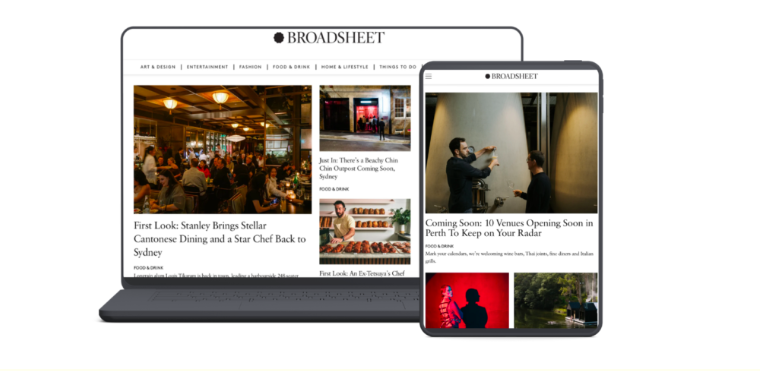
Seventeen years later, Broadsheet is Australia’s largest culture brand and its second-largest independent publisher, covering food and drink, fashion, art, design, entertainment and travel. It has also recently launched in London – its first major international city outside Australia.
“We only write about what we like,” Shelton says. “We’re journalistic. We report on news. We take culture seriously. Just because it’s lifestyle content doesn’t mean it doesn’t deserve real rigour, but at the end of the day, it’s enthusiastic.”
Enthusiasm is part of the premise: “We think this is great, and we think you will too.”
The culturally hungry
Broadsheet’s audience is not defined only by age. Its core is 25 to 45, but Shelton says behaviour is more useful. “It’s people who are culturally hungry and culturally active. The bums on seats in restaurants, they’re booking the theatre tickets, they’re going to the gigs, they’re booking that weekend trip. They’re getting out, and they want to do it well.”
Its mission works on two levels: helping readers live what Shelton calls “a better everyday life,” and contributing to the cities it covers.
“We want our cities to be better places because of our presence,” he says. “We want to be celebrating the things that make our cities great, and therefore have them thrive.”
Broadsheet also sees itself as part of that culture, rather than simply observing it. “We think of ourselves as participants in culture, not just sitting on the outside with a notebook looking in. We want to be a part of it.”
Trust, one recommendation at a time
Broadsheet’s relationship with readers is built through repeated recommendation. Someone tries a restaurant, shop or event because Broadsheet recommends it; if the experience lives up to the promise, they come back.
“You’ve got to make a recommendation, or you’ve got to tell them some information that they then act on, and that they like the outcome of that, and then they come back and do it again,” Shelton says.
That trust now shapes how some people use the brand.
“One of the compliments we get is when people say, all I have to do is read the headline, and then I know if it’s on Broadsheet, I need a lot of it,” he says. “And I always say to them, people worked really hard to produce that article, I’d love you to read it!”
That relationship also supports the commercial model. Partnerships remain the “heart and soul” of the business, alongside subscriptions and other revenue lines. “Media is about putting your brand and connecting it with an audience,” Shelton says. “And anything you put between those two things is the media.”
A lens, not a template
“We don’t want to come to London and apply exactly what we do in Melbourne, or exactly what we do in Sydney,” he says. “It’s a different city.”
Shelton thinks of Broadsheet as a lens. “This is how we think about what we like in a city. This is how we think about what we like in a culture… We love quality, we love authenticity, we love new ideas, we love innovation.”
What that reveals differs by place. “Sydney’s an outdoor city,” he says. London, by contrast, is “a very busy city” and “a very dense city”, with a distinctive pub culture, fashion scene and access to European travel. “What we see through that lens is very different, but the framing and the lens is consistent.”
This time, Broadsheet is also bringing 17 years of experience with it. “When we started in Australia, we were brand new,” Shelton says. “In coming to the UK, we can bring an established model and apply that to a new city.”
The learning can move in both directions: “We can learn so much in the UK and bring that back to Australia.”
The case for print
Broadsheet has always been digital-first, but print remains an important part of the brand. “I’ve always felt that there’s no better way to build a brand in media than through print,” Shelton says.
“So much of media now is disintermediated through an algorithm. Whether it’s the Facebook algorithm, Instagram algorithm, TikTok algorithm, Google algorithm. What you see through Broadsheet is different than what I see through Broadsheet, depending on what their feed looks like and what they’re searching.”
Print gives Broadsheet greater control over how the whole brand is experienced. “What print allows us to do is put out a really considered media product and say, this is what we want it to look and feel like.”
Shelton expects to keep publishing in print “for as long as I can”, and sees a commercially viable role for it alongside other formats. “I think finding a place in the media ecosystem and the medium mix that’s stable and commercially viable, and playing an important role, is very realistic.”
When the walls get higher
The thing that both excites and threatens Shelton most in media right now is distribution.
“All of the platforms that we operate with, whether it’s Meta or TikTok or Google, are tightening the walls in their walled garden,” he says. “Zero-click search in particular is something Broadsheet is “thinking about and taking very seriously.”
“We have to think about where does our audience come from, where do we find new audiences, and where do we share our content to? It forces us to have a one-on-one direct relationship with our audience, which is the best place for us to be.”
AI brings similar tensions. Shelton is frustrated by platforms using copyrighted publisher content for their own economic benefit, but he also sees potential: “We’ve got to recognise the magic of the technology,” he says. “How do we apply that in our business? How do we help people navigate our website and the content that we created?”
Audience first
The media fundamental that matters most, he says, is audience service.
“You have to serve your audience,” Shelton says. “It’s so basic, and it’s so obvious, but I never cease to be surprised by how frequently I encounter a publication or a media outlet, or a team that has lost sight of that.”
Projects, commercial priorities and platform changes can all become distractions. The audience, he says, still has to come first. “At the end of the day, if you’re serving the audience and you’re delivering them value, I think you’ve got a business.”
This article originally appeared on our FIPP website.
For more information about our FIPP World Media Congress, click here.