‘Readers don’t buy subscriptions, they buy for the value’: learnings from Manorama Online
“Like many digital publishers globally, we realised that reader revenue was not just an opportunity but a logical next step in our digital evolution,” says Arun Rahim, Head of Business Development, Manorama Online.
Based in Kerala, India, the parent news publishing house, Malayala Manorama, was founded in 1888, and the newspaper has a daily circulation of approximately 2.3 million. The company produces more than 40 publications, and operates a variety of other media businesses, including a 24-hour news channel, Manorama News, and radio. Manorama Online launched in 1997 and has more than 36 million monthly unique visitors from around the world.
Before 2024, Manorama Online’s business model was largely based on advertising, which continues to be a valuable revenue stream for the company, “but we also thought we need to have alternate revenue streams and something that deepens our relationship with readers,” Rahim told participants at our Digital Media India conference in Delhi recently.
Arun Rahim, Head of Business Development, Manorama Online, on stage at WAN-IFRA’s Digital Media India in Delhi.
A large, loyal audience of heavy users
Rahim noted that when they began considering a paywall, in 2023, a major question for them became whether they could get readers to pay for something they had previously been accessing for free for so long.
To answer this, the Manorama Online team used a variety of digital subscription frameworks and methodologies to assess whether a paywall would work for them, he said.
Among their key findings in this area showed that about half a million readers visit Manorama Online at least 20 days each month, and were also accessing 50+ articles per month.
Realising there was such a large loyal audience already in place was crucial.
“That’s when we thought we should go ahead with this,” Rahim said.
They then needed to decide which paid model to use and settled on the freemium model, which allows users a set number of freely available articles, because it would not interfere with their existing workflows or revenue streams.
Determining a value proposition
WAN-IFRA Members can access Arun Rahim’s presentation slides on our Knowledge Hub.
The next step was creating a different brand, Premium, with its own visual element to represent it, he said.
The Manorama Online team also needed to settle the issue of value proposition, which they decided to base on three key pillars: Content, trust and convenience.
The team was confident about the second pillar, trust, because of the legacy the Manorama brand has built over the last 138 years, Rahim said.
In terms of convenience, they decided to offer paying readers an ad-free experience and seamless access across devices.
But the first of the three pillars, content, proved to be the most difficult, Ramin said. After all, he noted, not every story can be considered to be premium content. Nor does “premium” only mean long-form articles.
“We had to realign our content operations,” he said. “We had to define premium content.”
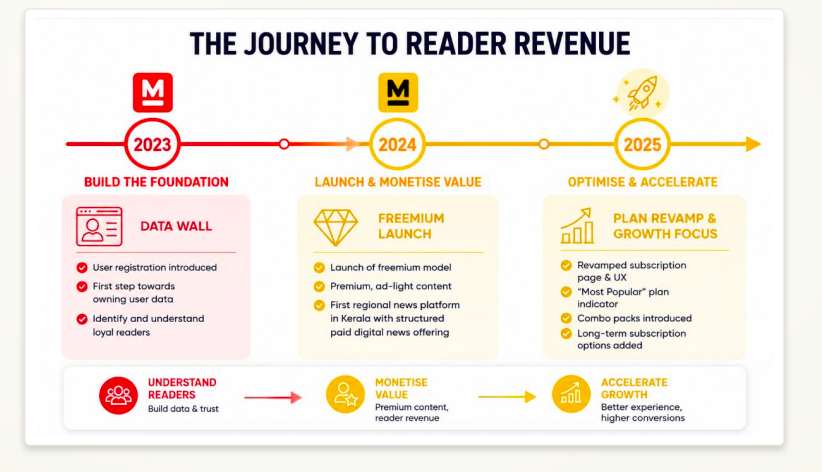
To help them find answers, the Manorama Online team launched a data wall.
“The data wall was a proxy for us to find out what users considered was a valuable story. So it helped us fine-tune, and we started off with some bits and pieces, and we gradually put all articles under the data wall in 2023,” Rahim said.
Launching the paywall and testing pricing strategies
In 2024, they rolled out a paywall, but continued testing a number of different versions of it to determine what would work best for them.
They have also tested a variety of pricing strategies.
Some of these strategies are based on user behaviour, Rahim explained.
“A user who would be coming as a fly-by user would be typically looking at one article, whereas the user who has been on the site for some time would be looking at offers, so the prices you see on this paywall are different. It’s a lower price for a loyal user, and a higher price point for a user who’s a fly-by,” he said.
Likewise, they are watching what other news publishers are doing.
“We’ve seen other publishers and how their pricing works, so we also wanted to try different sorts of pricing. This is an experiment I think we will continue for some more time,” Rahim said.
For example, they have offered bundles with some of Malayala Manorama’s other products, including entertainment offerings, magazines and e-paper.
In testing a range of bundle options, he said, they learned “users get confused when they get a lot of options.”
While they are still in a relatively early stage of having their paywall, Rahim noted that Manorama Online is achieving success on a number of fronts and has learned a number of lessons.
Keep things simple and close to your brand
“In terms of what worked, I think again, simplicity really works,” Rahim said. “The simpler you keep your message, and the closer it is to your brand identity, it works better.”
Likewise, he noted, it has been important to make UX workflows easy to navigate. The fewer steps there are between a user getting the paywall and the payment processing page, the better, Rahim added.
Something else that has worked well is ensuring that Premium readers see plenty of Premium articles.
“It’s important that a user who comes to the site reads what he or she is paying for,” Rahim said. “So, showing them Premium content is very important, and we’ve used our marketing tools specifically to target subscribers so they are able to see Premium content. We also try to gather as much feedback as possible of content of what they’ve actually subscribed for.”
Finding out what users value
For example, one survey found that many users highly value the ad-free experience.
“Regular users, loyal users, really find ad-free as a good experience, so that is something very interesting for us,” Rahim said.
Something else the Manorama Online team has learned is “readers don’t really buy subscriptions, they buy for the value.”
This value is different for different users and it can also be seen at different times of the journey, he said. For some users, the value might be found right away.
For users, the value is different and it’s up to publishers to try and understand what their value will be.
“It could be a bundle that we’re providing them,” Rahim said. “It could just be the content we’re providing them. It could even be the ad-free experience we’re providing for them. It’s up to us to experiment and find that value.”
Ultimately, digital subscriptions and their success is not merely a paywall project, he added.
“It’s a mission that combines efforts from all the teams that work in a digital publishing ecosystem, including your editorial, product, data, marketing and technology teams.”
Their efforts are paying off, and Manorama Online won the Gold medal in WAN-IFRA’s South Asian Digital Media Awards earlier this year for the Premium initiative.