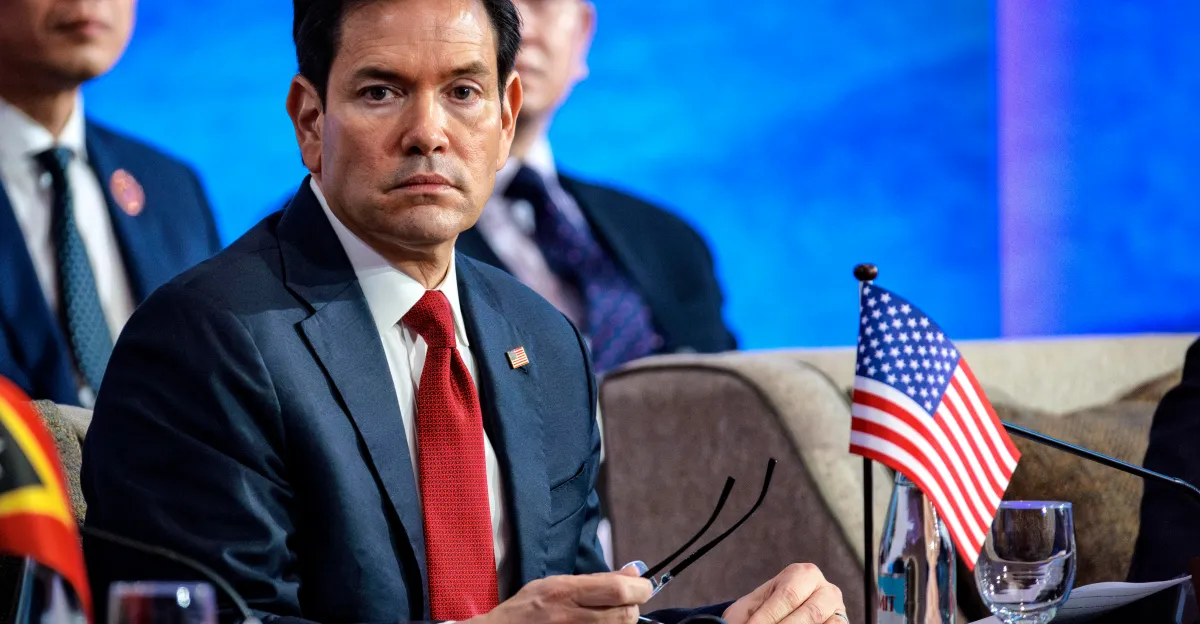
Trump and Rubio declare war on the International Criminal Court: What to know
The International Criminal Court is in the trenches right now.
Last week, its chief prosecutor, Karim Khan, was voted out of his position. In a first-of-its-kind vote, 82 member states decided that he engaged in misconduct and a serious breach of duty. The vote comes after he was accused of sexual misconduct by a female colleague at the ICC, which Khan has denied.
It’s a mess, and it’s hitting the ICC at an inopportune time. On top of this internal turmoil, US Secretary of State Marco Rubio recently launched an all-out attack on the court.
In a Wall Street Journal op-ed earlier this month, Rubio wrote that the Trump administration’s goal is to “dismantle the ICC—brick by brick, if necessary,” citing the possibility that the court could “target” American citizens, such as Border Patrol agents or US soldiers.
The US is not a member of the ICC, and has a history of wariness about the organization.
Beth Van Schaack previously served as the US ambassador-at-large for global criminal justice, a role that led her to work directly with the International Criminal Court. She spoke with Today, Explained co-host Noel King about the decades-long tumultuous relationship between the US and the ICC. And they discuss whether, if the ICC is now weaker than ever, the Trump administration can actually break it for good.
Below is an excerpt of their conversation, edited for length and clarity. There’s much more in the full podcast, so listen to Today, Explained wherever you get podcasts, including Apple Podcasts, Pandora, and Spotify.
If the International Criminal Court is charged with dealing with people who have allegedly done very bad things and then trying them, why is the United States not a member?
The United States signed the treaty in the waning days of the Clinton administration, but never submitted it for ratification to the Senate. And one of the concerns is that the final treaty allows for jurisdiction over individuals who may commit crimes on the territory of state parties. And the United States has always been concerned about that principle because we have troop commitments.
Supporters of the court have always said the United States and its personnel are vulnerable regardless of whether you join. If US personnel are committing crimes on the territory of state parties, which we saw in Afghanistan, the response is to do those cases domestically and there’ll be no occasion for the International Criminal Court to consider those matters.
There’ve been peaks and valleys in the relationship between the ICC and the United States. So we’re in a frankly pretty deep valley right now with this new campaign that Secretary Rubio announced.
But back in the Bush administration, there was also very acute concern and it stemmed from this Afghanistan investigation. The Bush administration and Congress both put in place measures that they thought would be protective of US servicemembers. So that was one valley.
Now what’s interesting is in the second term of the Bush administration, many of these measures were dismantled because the Bush administration realized that the court was doing important work in some areas where it also cared about justice — in particular, Darfur.
Then, the Obama administration announced a reset in its relationship with the court, and that’s where I entered the picture. The Obama administration directed various executive agencies to look for ways to support the court where the work that it was doing was consistent with US policy.
Then, we had the first Trump administration, which reversed course almost immediately and eventually imposed sanctions on senior figures, including the prosecutor herself and one of her key aides.
Then, we get to the Biden-Harris administration. They pulled down those sanctions and again launched a reset of the relationship. At that point, there were a number of situations where the court was working, including following the brutal war of aggression by Russia against Ukraine.
Here we saw a remarkable rise of bipartisan support for the work of the court. You had senior Republican figures in Congress supporting the court. The late Sen. Lindsey Graham (R-SC) led a resolution that was supporting justice in Ukraine. Secretary Rubio, then Sen. Rubio, joined that resolution. There was new legislation passed that made it easier for the United States to support the work of the court.
Of course, with the second Trump administration, we have reversed course again, and in particular with Rubio’s announcement.
Well, let’s talk about the reversal. Secretary of State Marco Rubio is at one point on board with the ICC, and then recently he vows to dismantle it. What happened here?
It’s not clear what the precipitating event is, to be honest. There is no existential threat at present. Obviously, there’s always the concern that this is some kind of a distraction because matters are not going well in Iran and with respect to the economy — that this is something to pull eyeballs away from those matters onto something that he can look tough in. Is this just kind of red meat for anti-multilateralism or is there something that is not made public that is happening?
Is there anything actually that Marco Rubio or anyone else in the United States at the highest level could do to the International Criminal Court to put an end to it?
The International Criminal Court is part of a larger system of the rules-based order that we’ve been trying to build since World War II. Almost all of our friends and allies are members of this court and they care deeply about its success. They are committed to seeing a system of international criminal justice. So, no is the answer. The United States alone cannot dismantle this court.
Now, it can injure the court and it has already done so. There are already eight ICC judges, including judges who hail from some of our closest allies — France, for example — who have been subjected to brutal sanctions. They can’t use credit cards that pass through New York. They can’t make reservations online because of financial sanctions. They can’t travel to the United States because of travel bans, et cetera. The chief prosecutor and two of his two deputies have been sanctioned. Non-governmental organizations that are involved in human rights in Palestine have been sanctioned and a UN figure has been sanctioned. Those measures are already in place.
What his most recent campaign seems to announce is some diplomatic move to try and convince states to leave the court or to cease their cooperation with the court. And we have seen in recent days a couple of states announcing that they were withdrawing. These are mostly states within Africa, but also Venezuela, subject to investigation by the prosecutor’s office. The United States can certainly injure the court, but there’s no way that we could dismantle the court.
Most Americans don’t spend a lot of time thinking about the International Criminal Court, but they may know it because lately, it has gotten a lot of attention that the court has issued an arrest warrant for [Israeli Prime Minister] Benjamin Netanyahu. New York City Mayor Zohran Mamdani has said he would like to see Netanyahu arrested if he comes to New York.
Mamdani has said he does not have that power. He cannot order the NYPD to do it, but he would like for it to happen. What are the chances that Benjamin Netanyahu comes to the United States and is arrested?
Pretty close to zero, if not actually zero. This is a matter of federal law and international law. And the Headquarters Agreement between the United States and the United Nations, which placed the headquarters of the UN in New York, basically gives certain privileges and immunities to individuals who are coming to New York to attend official functions.
New Yorkers are a feisty bunch. So when word is out that Benjamin Netanyahu is in New York, can you imagine the protests that would happen? Can you imagine the embarrassment that he might experience when he’s supposed to be giving his remarks at the General Assembly High-level Week where all the heads of states convene to deal with transnational issues and his motorcade is ensnarled in protests protected by the First Amendment, calling for his arrest for various international crimes? If I were his lawyer, I would say, “There’s no chance you’re going to get arrested.” But honestly, it could be a miserable visit, given all of the strong support for accountability in this matter in the United States.
This is a lot of drama for a body that for a long time seems to have avoided a ton of very public drama. So who gets hurt in all of this? Is it the court? Is it the US and its reputation? Where do you think this leads?
Unfortunately, I think everyone comes out not looking great here. The court needs to put in place measures to be able to receive those complaints by witnesses, whistleblowers, victims themselves, process them quickly, but also fairly to all parties involved. The United States looks terrible as well, launching a campaign like this against an international organization whose mandate it is to deliver justice for the worst crimes known to humankind.