What Newsweek has learned about building deeper brand partnerships
This article is from a series we are publishing in advance of the FIPP World Congress in Madrid, 12-15 October.
By Joanna Cummings
For Kylie McCoy, Vice President, Strategic Marketing at Newsweek, the future of brand partnerships is less about selling ad space and more about understanding what a partner is trying to achieve.
As Newsweek has expanded across rankings, healthcare, events, subscriptions and premium print, McCoy’s own role has broadened too, taking in brand positioning, audience and subscription growth, events, and advertiser-facing marketing.
That evolution, she says, reflects a wider shift in how legacy media brands can work with commercial partners. “In the old model, advertiser marketing largely meant placing a campaign against editorial reach,” says McCoy. “Today, we bring advertisers into entire ecosystems.”
For McCoy, that reinvention is not about adding revenue streams for the sake of it. It is about working out where Newsweek has authority, where audiences are already engaged, and where commercial partners need something more useful than reach alone.
From selling inventory to building solutions
As Newsweek has diversified, the partnerships function has become more consultative and cross-functional. “It’s moved from selling inventory to building solutions,” says McCoy.
That is particularly clear in healthcare, where Newsweek’s work now spans editorial authority, hospital and specialty rankings, events, subscriptions and advertising through Adprime, the healthcare adtech company Newsweek acquired.
A healthcare marketer, McCoy explains, can now engage with different parts of Newsweek’s business rather than buying against a single channel.
“That changes the conversation from ‘what’s your CPM?’ to ‘what outcome are you trying to drive, and which of our assets get you there?’” she says.
A smarter exchange
Health is one of the clearest examples of Newsweek’s diversified model. But for a heritage news brand, building a commercial offering in a sensitive category requires clear boundaries.
McCoy says the starting point is that health is already one of Newsweek’s strongest editorial tentpoles, not a category added only for commercial reasons.
“Our healthcare coverage is led by Alexis Kayser, our Healthcare Editor, whose weekly newsletter has built a deeply engaged audience of industry leaders,” she says. “Our health rankings are a separate editorial pillar with its own rigour. Each of those areas is led by someone who sits in the newsroom.”
Alongside that editorial foundation, Newsweek has a framework for how commercial and editorial teams engage.
“Editorial depth in health tells us where real audience interest and expertise lie, and the commercial conversations we’re having signal where the market is moving,” McCoy says. “That exchange makes both sides smarter.”
But the framework exists to protect the boundary. “The line never blurs,” she says. “Editorial independence is always the top priority.”
Why infrastructure matters
The acquisition of Adprime brought healthcare adtech and data infrastructure in-house, giving Newsweek more control over how it serves healthcare advertisers.
“Owning a healthcare-specific demand-side platform lets us connect editorial authority directly to precision media delivery across web, mobile and CTV,” says McCoy.
The practical value, she says, is that Newsweek can now build campaigns “that start with credible editorial and rankings context” and carry through to “precisely delivered, accountable media,” rather than handing the back half of that journey to a third party.
For publishers considering similar moves, she says the question is not simply whether to build or buy, but whether the capability is central to the business.
“Be honest about whether the capability is core to your future or just adjacent to it,” she says.
The real test is whether the decision deepens a vertical the publisher is genuinely committed to and whether it allows them to offer advertisers something “structurally new, not just incrementally cheaper.”
Newsweek bought rather than built because the infrastructure and team were already mature, and because health was central to the company’s strategy.
“Build-versus-buy is really a focus question,” says McCoy. “The risk in building isn’t cost; it’s diverting attention from what you’re already best at.”
Print as intention, not scale
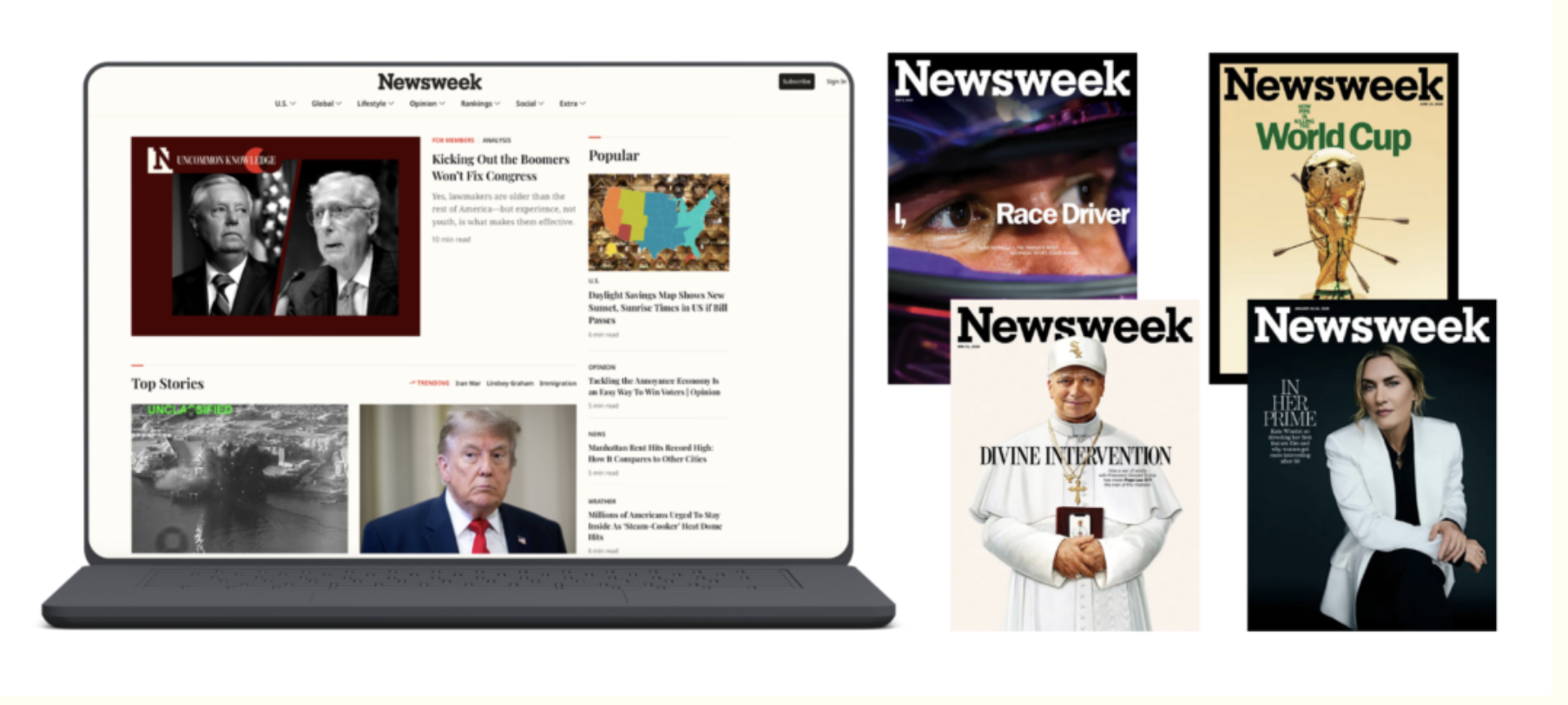
Newsweek’s reinvention has also included a new visual identity and the relaunch of its print edition with a focus on premium storytelling.
For McCoy, that move changes the commercial conversation around print. It is no longer about the old mass-circulation model.
“The mass-circulation model sold scale,” she says. “The premium print model sells intention.”
When print is positioned as a curated, collectible and identity-driven product, it attracts a different type of partner.
“The question is no longer how many people will see this,” McCoy says. “It becomes who is choosing to spend deliberate, undistracted time with this, and what it says about a brand to appear alongside that.”
That shifts the buy closer to luxury or sponsorship than traffic-based advertising.
“The work shifts from volume to alignment, where the brand buys into trust and experience,” she says.
Reinvention beyond traffic
At the FIPP World Media Congress, McCoy will speak about Newsweek’s reinvention as a legacy media brand. The print relaunch is one part of that story, but not the whole story.
“The broader conversation is about how legacy publishers can build more diversified revenue models beyond traffic-based advertising,” she says.
For Newsweek, that includes rankings, events, healthcare, subscriptions, print and advertiser partnerships — not as separate experiments, but as connected parts of a broader strategy.
For other publishers, the takeaway is not that every company should copy Newsweek’s exact model. It is that legacy media brands need to understand what assets and authority they already have, and how those can become more valuable than reach alone.
McCoy hopes to bring a candid practitioner’s perspective to Congress: “I hope to speak openly about what is working, what still falls short, and where the model still raises important questions.”
This article originally appeared on our FIPP Congress website.


