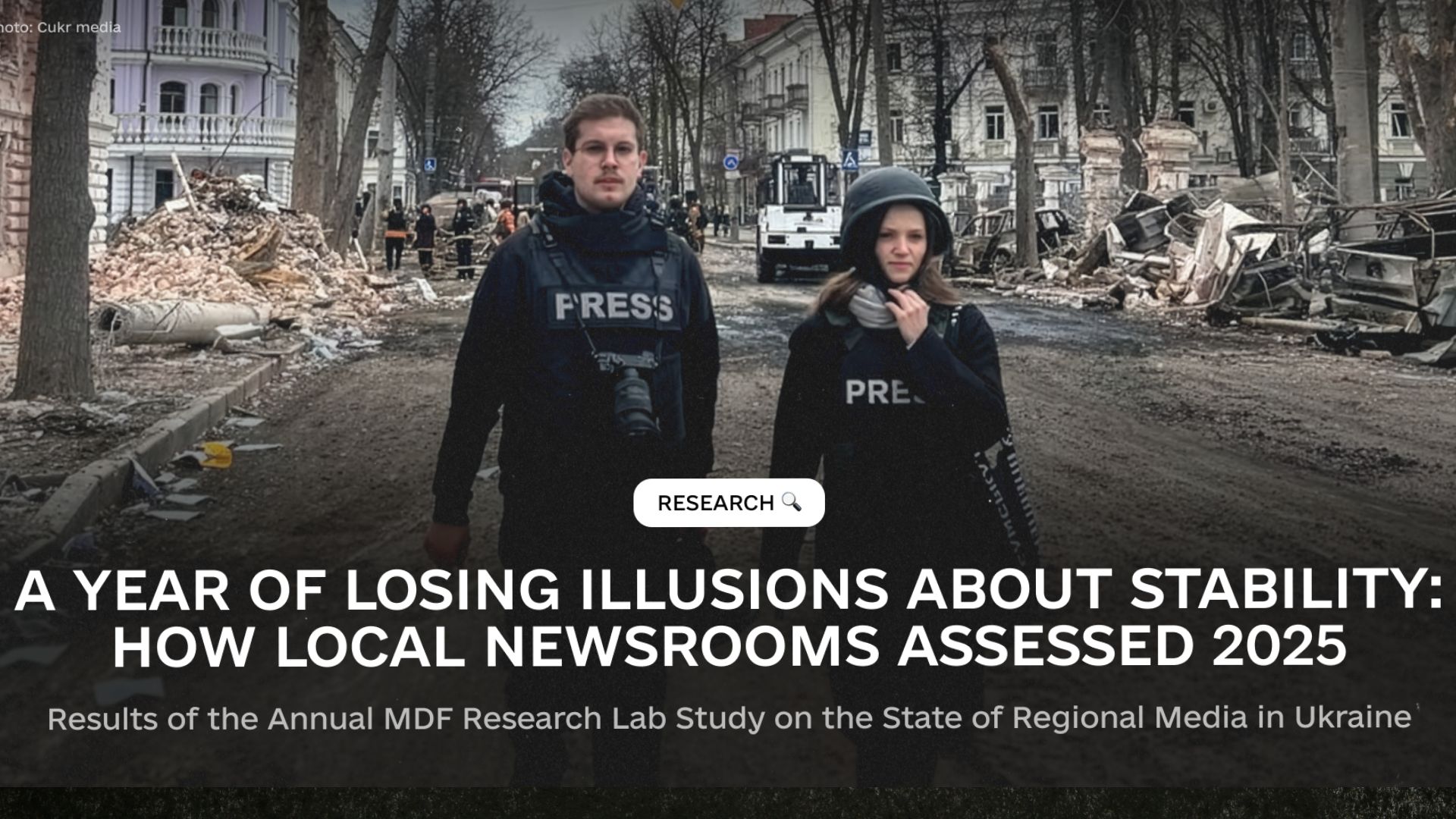
‘Forced maturity’: The year Ukraine’s newsrooms stopped waiting for donor funding to save them
Described as a year of “forced maturity,” 2025 was the hardest year yet for Ukraine’s independent local newsrooms – harder, by their own account, than any point since the full-scale invasion began.
Only 13% of newsrooms surveyed in the Media Development Foundation’s latest sustainability study – Who Will be Reporting the News Tomorrow? – called the year easier or more successful than 2024.
A collapse in US foreign assistance, deepening mobilisation pressure on staff, and sheer accumulated exhaustion combined to push financial sustainability to the top of nearly every newsroom’s list of concerns, cited by 72% of the 61 outlets surveyed.
And yet, the story emerging from this year’s data – and from a companion webinar of media managers and researchers at last week’s launch of the report – is one of resilience and crisis-driven innovation.
Forced reckoning
The suspension of USAID-funded programs in early 2025 landed hardest in Ukraine’s centre, where more than half of surveyed newsrooms described the impact as significant or critical.
Reserve funds tell the same story: the median newsroom holds enough cash to survive roughly one to three months without new funding. None of the 61 surveyed outlets said they could sustain a year of operations from reserves alone – down from 14% who could as recently as 2023.
Yet newsrooms describe this less as collapse than as a forced reckoning. In a discussion of the findings, several managers noted that it took years of relying on the same grant-funding model for outlets to seriously test alternatives.
As one researcher observed, media organisations that once treated grants as their default operating model are now, out of necessity, building something more resilient – even as that transition remains difficult, unstable and far from complete.
Building community as a business function
Perhaps the clearest sign of this shift is the rise of audience communities. In 2024, membership programs and organised supporter communities were still a rarity among regional outlets. By 2025, 34% of newsrooms had launched one, another 23% were mid-launch, and a further 23% were actively planning one – leaving only a tiny fraction with no plans at all.
The newsrooms getting real traction share a recognisable pattern: a dedicated community manager rather than a CEO juggling the role alongside everything else; upfront research into why audiences actually choose to support independent media; proper CRM and payment infrastructure, and a genuine marketing strategy with a budget behind it — not just a donation button bolted onto a website.
The challenge, of course, is finding the funding to support these operations. Regional newsrooms currently spend, on average, only 4-6% of their budgets on marketing – resulting in most reaching a plateau after their first 20 to 50 supporters.
That said, momentum is noticeable: Newsrooms overall reported that community and membership programs were among the most significant new revenue sources to emerge in 2025 – ahead of advertising sales and platform monetisation.
It’s also worth noting that advertising is showing hard-won, modest gains: Over half of surveyed outlets still grew their advertising revenue year-on-year.
Innovation under fire, literally
Newsrooms in frontline regions have restructured entire operating models around blackouts, shelling, and evacuation planning – relocating servers abroad, equipping staff homes with backup power, and building “editorial house” concepts where teams can retreat to work safely.
Meanwhile, digital teams are being rebuilt from the ground up: several outlets have created dedicated “digital journalist” roles distinct from web writers, reflecting a broader shift where content is now created social-first – filmed for Instagram or TikTok and adapted into web articles, rather than the reverse. One regional editor noted the risk this creates as well: fast-moving aggregator channels that repost original local reporting without producing anything themselves, quietly siphoning off the reach that newsrooms worked to build.
Rethinking what ‘diversification’ even means
In practice, “revenue diversification” has narrowed to a choice between two options: advertising or membership. But the underlying opportunity is much broader, as an editor from a frontline Sumy outlet explained: regional media have barely begun exploring merchandise, paid events, owning physical space, or selling editorial expertise and research capacity to local businesses, and evolving the sector’s sense of what’s fundable.
For now, grant funding will remain the largest single revenue source for the vast majority of newsrooms in 2026, and few believe that will change quickly. Staff shortages – particularly in sales, SEO, and social media roles – continue to constrain exactly the functions needed to build alternative revenue.
But the direction of travel is clear enough. Facing the toughest year in the study’s history, Ukraine’s regional media is building community infrastructure, restructured for a social-first internet, and is rethinking – however incompletely – what commercial sustainability could look like.
Also See: