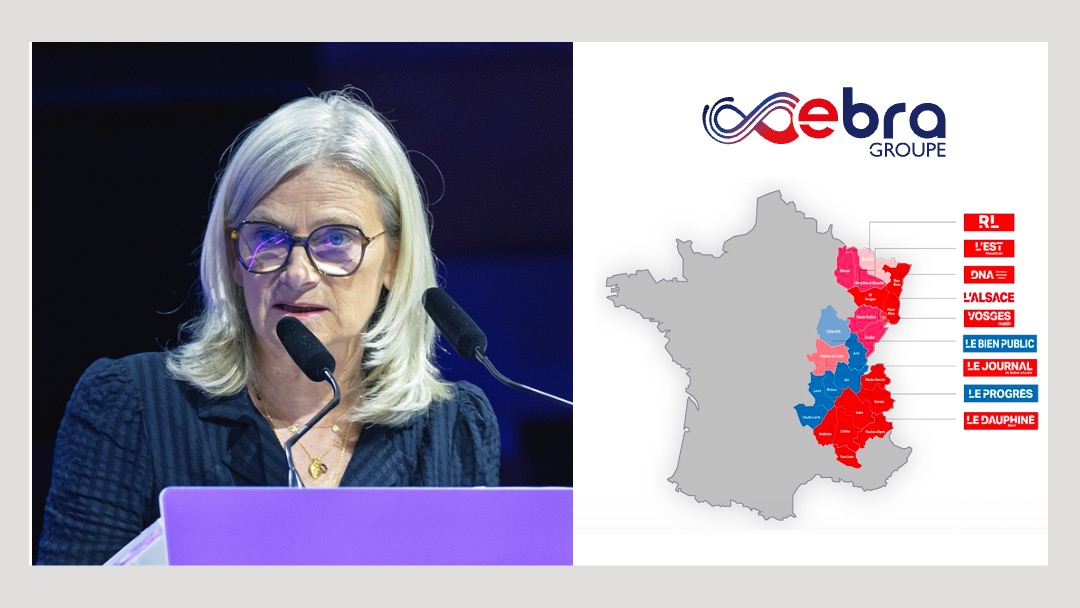
EBRA Group’s transformation plan: focus on local presence and invest in people
The EBRA Group is in the process of refining its roadmap for a multi-year transformation, according to Sophie Gourmelen, who started her tenure as the group’s president in 2025. During her presentation at our World News Media Congress in Marseille, she shared the key principles that will guide this process.
EBRA Group is France’s leading regional newspaper publisher with nine regional newspapers in Eastern and South Eastern France. Its titles reach a quarter of the country’s population, Gourmelen said.
Still a mostly print-based organisation, 800,000 copies of the group’s newspapers are sold every day. Overall, they have 500,000 subscribers, 100,000 of whom are digital. The group employs 3,100 people, of which 1,300 journalists.
“One of our priorities […] will be to rebalance the business model from print to digital,” Gourmelen said.
“We are actively transforming our business model, and we try to build new growth engines.”
For example, the group’s nine newspaper titles still represent 88% of its business, but the company is investing in new digital media outlets, mostly focused on tech, through its Humanoid subsidiary, while also growing its events business and strengthening its ad agency.
Key challenges for local press
As a major regional news publisher in France, EBRA Group is heavily affected by the challenges facing the local press more broadly.
With fewer people willing to pay for news and advertising revenue continuing to go mainly to digital platforms, the business model for local journalism faces significant structural challenges. Moreover, maintaining local newsrooms and paying for the printing and distribution networks is further weighing down the local press.
But there are advantages as well. For example, compared to national titles, the local press enjoys a relatively high level of public trust, thanks to local presence of journalists and their proximity to the covered communities, Gourmelen said.
Publishers like EBRA Group need to navigate the “paradox” of local journalism, she said: “Society needs it more than ever, while the economic model that supports it is becoming increasingly fragile.”
Building blocks of a five-year plan
To tackle this challenge, EBRA Group is developing a five-year strategic plan. Its foundations are a strong editorial vision, defined business objectives, a roadmap for digital transformation, and clear investment priorities.
“In the changing media environment, even if you can’t forecast what’s going to happen in the next five years, it’s very important to have a clear long-term vision, to have disciplined execution, which I think is as important as the vision,” while also adapting quickly when circumstances change, Gourmelen said.
The goal is to emerge as a stronger, more modern organisation, fully adapted to the digital environment and able to reach new generations of audiences.
“The future of regional media is not about choosing between the tradition and the innovation. It’s about combining the strengths – trust, proximity and journalism – with the capacity that we have to succeed in the digital world,” she said.
“Our goal is to ensure that the next generation discovers EBRA first on the smartphone and not just on the newspaper, while trusting us for the same reasons their parents trust us in the print.”
Realigning its business model, the company will pursue sustainable growth from several areas while also maximising the long-term profitability of the print business.
On digital, the goal is to strengthen the value of the digital subscription offering while also engaging new, younger audiences. A revised social media and video strategy is an essential part of this. The company is also developing new long-form storytelling formats including video, podcasts and newsletters.
In addition, the group will double down on diversification, technology and events as new drivers of growth, Gourmelen said.
Underlining all this is an investment in high-value editorial content, based on strong local presence of journalists, who aim to identify emerging local issues and grassroots stories and “bring them to light and create national trends,” she said.
The local/centralised conundrum
Another key challenge for EBRA Group is to find a balance between the efficiencies that come from centralisation while also allowing its local titles to have sufficient autonomy and keep them firmly rooted in their communities.
Gourmelen said that the goal is not to “standardise” the different newspapers but rather preserve what makes each title unique and trusted in its region. To that end, all operations that have close links with the regions – editorial, relations with advertisers, communication – are handled at a local level.
But certain areas are centralised “to increase efficiency and accelerate the transformation,” she said. These include an editorial team that covers national and international news for the nine titles, as well as a shared tech and digital platform.
Gourmelen concluded by underlining the need to invest in people as a driver of the group’s transformation strategy.
Developing new digital skills that support newsroom development is essential, as is attracting and retaining talent and encouraging innovation internally.
“At EBRA we believe that transformation is not only about technology, but it’s also about people,” she said.
To that end, the publisher has created its own training organisation “EBRA Academy” that further supports the continuous development of its employees while also offering media literacy education at schools and journalism training.
Nearly 600 employees are trained every year, with the focus on new digital competencies, including AI, as well as leadership skills.
“We believe that the future of media is shaped by technology, of course, but will be determined by people. So investing in skills, talent and education is one of our most important strategic priorities,” Gourmelen said.