Signature journalism, strong brands, higher customer value: Mediahuis’s playbook for growth
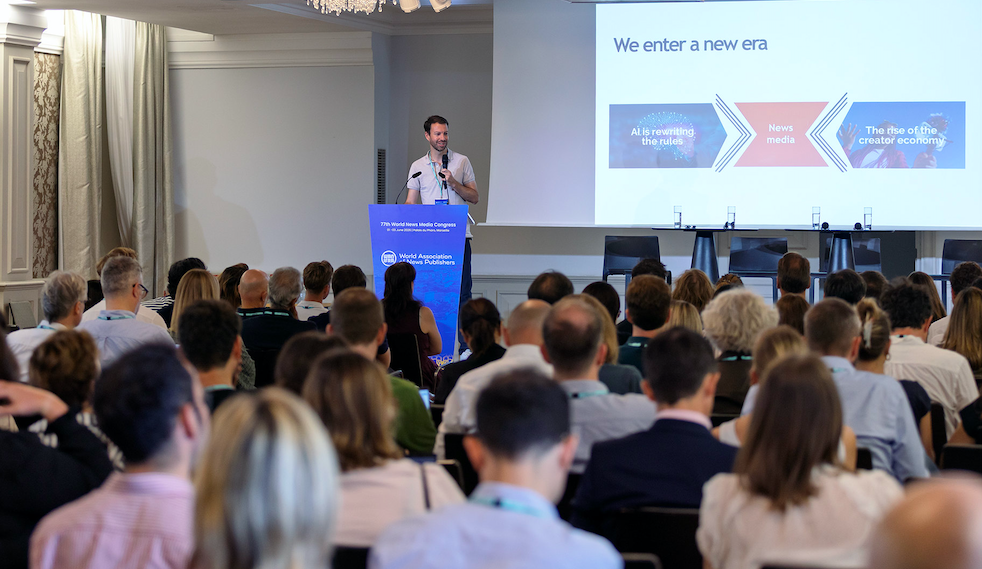
“We are focusing on signature journalism. We are focusing on our brands. We are focusing on customer value. And that’s how we think we can build a sustainable business model in this new era where AI and creators are reshaping the media industry,” Matthijs van de Peppel, of Mediahuis, Netherlands, told World News Media Congress participants recently in Marseille.
Mediahuis is using these three key pillars (signature journalism, brands and customer value) as the basis for their overall strategy going forward, van de Peppel said.
WAN-IFRA Members can watch the video of Matthijs van de Peppel’s presentation, and download his presentation slides on our Knowledge Hub.
“To build a sustainable business model, we projected where we have to go,” he said. “We know where we have to go in digital subscriptions, we made our projections until 2030 to build that digital sustainable model for our journalism.”
Taking action to boost sluggish digital growth
Overall, Mediahuis is doing quite well, van de Peppel said. Even in print.
“Print is keeping up better than expected, like I think in many markets, but also for us. But digital growth is challenging: It’s not growing fast enough, especially in the past couple of months. Probably also because of the market situation, and the situation in the world,” he said.
Average Revenue Per User (ARPU) is a key metric for most publishers today, and van de Peppel said Mediahuis has managed to increase ARPU for print while also doing fairly well for digital. “Those factors together should build this sustainable model for the future,” he said.
However, “we are entering a new era and things get uncertain,” he added.
For news publishers, this era is being defined by two seismic shifts: AI is rewriting the rules of nearly everything, and the creator economy has been rising rapidly.
“That’s a challenging situation for us: News media are under pressure of those two forces,” van de Peppel said.
In response to these developments, he said Mediahuis decided to look at a couple of key questions: “What’s the core of what we are? and What’s the core of where we can make a difference?”
What signature journalism means
From there, Mediahuis developed the three-pillared plan to build on their core, traditional strengths: Signature journalism; their brands and customer value.
Van de Peppel offered some specific examples of how they are working on each of them.
For instance, with signature journalism, he noted there have been recent estimates that within the next decade only a tiny percentage of content will actually be created by humans.
“All the other content will be generated by AI. That feels like a challenge, but it will also be an opportunity because we are human, and we are the humans generating journalism. So signature journalism, first of all, is human. It’s made by humans and for humans,” he said.
This also means in-depth journalism, van de Peppel noted, not something like article summaries, which AI can already do and do well. “Really making the human connection to audiences and to other people, that’s something special. And AI can’t do that,” he added.
“Signature journalism is also close to the brand identity,” he said, adding that it is also something unique for each brand, and that one of his colleagues is currently travelling from newsroom to newsroom within Mediahuis to guide each of them through “signature weeks,” to find what the signature journalism is for that particular brand.
“And, of course, it’s not only text anymore, it’s also audio, it’s also video,” he added.
During these sessions, there are also discussions around whether the individual brand’s best signature journalism is actually working, as well as looking at what needs to be changed.
“This is how we find where we are really distinctive,” van de Peppel said.
Building on trusted brands
“Our brands are what we are, and also reflecting our journalism,” he said.
In the past, Mediahuis could count on the kitchen table within a family’s home to spread their brands. Content could be read and shared among generations.
Today, this has been replaced by social media and podcasts.
“That’s the place where we have to build the new relationships with our new audiences because those are the new kitchen tables. That’s where our content lives. That’s where we have to be present,” van de Peppel said.
“For a long time, it felt like branding was one of the capabilities of fast moving consumer goods. They did branding. We did some kind of content promotion, maybe. And we did a campaign once a year,” he said.
Today, publishers must do far more: “We have to invest in branding because it’s the one thing that makes us distinctive also in this very crowded space,” he added.
Adding products and services to boost customer value for subscribers
For the third pillar, customer value, van de Peppel said Mediahuis, like other legacy publishers, has something valuable.
“We have a relationship with our customers that goes back not for 10 seconds but for 10 years or 20 years, 30 years, and we can build on that relationship. We can increase the value. It’s something special. Creators don’t have that. AI agents definitely don’t have it,” he said.
Mediahuis is aiming to leverage that relationship and has developed a framework “to build the essential subscription into a unique integrated experience for our subscribers, increasing the value for our subscriptions,” he said.
“It starts, again, with signature journalism – that’s the core to the whole,” van de Peppel said.
For example, he said, “we also offer service journalism, guiding people through life – not only informing but also guiding.” This could be helping them to understand how to invest in solar panels, or to sleep better, he said.
While Mediahuis has been doing this for some time, they are now connecting services to subscription offers.
“We are building new services, subscriptions on top of our core subscription, to increase the value and to enable people to do something with the content they consume,” he said.
For example, NRC, one of Mediahuis’s premium brands in the Netherlands, has added bundle offers to other premium brands, including The New York Times and The Economist.
In another example, with one of their regional Belgium titles, they’ve bought an established hiking and biking app called “Route You” because those activities are very popular in that region.
Van de Peppel said the app offers a direct connection with the editorial content. Users can read something about a hiking or biking trail and then use the app to help them get there and experience it for themselves.
They are also doing things like connecting downloadable ebooks to titles and making those a part of subscriber packages.
Subscribers can download one book each month and read it on their own device.
Early results show a strong correlation between added benefits and lower churn
While acknowledging it is still early days, van de Peppel did share some early results.
“At least 30 percent of subscribers downloaded at least one book. We are a bit higher at this moment, even. Eighty-six percent of those people say it adds value to their subscription,” he said.
Furthermore, he said that among those who download an ebook they are seeing more than 50 percent lower churn.
“Of course this is always a chicken-and-egg question, but the correlation is very, very strong with the lower churn,” van de Peppel said.
Video: Highlights from the World News Media Congress 2026