CEO Insider: The human in the loop – the human above it
This is the seventh of seven lessons from Ladina that we are publishing each day leading up to our World News Media Congress. Her first six covered:
Lesson #1 Building products is trivial. Running them isn’t.
Lesson #2 The living policy. Why AI guidelines are never finished.
Lesson #3 Forget the AI mandate. Start with the Time Wasters.
Lesson #4 Don’t convert the resistors. Reward the curious.
Lesson #5 Don’t wait for the experts. Grow your champions.
Lesson #6 Showcases light the way. Processes win the race.
By Ladina Heimgartner
President of WAN-IFRA and CEO Ringier Media Switzerland
The numbers are sobering. Recent studies suggest that nearly three quarters of newly published web pages now contain AI-generated content in some form, and on YouTube, between a fifth and a third of the feed is estimated to be low-quality AI material (slop). The exact figures vary by methodology, but the direction is clear: synthetic content is no longer the exception. We can no longer reliably tell the difference between real and fake with our own eyes.
This puts the media industry in a position that is both new and very old. We were always the stewards of trust – of facts, of verification, of judgment. For a while, in the rush of platform distribution and algorithmic reach, we forgot that. Now scarcity is shifting back in our direction, but only if we understand what it actually demands of us.
The personalities working in our newsrooms have become more important than ever, but the rules around them have changed. You can no longer just write under a masthead and trust the brand to do the work. You need to be willing to show your face, to put your name on platforms beyond your own, to expose yourself in ways that traditional journalism rarely required. People will trust brands, yes – but they will also, increasingly, trust people.
It also means we need to think differently about creators. Internal ones, external ones, partnerships across both. They don’t need our infrastructure anymore – they can earn a living on global platforms without us. What we can offer them is something different: a trustworthy brand, consistent reach, stability, a long-term partner that doesn’t disappear when the algorithm changes. But we need to make that offer real, with concepts and incentives behind it, or we’ll lose them to platforms that compete on terms we can’t match.
The second shift is more conceptual, and it’s the one I find genuinely exciting.
Intentionality requires us to act now
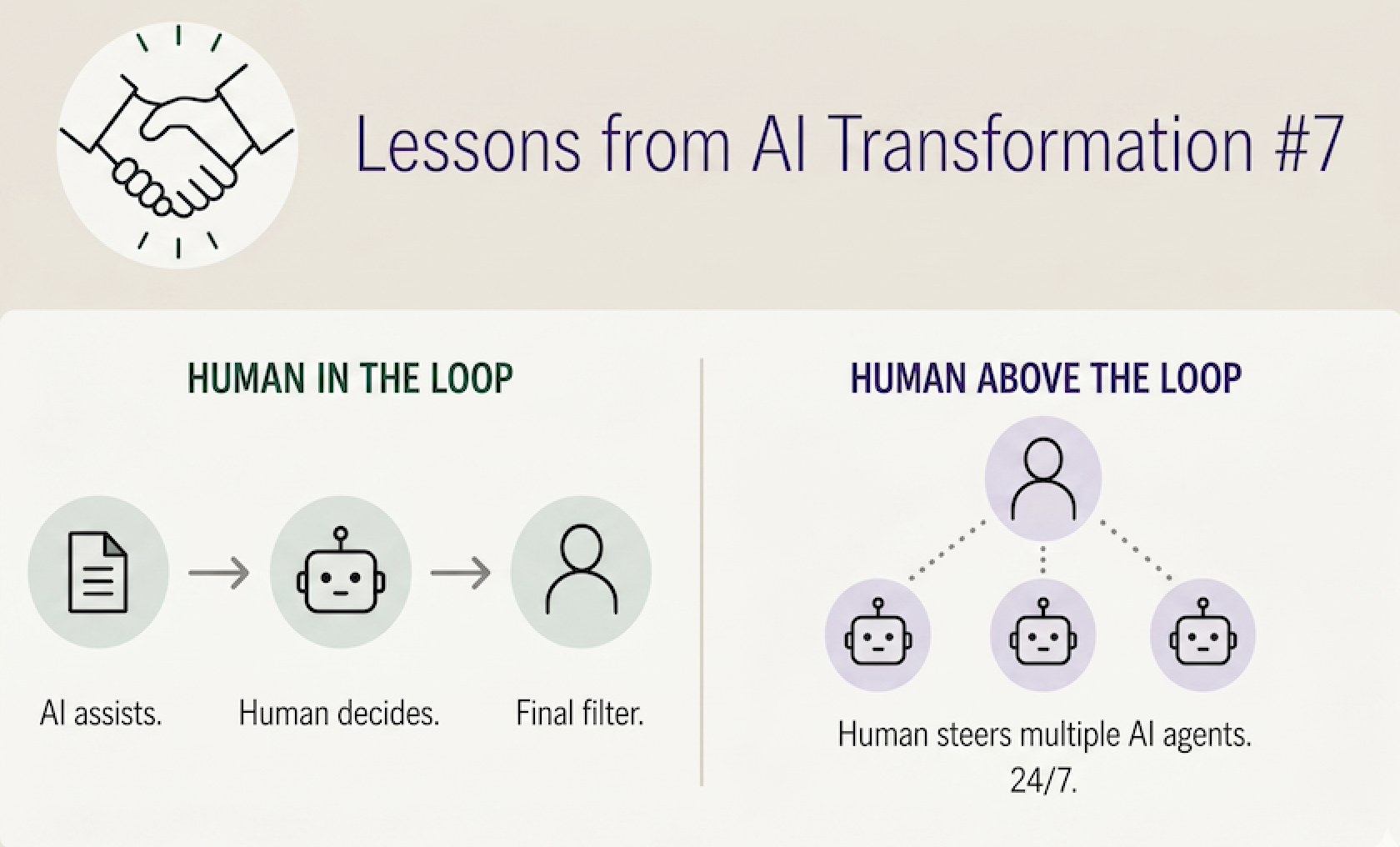
Right now we talk about humans in the loop – the idea that AI assists with content creation, translation, research, sharpening, but human judgment remains the final filter before publication. That model is still right, and it will remain right for a long time.
But a second model is emerging: the human above the loop. In other industries this is already reality. In ours, it’s the beginning. You will increasingly have editors, or whatever we end up calling these roles, who don’t sit inside a workflow but above it, steering several AI agents working in parallel, 24 hours a day, on different parts of a story or a publication.
This requires a kind of leadership that doesn’t really exist yet. Leading humans is one thing, leading agents another. Leading both at once, holding standards across both, being a steward of trust while orchestrating machines – that’s a job description we’re only beginning to write.
Here’s why I end on an optimistic note. Compared to many other industries, ours is unusually likely to remain one where humans play a central, irreplaceable role. Trust is fundamentally a human relationship. Judgment is fundamentally a human capacity. Personality, voice, presence – these don’t transfer to machines, no matter how good the machines get. Unlike other industries – we can be intentional.
But intentionality requires us to act now. Skill ourselves up, learn quickly and share what works and what doesn’t.
That’s why I’ve written this series. Six chapters of work-in-progress thinking from inside one company in one country. Not everything has been successful or polished over the years, but it’s all based on real experience. We’ll get further as an industry if we learn from each other rather than repeating each other’s mistakes alone.
Thank you for reading along. The series pauses here, but the work doesn’t. I’d genuinely like to hear what you’re seeing in your own organisations – what’s working, what isn’t, where the human-above-the-loop question is showing up first. The next chapter, we write together.
WAN-IFRA is working on a report about how publishers are responding to the impact of AI Search and bot traffic. We would be thrilled to have your perspective. TAKE OUR SURVEY: in English, German, French, Spanish.