Comparing hiring software engineers vs using an FDE service | by Hamnaghufran | May, 2026
14 min read
·
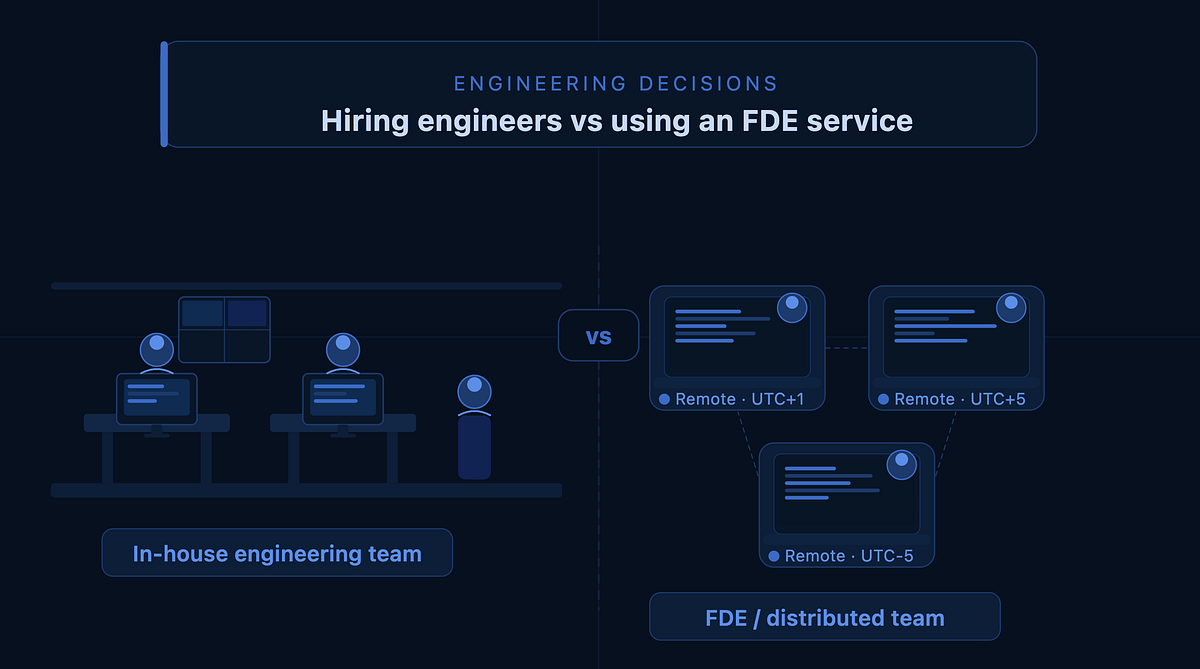
22 hours agoPress enter or click to view image in full sizeHiring software engineers vs using an FDE service
When you’re building serious software, the decision is rarely about whether talent exists. It is about how you structure access to that talent.
Hiring full-time software engineers has long been the default path. It gives you dedicated ownership, deeper institutional knowledge and long-term product alignment. Over time, an internal team can evolve with the architecture, shape engineering culture and become a core competitive advantage. But that model also comes with significant commitments: recruiting cycles, onboarding time, fixed payroll costs and the reality that capacity is either underutilized or overstretched depending on the quarter.
In the U.S. today, a fully loaded senior software engineer after salary can cost a company 40–70 percent more than the base salary alone, often exceeding $250,000 / year for experienced roles. This includes extended hiring cycles (often 3–6 months), where companies lose productivity and opportunity while a role remains unfilled.
An FDE (Fractional Development Engineering) service introduces a different operating model. Instead of building permanent capacity, you access senior-level engineering expertise on demand. The focus is on targeted execution, faster ramp-up and flexibility. You engage specialized talent for specific product milestones, architectural shifts, scaling challenges, or time-sensitive launches without expanding headcount.
At a high level, this comparison is not simply hiring versus outsourcing. It is a structural decision about how you allocate engineering capacity, manage risk and maintain velocity. One approach builds long-term internal muscle. The other optimizes for capital efficiency and precision deployment. The right choice depends less on ideology and more on your product stage, roadmap volatility and appetite for operational overhead.
In this article, I’ll break down the tradeoffs between hiring software engineers and using an FDE service, so you can evaluate which model aligns best with your current growth phase and long-term product strategy.
The “hire-first” bias: Why the old playbook is breaking?
Before we jump into why, I want you to just let go of the assumption that hiring is the best option. Only then can you make the right decision, which could be either. But for now, just look at things objectively.
Why technical organizations default to hiring?
For the better part of two decades, hiring engineers internally has been the safest strategic move. Companies needed a stable technical stack to build web platforms, mobile applications and SaaS products and hiring software engineers does exactly that.
That way, once the engineering team understands the architecture, they can refine it and scale it for years. On top of that, the employees remain aligned with your company’s culture, roadmap and internal politics.
Even from a capital perspective, fixed headcount can appear cheaper than ongoing service engagements. It’s because you know the exact salaries and the employees are right in front of your eyes.
However, with AI tools on the rise, things are not the same anymore.
Talent scarcity has intensified
There’s now a high demand for AI-capable engineers. In fact, according to the U.S. Bureau of Labor Statistics, software developer roles are expected to grow 25 percent from 2022 to 2032. We’re already experiencing the surge.
In the last few years alone, FDE roles in AI-first companies have seen growth of up to 800 percent.This shows the rising demand for engineers who can operate inside client environments and deploy production systems quickly.
Even the difference in compensation reflects this imbalance. Senior AI and machine learning engineers are being offered base salaries of over $160,000 to $200,000 in major markets. And this does not include the bonuses.
Scarcity alone isn’t enough to change your mind from in-house hiring. However, it’s definitely a stepping stone.
AI expertise obsolescence is faster than traditional stacks
The best part about software development was that if someone had en expertise in a particular domain, it remained relevant for several years.
Not anymore.
AI tooling evolves on a much faster cycle. This is why when you hire an engineer with a strong AI exposure, you might have to retrain him or her within twelve months due to changing patterns.
This will also increase the overhead cost if the employee does not get continuous exposure to multiple production departments. So, if your in-house team comes up with a product, it might not be relevant in the next 6 months.
Production AI systems are multidisciplinary by default
To ship AI-powered software to production, you need more than the application code.
You need coordinated expertise in all of the departments, including:
- Application engineering
- DevOps and CI/CD infrastructure
- Security hardening and data protection
- Compliance oversight, particularly in regulated industries
- Integration architecture for legacy systems
- Monitoring and observability to track model performance and drift
As you know, AI systems often process sensitive data, which increases the exposure surface. Due to that, security and governance become non-optional for deployment.
Even Deloitte found that 79 percent of executives cited integration with existing systems as a top challenge when deploying AI initiatives. This integration friction alone can stall production timelines even when models perform well.
And I think you understand that one person alone cannot do all these tasks. You can try hiring a couple of engineers, but that would still leave gaps. So, if you want the best results, you require multidisciplinary coverage from day one.
Workload inconsistency creates a fixed-cost mismatch
Most mid-market organizations do not ship a continuous stream of AI products every quarter. Instead, they launch one or two significant initiatives every year based on their strategic priorities.
Just imagine having in-house software engineers where you’re paying them all year long only to come up with a viable product once or twice. Doesn’t that make FDE service a far better choice?
Additionally, the U.S. Bureau of Labor Statistics reports median tenure for workers aged 25 to 34 at roughly 2.8 years. This tenure can be even shorter in fast-moving technical fields.
For instance, if a company only launches one or two major AI initiatives per year, an engineer may contribute to only a handful of deployments. It means you might not need full-time employees to do the needful for you.
Hiring vs. FDE: A direct comparison across seven strategic dimensions
Press enter or click to view image in full sizeHiring vs. FDE: Comparing Key Business Factors
Now that we’ve examined the hire-first bias and the structural shifts introduced by AI-driven development, the decision becomes less philosophical and more operational.
The question is not whether hiring is good or bad; it’s about which model produces better outcomes under specific constraints. Let’s evaluate both approaches across seven dimensions, and then you can make your decision. Not before.
Dimension 1: Time to value
Time to value is often underestimated because hiring timelines have been normalized inside organizations.
But they’re not and here’s why:
Hiring reality
A typical internal hiring cycle for a senior engineer includes:
- 3 to 6 months recruiting
- 2 to 4 weeks’ notice period
- 1 to 3 months onboarding and ramp
- Additional architectural iteration before production
Even under optimistic assumptions, it takes around 3 to 6 months for a meaningful production deployment after the initial “let’s hire” decision.
During that window, roadmaps slip, competitors ship, market conditions shift and leadership pressure increases. In engineering, speed is not the only component; it is about the value it brings.
FDE reality
Forward Deployed Engineering engagements are structured around immediate execution. Teams are already staffed, multidisciplinary and deployment-focused.
So, instead of recruiting, onboarding and experimenting, you can simply skip to the good part, which is architecture definition and rapid iteration.
Here, the production deployment typically targets a 10 to 12 week window for defined initiatives.
If my math is correct, that is way less time than hiring an in-house software developer. That difference comprises time to value from potentially nine months to roughly three months. And in such markets, a six-month acceleration is highly strategic.
Dimension 2: Total cost of ownership (24-month horizon)
To find the right cost of ownership, we need to compare costs beyond the base salary. For our evaluation, we’ll be explaining a full 24-month cycle, including risk and turnover.
Hiring: 24-month cost structure
Year-1 costs include:
- Base salary ($160,000 — $200,000 for senior AI engineers in competitive markets)
- Benefits and payroll taxes (typically 20–30 percent additional)
- Recruiting fees (20–25 percent of first-year salary if external recruiters are used)
- Onboarding overhead
- Productivity ramp inefficiency
By conservative modeling, a $180,000 base salary can exceed $250,000 to $300,000 in fully loaded Year 1 cost.
Year-2 includes:
- Continued salary and benefits
- Tooling and infrastructure costs
- Ongoing training and AI tooling refresh
Then there is retention risk. If the employee departs between 18 and 24 months, you need to restart the recruiting cycle. That also means the employees take their knowledge with them and you have to bear the replacement costs again.
Overall, in two years, the total cost exceeds the initial salary-based estimate by a meaningful margin.
FDE: 24-month cost structure
FDE pricing typically reflects scoped engagement rather than headcount. Here, the costs vary by:
- Technical complexity
- Regulatory requirements
- Interaction depth
- Deployment scale
A three-month production-focused engagement may range from mid-six figures, depending on the scope of your initiative. More complex enterprise deployments increase accordingly.
The best part is that there is no recruiting cost, no long-term retention risk and your costs align with your delivery windows. If two major initiatives are executed over 24 months, the total engagement cost can be modeled clearly upfront.
You can also hire a couple of engineers to work onsite and help the FDE understand your company’s morals and agenda.
Dimension 3: Expertise breadth
For AI-enabled production systems, you need layered expertise working in coordination. If not, things won’t work the way they are intended.
Hiring reality
When companies hire, they usually start with one or two engineers and expect them to cover all the bases. But they forget one thing: software delivery is not built on silos, it’s built on cross-functional strength.
In the DevOps context, high-performing teams deploy more frequently, have faster recovery and lower failure rates.
For example, research shows that high-performing DevOps teams deploy code multiple times per day and achieve change failure rates under 15 percent. However, it is rare for only a couple of individuals to have all the capabilities.
What do you think you’d need in that case?
Get Hamnaghufran’s stories in your inbox
Join Medium for free to get updates from this writer.
Remember me for faster sign in
You’d probably need to hire 6 to 8 people and more to cover all the requirements. These range from application engineering to data integration and compliance. In short, more people mean more hiring cycles and more salaries.
FDE reality
FDE engagements eliminate the sequential hiring problem by providing multidisciplinary coverage from Day 1. Rather than individuals who may need cross-training or time to adapt, FDE teams already:
- Bring embedded DevOps and security expertise
- Use production-hardened deployment templates
- Apply compliance-aligned frameworks
That breadth reduces late-stage surprises, which are the most expensive form of risk.
Also, as FDE teams operate across engagement, they internalize coordination practices that in-house teams often don’t realize they need until late in the cycle.
Studies also show that teams designed for diversity in expertise and communication significantly outperform siloed groups.
Dimension 4: Risk and success probability
While choosing between hiring and FDE services, you are ultimately deciding how much execution risk you are willing to absorb.
Software and digital transformation projects have a long history of underperforming expectations. According to Boston Consulting Group, only about 30 percent of digital transformations achieve their intended objectives.
If you have led a complex initiative before, you have likely seen where risk accumulates, such as:
- Initial scope expands once stakeholders see early prototypes
- Integration challenges emerge late in the timeline
- Security and compliance reviews slow deployment
- A key engineer leaves midstream
- Competing business priorities redirect attention
These projects rarely “fail” dramatically. More often, they stall, miss timelines, or deliver partial functionality. However, partial success still consumes full capital.
Across thousands of software projects, only 31 percent were delivered on time, on budget and with the originally specified features. This means that the other 69 percent of the projects were either challenged or failed outright.
But if you jump to FDE services, the success rate also climbs up to 67 percent. So, when there’s a way to have a higher success rate, what’s stopping companies from using it in the first place to have more successful initiatives?
When FDE engagements do not reach production
To stay a credible source, the FDE service needs to address production delays immediately.
But one thing is for certain: No model guarantees 100 percent success. These services understand this thing, and when FDE engagement does not progress toward production as expected, their response is usually structured.
Here’s how.
This shows that the key difference between in-house software engineers and FDE service is how they manage risk.
It’s a bit difficult for employees to set a standard and follow it when something goes wrong; meanwhile, FDE services already have steps in place.
Dimension 5: Scalability and flexibility
When you choose between hiring and an FDE engagement, you are choosing how flexible your cost structure will be over the next 12 to 24 months.
Hiring: Slow scale-up, difficult scale-down
Scaling an internal team takes time. In fact, it takes, on average, 42 days to fill a role across industries. For senior technical roles, especially in AI and machine learning, hiring cycles commonly extend to 60–90 days or more.
That timeline does not include onboarding. Research from Gallup shows that it can take up to 12 months for employees to reach full productivity in complex roles. If that estimate varies by company, ramp time is real and measurable.
Now imagine if you need to scale by three engineers. Even under efficient conditions, you might need six months or longer to see any promising results.
Scaling down is another issue here. You cannot just lay off employees without severance pay or any reputational consequences. Fixed salary commitments remain regardless of initiative intensity, which means you still gotta pay them regardless of the fact that you’re losing money.
FDE: Immediate scale-up, natural scale-down
In this regard, FDE engagement is structured around scope rather than the headcount. You can simply increase the delivery timeline and the company will use more of its resources to get the work done quickly.
The best part is you might not have to pay anything more. And once you’re done with the project or feel like it might not work, you can simply terminate your contract without incurring any additional losses.
For you as a decision-maker, this becomes a capital efficiency question.
Dimension 6: Knowledge retention
Many CTOs hesitate to partner with a third-party service because they worry about losing long-term capability.
The assumption here is quite simple: if you hire, knowledge stays. But if you partner, knowledge leaves.
The data might suggest otherwise.
Hiring: Knowledge walks out the door too
If you think that hiring can protect institutional knowledge, you might be wrong. In reality, retention risk remains significant, especially in technology roles where there’s high demand and voluntary turnover.
This means if an AI engineer leaves after 18 to 24 months, institutional knowledge leaves with them. However, unless you note down every little thing the engineer does or thinks. It’s also quite difficult to replace that engineer as it restarts the recruiting cycle.
Additionally, research shows that technology roles consistently experience higher-than-average mobility compared to many other professionals. Remember, high demand increases movement and to retain employees, you might have to increase their salary more often.
FDE: Knowledge transfer is built into the model
FDE services make sure they note down every little detail as it’s part of their deliverable. They show how they think and how they came up with the brilliant innovation.
A typical week-by-week progression would look something like this:
Press enter or click to view image in full sizeWeek-by-Week Progression Overview
Weeks 1–2:
Architecture overview sessions with your internal engineers. Systems diagrams, infrastructure decisions and integration constraints are documented collaboratively.
Weeks 3–6:
Paired development now occurs. Your engineers get to work alongside FDE engineers in code reviews, pipeline setup and deployment workflows. This way, the knowledge is transferred to your engineers.
Weeks 7–10:
Your team begins owning feature components while FDE engineers provide oversight and optimization feedback.
Final Phase:
In this final phase, the FDE team hands off all the documentation, operational rulebooks, monitoring dashboards and deployment playbooks to your engineering team. This way, the production-readiness reviews include your team directly.
Dimension 7: Platform advantage
One of the most underestimated differences between hiring and using an FDE service is pattern reuse. When you hire internally, you have to build everything from scratch. Meanwhile, FDE services already have the foundation you might need.
Hiring: Every initiative starts closer to zero
Internal teams typically design architecture based on what they know today. If your organization launches one or two AI initiatives per year, your team may only gain deep production experience a handful of times.
In simple words, the compounding effect is quite limited.
Once you build a platform, your costs reduce significantly. For instance, research shows that companies that develop standardized digital platforms and reusable components reduce development costs by 20–30 percent.
FDE: Reusable patterns
An FDE team works differently because it has already deployed similar systems across multiple clients. Due to this, FDE teams don’t have to reinvent foundational layers each time, it reuses proven patterns and adapt them.
Here are specific examples of reusable patterns and how they create measurable value.
1. Pre-built CI/CD pipelines for AI systems
AI deployments require model versioning, automated testing, containerization and environment isolation. An FDE team brings a hardened deployment template that has already been tested in production.
Measurable value: Instead of spending 3–4 weeks stabilizing infrastructure after development, deployment readiness can be reduced to 1–2 weeks.
2. AI monitoring & drift detection dashboards
AI systems require monitoring beyond uptime. Model latency, cost per request and performance drift must be tracked continuously. FDE teams reuse an observability framework designed specifically for AI workloads.
Measurable value: Rather than building monitoring from scratch, teams inherit dashboards and alert logic that reduce post-deployment surprises.
Decision framework
After comparing time, cost, risk and everything else, you might already have the answer you need. Just remember that the right model depends on workload consistency, strategic intent and execution urgency.
Let’s make this simple.
Press enter or click to view image in full sizeHiring Vs FDE: Decision framework
Choosing hiring when the following conditions are true
If most of the statements below describe your organization, internal team expansion likely makes sense.
- Your company roadmap includes three or more major AI-enabled products annually, which creates continuous engineering demand.
- Software serves as a core competitive differentiator, not simply operational support.
- The organization can compete effectively for senior AI talent in a tight labor market.
- You are prepared to absorb the structural risk reflected in digital transformation research, where only about 30 percent of initiatives fully meet objectives.
- The primary goal is building long-term internal AI capability and proprietary platform depth.
Choose FDE when the following conditions apply
Now let’s examine the other side. If most of the statements below describe your situation, you should go toward the FDE model.
- The organization launches only one or two major initiatives per year. This results in episodic demand.
- Production deployment is required within 8–12 weeks, not over multiple quarters.
- Immediate access to multidisciplinary expertise across engineering, DevOps and security is necessary.
- Knowledge transfer is required without relying on long-term employee retention. Median tenure for younger professionals is under three years.
- You want 67 percent success rate for your initiatives and want to de-risk your investment.
Summing up
Hiring in-house software engineers and FDE services are not so different. They are just different capital allocation strategies. One builds long-term internal depth, while the other accelerates defined outcomes.
If AI is going to sit at the center of your company for years to come, it’s better to invest in a team and accept that it will take time. However, if you want to get things done quickly, an FDE model may be the smarter approach.
At the end of the day, it all comes down to alignment. Match your decision to your workload, your urgency and your risk tolerance. Choose a model that turns effort into results and not just activity.