CEO Insider: Don’t convert the resistors – reward the curious
This is the fourth of seven lessons from Ladina that we are publishing each day leading up to our World News Media Congress. Her first three covered:
Lesson #1 Building products is trivial. Running them isn’t.”
Lesson #2 The living policy. Why AI guidelines are never finished.
Lesson #3 Forget the AI mandate. Start with the Time Wasters.
By Ladina Heimgartner
President of WAN-IFRA and CEO Ringier Media Switzerland
At Ringier we’ve made Gemini Enterprise available to everyone. Documents, mail, and calendar are seamlessly connected. Summaries, research, briefings can be produced in a fraction of the time. The same applies to companies running Microsoft Copilot or comparable suites.
But what happens when those tools barely get used?
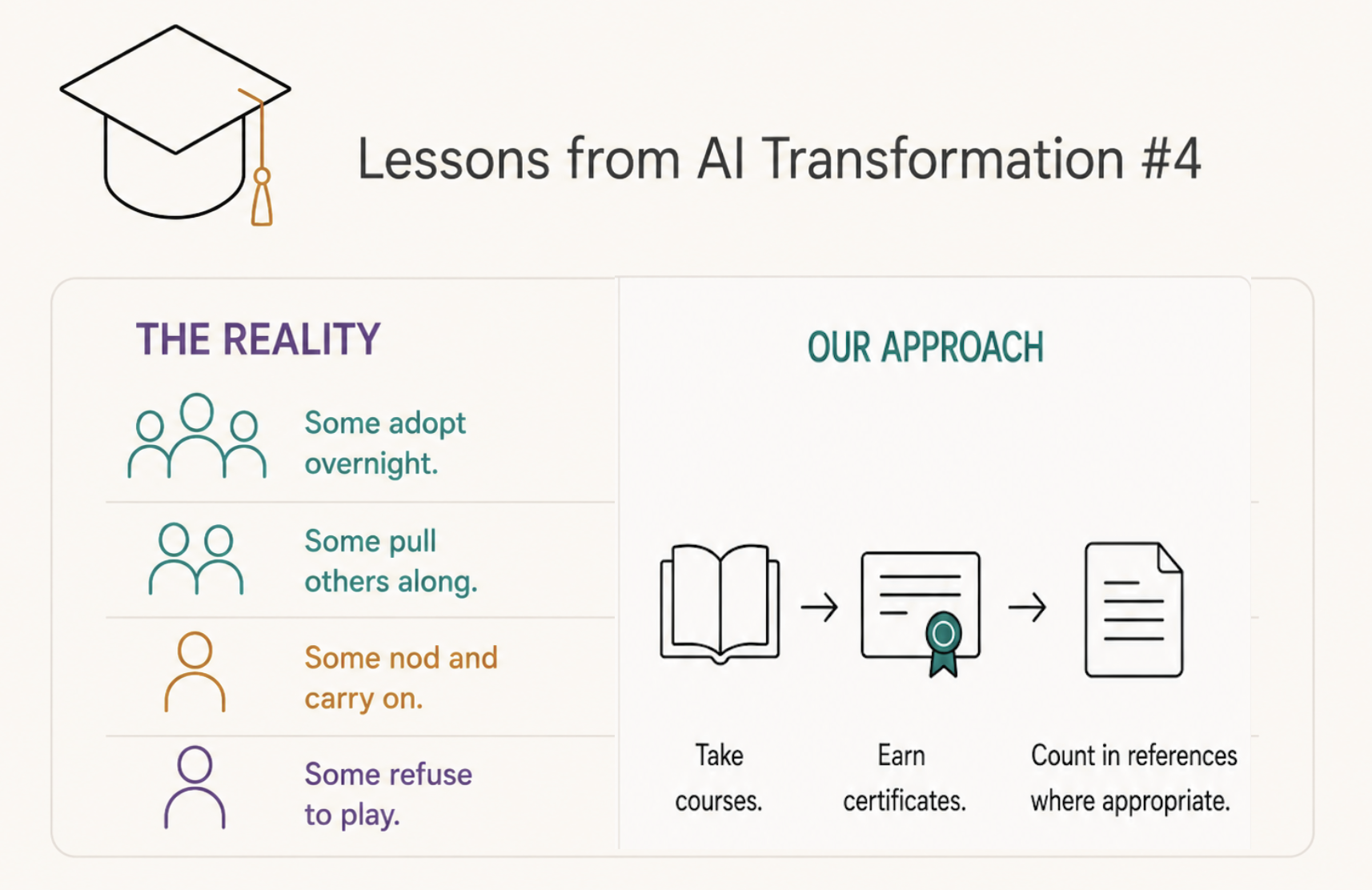
What I see across the industry is roughly this: some people fold AI into their work overnight. A smaller group does the same and pulls colleagues along with them – the multipliers, who turn out to matter more than any tool rollout.
Others nod through every meeting about it and quietly carry on as before – often with enough surface knowledge to talk their way through any conversation, but reaching for the good old way the moment something actually matters. With this group, I’ve often seen that a hands-on demo of something like NotebookLM has an almost transformative effect. Suddenly they’re hooked.
And then there are those who simply refuse to play. Some of them have human skills so valuable and durable that they can afford to opt out. Most don’t, and the working world of the coming years will be unforgiving.
Treat the learning effort as a personal asset
When you design training programs, don’t build them around the resistors. Trying to convert them means making the programs mandatory – which can make sense for certain basics, but turns the rest of the offering into something to be endured rather than chosen.
At Ringier Media Switzerland we’ve taken a different route. Complete a certain number of courses (many of which we offer in person), and you receive a certificate. Complete the next block, and you receive the next one. The certificates can be shared on LinkedIn and are mentioned in employment references where appropriate.
I’m excited to see how this will evolve in the near future.
The logic behind this matters more than the mechanic. We’re treating the learning effort as something that belongs to the employee, not the company. It’s an asset they build for themselves, that travels with them, and that we publicly acknowledge.
The same principle as in the last episode: we equip people for a world shaped by AI, whether they stay with us or move on.
Which brings us to a question I’ll take up next: every program like this lives or dies by that small group of multipliers in the teams. How to find them, support them, and avoid burning them out – that’s the next episode.
WAN-IFRA is working on a report about how publishers are responding to the impact of AI Search and bot traffic. We would be thrilled to have your perspective. TAKE OUR SURVEY: in English, German, French, Spanish.