CMS platforms are evolving with embedded AI in newsroom workflows
Newsroom CMS suppliers say AI is no longer being treated as an experimental add-on, but as a structural layer within editorial workflows.
One message was clear throughout the discussion: AI delivers value only when it is embedded directly into newsroom processes, not when it exists as a separate toolset.
This means that when AI is standalone, journalists have to switch between applications, copying and pasting content each time.
Embedding AI into the CMS reduces this extra effort, saving time and allowing journalists to focus more on creative work instead of repetitive tasks, said Tom Pijsel, Vice President of Product Management, Woodwing.
This shift is starting to change how CMS platforms are designed, how newsrooms approach automation, and how publishers think about challenges such as system migration, workflow fragmentation, and editorial control.
WAN-IFRA Members can watch the entire session on our Knowledge Hub.
Embedded AI: reducing friction in editorial production
A key design principle across modern CMS platforms is that AI must not interrupt editorial flow.
Massimo Barsotti, CMO & CPO at Eidosmedia, Italy, said that standalone AI features often introduce friction rather than efficiency.
“They interrupt creative flow, add steps instead of removing them, and create silos instead of streamlining workflows,” he said.
Instead, the direction is toward tools that appear within the writing environment itself. This includes actions such as shortening paragraphs, converting text into structured tables, or generating charts directly inside editorial interfaces without requiring external applications.
Sara Forni, Product Manager at Atex, Italy, gave an example of automated audio transcription and “voice-to-story” workflows, which convert raw audio and video into structured drafts ready for editorial review.
In this model, AI is not an end product, but part of a pipeline involving journalists, newsroom teams, and customers during development.
How AI is being used beyond basic newsroom tasks
Earlier, AI was used in newsrooms merely to generate summaries and social posts, but CMS vendors are now using it for more complex processes within the editorial workflow.
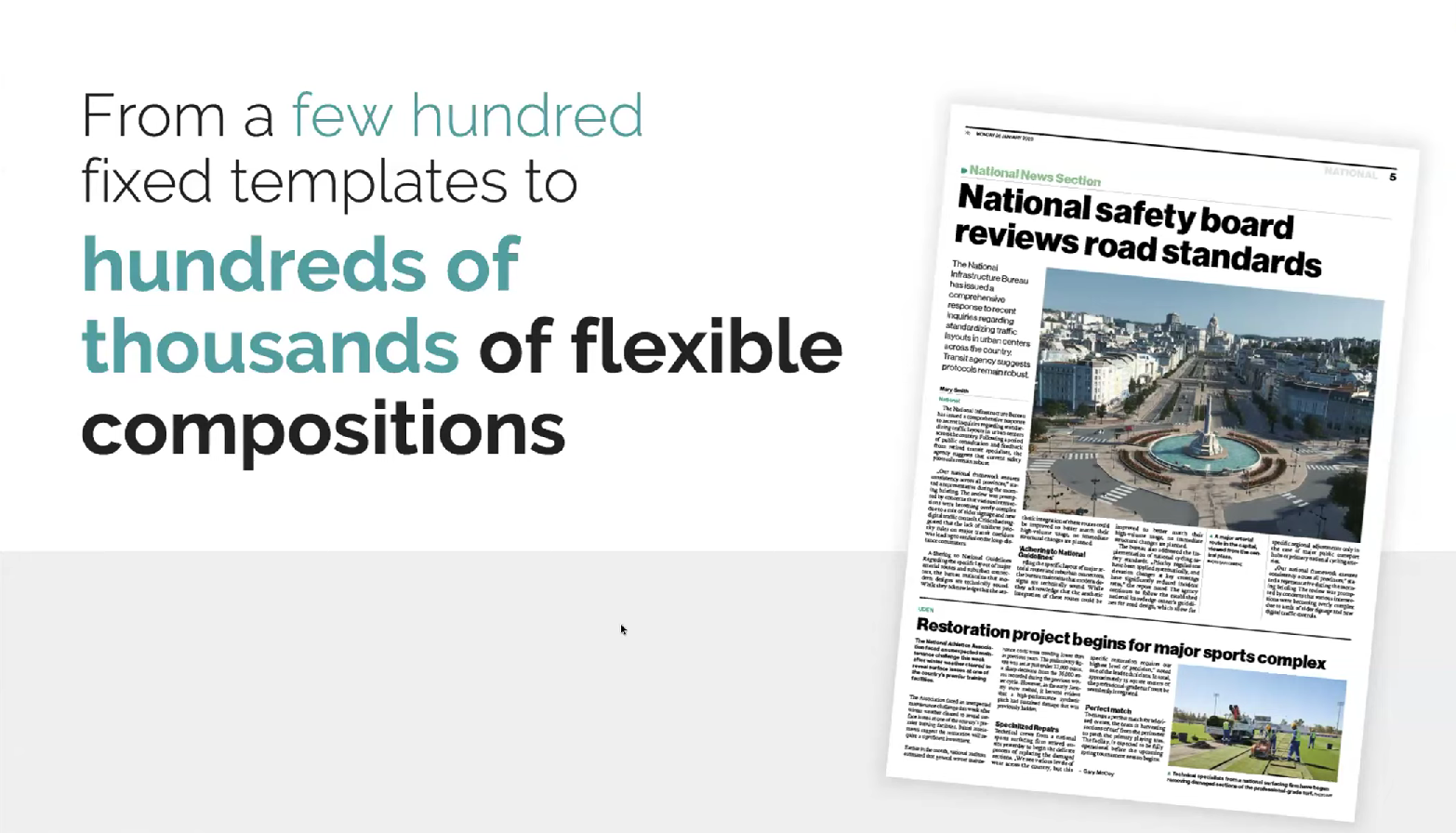
Publishers are now considering more practical uses of AI, such as automated pagination for print production, according to Barsotti.
“These systems generate print layouts automatically based on editorial content and design rules, reducing manual page-building effort and freeing editorial teams to focus on content decisions rather than production mechanics,” he said.
Image source: WoodWing
Renovating CMS platforms instead of rebuilding them
“Newsrooms do not have time to wait 18 or 20 months for a full migration,” Forni said, particularly when content operations must continue uninterrupted.
Instead of replacing the CMS, companies are now making it easier and seamless to incorporate AI functionalities and add-ons.
For instance, Atex’s MyType does not require replacing existing CMS platforms. Instead, they introduced “Editorial Layer” that connects to the existing systems, whether it is WordPress or Drupal, without interfering with the workflow.
The CMS also includes an “Ask AI” dashboard that brings functions like summarising, paraphrasing and transcription directly into the newsroom workflow.
The result: journalists can work in a modern AI-enabled interface while legacy infrastructure remains unchanged.
AI-readiness through API-first design
Eidosmedia’s Neon CMS is designed around APIs, making it easier to plug into existing newsroom systems. Rather than forcing a full rebuild, AI features are embedded into the workflow and connected across tools already in use.
Barsotti described Neon as a digital CMS “developed from scratch specifically for news media workflows,” with an API-first design that supports future automation.
He said this setup allows for more advanced agent-based features in the future, handling tasks like analytics and monetisation in a more automated way, while keeping the system flexible and easy to extend.
WoodWing also takes a similar approach, using APIs to integrate AI features into existing newsroom workflows instead of requiring full system replacement.
Its ecosystem is built around three core products. WoodWing Studio is the main editorial workspace where teams create and edit content for print and digital, with AI tools built in to support tasks such as headlines, SEO, copy editing and page layout.
WoodWing Assets acts as a central content hub, where images, videos and documents are stored, searched and reused, helping teams manage media in one place. WoodWing Connect sits in the middle as the integration layer, linking Studio and Assets with CMS platforms and other third-party systems.
Human oversight remains structurally embedded
Barsotti highlighted the growing use of agent-based workflows in CMS platforms.
“Agents can perform multiple tasks, such as linking content, creating sections, and automating workflows. These agents would work in parallel, but journalists would still stay in control of the process,” he said.
He also stressed the need for “proper degree of control and guardrails,” noting that governance is still a key challenge.
Overall, this shift is still at an early stage, with CMS platforms gradually moving from tools to more automated workflow systems.
Despite increasing automation, all three suppliers maintained a consistent position: human editorial control remains non-negotiable.
AI outputs are designed to be editable, reversible, and reviewable. In WoodWing’s case, AI-generated layouts and copy-fitting suggestions remain under editorial approval. The same is true for Atex’s system.
Principles for newsroom AI adoption
Some of the principles to apply when selecting and enabling AI features within your workflow:
- Respect the brand: Any AI-generated output must align with editorial identity and design standards. Consistency is non-negotiable.
- Support, not replace: AI should assist journalists, not take over their role, with humans remaining in the loop.
- Boost creativity: AI should help generate ideas, offer alternatives, and remove repetitive tasks so teams can focus on more creative work.
- Stay intentional: Newsrooms need to be deliberate about where AI is applied, keeping key editorial decisions, such as story selection, firmly human-led.
As Pijsel put it, “AI is creating real opportunities to improve efficiency, but it only works when it is applied in the right places.”
This webinar had an impressive turnout, with 310 registrants from 90 countries. About 80 percent were senior or mid-level publisher managers, including 200 in leadership and strategic roles and 100 working in AI-related functions. In total, participants represented 270 companies.
Register for our next WIZONE webinar AI Tools: Automation, Trust and Revenue