Why audience participation is becoming core publishing infrastructure
By Francesca Dumas
Co-Founder of Contribly
As publishers confront declining trust, subscription fatigue, and the rise of AI-driven search experiences, from conversational assistants to search overviews that summarise and often obscure original sources, a new question is emerging:
What does meaningful engagement actually look like when distribution is no longer guaranteed?
Increasingly, the answer lies not in how audiences consume journalism, but in how they participate in it.
The participation paradox: audiences want in, but rarely return
Most news organisations already invite reader input in some form: comments, emails, social media replies, or one-off call-outs. Yet participation remains inconsistent and fragile.
The reason is structural.
Reader contributions are often:
- Collected reactively
- Managed outside core editorial workflows
- Published selectively, or not at all
- Rarely acknowledged or followed up
From the audience’s perspective, the value exchange is unclear. From the newsroom’s perspective, participation feels labour-intensive and difficult to scale.
The result is a paradox: high willingness to participate, low long-term engagement.
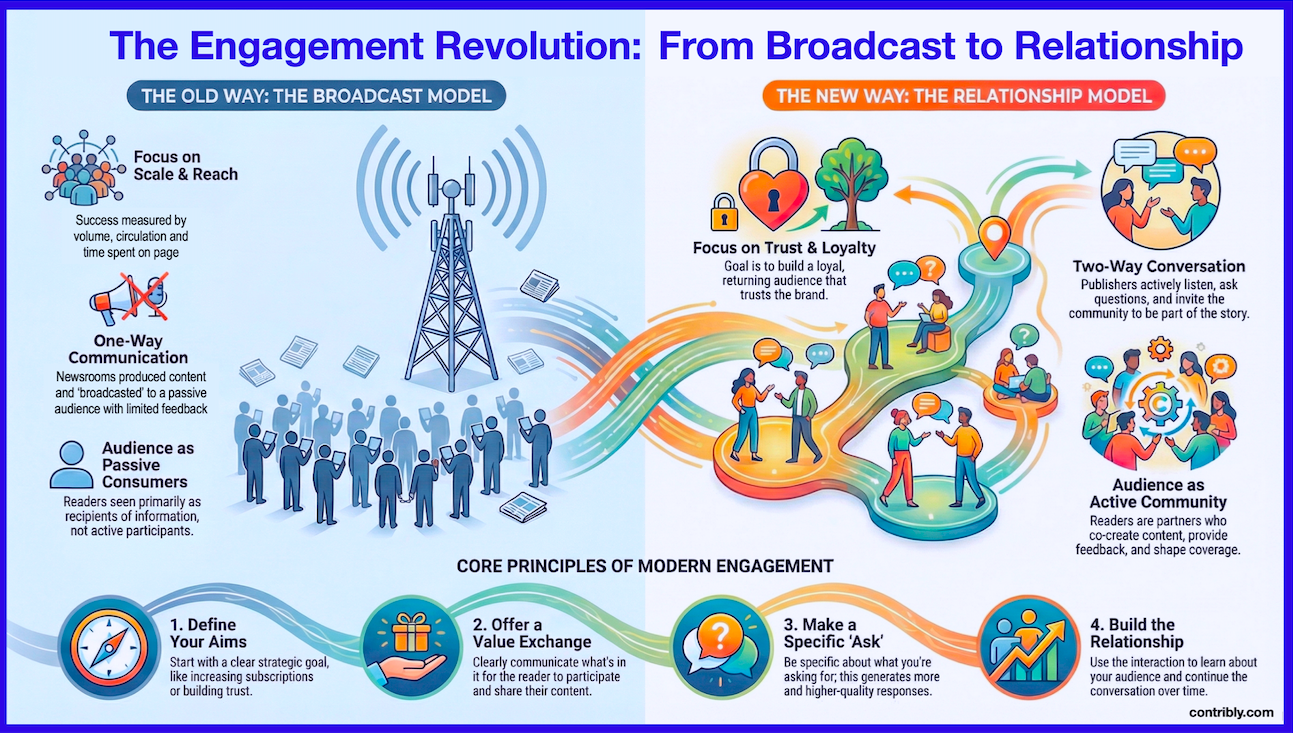
Moving beyond UGC: participation as a designed system
Just as static paywalls fail to account for differences in user behaviour and value, traditional approaches to user-generated content treat all contributions as equal… and disposable.
A more effective model recognises that not all participation serves the same purpose.
Audience participation can:
- Inform reporting
- Surface lived experience
- Power local debate
- Enable visual storytelling at scale
- Strengthen accountability and trust
But only when it is intentionally designed, not improvised.
This marks a shift from reactive UGC collection to structured audience participation, where journalists lead the conversation, contributions are contextualised, and audiences can see the impact of taking part.
Local publishers: turning lived experience into reporting fuel
Local publishers are often closest to their communities, and best positioned to benefit from participation done well.
Across titles within Mediahuis, local newsrooms regularly invite readers to contribute photos, experiences, and hyperlocal insight tied to clear editorial needs: weather events, housing developments, transport changes, or neighbourhood debates.
Because these contributions are collected in a structured, newsroom-owned environment, journalists can:
- Reuse them across articles
- Credit contributors visibly
- Build repeat participation habits
The journalism feels with the community rather than about it, without increasing manual workload. Using the traditional measurements, these types of habit building structured initiatives get 3-10x more time spent on page and 6x more return visits than average articles.
The hidden cost of ‘wasted engagement’ for readers
One of the most overlooked risks in engagement strategy is what happens after someone contributes.
When readers submit a photo, opinion, or personal experience and never hear back, or never see it used…they are unlikely to participate again. Over time, this erodes trust and willingness to engage.
Participation, unlike pageviews, is relational. It depends on recognition, visibility, and feedback.
Publishers that fail to close the loop aren’t just missing content opportunities, they are actively training audiences not to return.
Meanwhile 20% of readers who are published, return regularly.
The hidden cost of ‘wasted engagement’ for news brands
Here is an example of how not wasting the participation can transform the engagement:
Every year, during autumn, gooieneemlander.nl, a local news brand in the Netherlands, asked readers to share mushroom photos. This isn’t breaking news, or hard facts, but a low barrier to entry way of inviting the readers in.
They would receive them via email, pick a few that were the best and publish those.
They then transformed this to be able to utilise all the reader contributions, published in live galleries that everyone could like and share.
The results were clear:
- 5x more submissions: when readers could see others getting involved, they wanted to too.
- 6x more page views than the year prior: readers wanted to see what others had shared, not just the top photos
- 4x more time spent on page than the average article and over 7,500 likes and shares: which proves that readers wanted to see what others were sharing, and lurkers were willing to react too.
The only difference was how they gathered and published the content without wastage. The quality also increased – when readers could see a model of what was expected of them, they matched that.
Above: Wasting engagement: DGE results comparing participation before and after.
The hidden value of visible participation
One of the most underestimated aspects of audience participation is its impact on readers who never actively take part.
Behavioural data from digital platforms consistently shows that the majority of users are observers (lurkers), not contributors. On platforms such as X (formerly Twitter), long-standing engagement analysis follows the 90–9–1 principle:
- Roughly 90% of users consume content without posting
- Around 9% engage occasionally
- Just 1% contribute regularly
This pattern is not a failure of engagement, it is a feature of how communities behave online.
The same dynamic exists in news audiences.
Readers notice when a newsroom regularly asks questions, invites contributions, or surfaces reader voices, even if they never respond themselves.
These prompts signal openness, humility, and a willingness to listen.
Crucially, trust is built not only through being asked to participate, but through seeing participation made visible.
When readers encounter photos, opinions, or lived experiences from people “like them” (neighbours, peers, fellow members), journalism feels less distant and less institutional. It becomes recognisably human, more authentic.
Participation therefore works on two parallel levels:
- For contributors, it creates agency, recognition, and belonging
- For observers, it provides social proof that the newsroom values its community and reflects it fairly
Even passive exposure to participation helps audiences understand that journalism is not a closed system, but a shared civic space where voices are welcomed, acknowledged, and respected.
In an era of declining trust, this visibility matters as much as participation volume itself.
National publishers: scaling debate without losing trust
At a national level, participation is less about volume and more about signal quality.
Publishers such as the San Francisco Chronicle have used reader opinion call-outs to inform coverage of civic issues, from public art, sports opinions and urban planning to local policy decisions.
By framing participation around specific, time-bound questions and publishing contributions transparently, these initiatives:
- Elevate public discourse
- Reduce moderation risk
- Reinforce the newsroom’s role as a trusted convenor
Here, participation strengthens journalism rather than fragmenting it. This also increases readers’ willingness to continue hearing from the news brand. 22% of readers that participate sign up to newsletters.
For the San Francisco Chronicle, for example, 2.76% of readers landing on a debate page sign up to their newsletter, compared to the 0.01% seen on other articles without participation.
Technology’s role: enabling participation without newsroom overload
The barrier to scaling participation has never been audience appetite. It has been newsroom capacity.
For participation to become sustainable, it must:
- Fit existing editorial workflows
- Reduce moderation and verification friction
- Structure contributions so they are searchable and reusable
- Protect contributors and editorial standards
This is where platforms like Contribly are enabling a new operational model, embedding participation directly into publishing workflows rather than managing it through inboxes, spreadsheets, or social feeds.
The goal is not to automate journalism, but to remove the operational drag that prevents journalists from engaging audiences meaningfully.
Membership-led models: participation as belonging
For membership-driven organisations, participation is often a retention engine rather than a growth hack.
At Daily Maverick, member contributions are part of a broader value exchange, inviting readers into the journalism process through opinion prompts, surveys, and community-led initiatives.
Members don’t just support the newsroom financially; they see their voices reflected back in coverage. This visibility strengthens emotional connection, reinforces mission alignment, and supports long-term retention.
Participation here is not a tactic, it is a manifestation of membership itself.
Participation as a trust and retention engine
When done well, audience participation delivers value far beyond engagement metrics.
Publishers are seeing:
- Higher return participation rates
- Deeper time spent with stories
- Stronger emotional connection to the brand
- Richer first- and zero-party data
- Greater willingness to register, subscribe, or support journalism
Participation creates habit. Habit creates loyalty. Loyalty underpins sustainable revenue.
In a media environment increasingly shaped by AI-generated content, human contribution becomes a differentiator, not a distraction and participation plays an even more urgent role.
Why participation matters more in an AI search era
As more users turn to AI-powered search tools and summary-based discovery experiences, original reporting risks becoming background material rather than destination content.
When platforms summarise journalism without prominently surfacing brand identity, publishers lose:
- Direct traffic
- Attribution visibility
- Habit-forming visits
- Brand recall
In this environment, engagement strategies built purely around search and passive consumption become increasingly fragile.
Participation changes the dynamic.
When readers contribute, or even observe participation, they build an association not just with information, but with the newsroom itself.
AI can summarise an article. It cannot replicate:
- A local reader’s photo published with credit
- A debate shaped by community voices
- The visible exchange between newsroom and audience
- The recognition of a member’s lived experience
Participation creates brand memory.
It strengthens direct relationships.
It increases the likelihood that readers return intentionally, not accidentally via algorithmic referral.
In other words, as AI intermediates distribution, participation strengthens ownership of the audience relationship.
The path forward: participation by design
Audience participation is no longer an experiment or a campaign tactic. Like dynamic paywalls or registration strategies, it is becoming core publishing infrastructure.
In a world where platforms increasingly mediate discovery, the competitive advantage is not volume alone, it is relationship depth.
The next phase of digital journalism will be defined not just by how efficiently content is produced, but by how effectively communities are invited into the process.
For publishers willing to invest in participation as a system, not a side project, the reward is more than engagement.
- It is relevance.
- It is brand recognition.
- It is loyalty that algorithms cannot erase.
As organisations such as WAN-IFRA continue to spotlight models that strengthen the relationship between journalism and the public it serves, one thing is becoming clear:
The future of news isn’t just about what we publish, it’s about who we publish with.
About the author: Francesca Dumas is Co-Founder of Contribly and an audience strategy specialist who helps publishers build direct, lasting relationships with their readers. She works alongside editorial teams to design simple, repeatable ways to turn passive audiences into regular participants – creating habits that drive loyalty, first-party data, and consistent return visits. Her work spans newsrooms across Europe and beyond, where these approaches are delivering measurable growth beyond one-off traffic spikes.