The time waste economy – why media companies need to rethink value
By Ladina Heimgartner
President of WAN-IFRA and CEO Ringier Media Switzerland
This is not an abstract industry problem. We see it across our industry. Media companies have discovered AI as a cost cutter – but their biggest cost trap is themselves.
This creates a structural mismatch: We produce what is easy to produce – not necessarily what is worth producing. For years, we have optimised our organisations for metrics that were never designed to capture value. Editorial and content production remain the single largest cost line at 32.5 percent of total expenditure – a structural imbalance highlighted in the WAN-IFRA World Press Trends Outlook 2025-2026.
AI is now accelerating this dynamic. AI will not fix broken models. It will expose them. If content was already abundant, AI makes it effectively infinite. Most companies approach AI pragmatically: How can we produce faster? How can we reduce costs? How can we automate workflows? These are valid questions. But they are not sufficient.
Ninety-three percent of publishers have made AI and automation their top investment priority. But nearly half of the industry (46.2 percent) still describes its AI maturity as “emergent.” The constraint is not the technology. It is the underlying operating model. Automating an inefficient process does not create value. It scales whatever already exists – value or irrelevance.
One implication is uncomfortable, but unavoidable: some content should not be produced at all. Every newsroom knows formats that generate measurable reach but negligible intent signals – no subscriptions, no transactions, no loyalty. As long as organisations optimise for reach metrics disconnected from value, they will continue to scale irrelevance.
The brand imperative
We need to move beyond thinking in silos – reach on one side, subscriptions on the other. They are stages of the same ecosystem. Our starting point is the constantly changing world. We should not forget: the media industry has an infinite pipeline of free raw material: crises, seasons, cultural moments, events. They all create thousands of daily trigger points. The role of news media is to capture these signals, translate them into meaningful context, and deliver them to our audience. Reach remains essential. It creates awareness. But in a world of infinite content, reach alone is not enough. Relying on anonymous traffic is becoming increasingly fragile. We need to translate awareness into relevance – real, individual relevance.
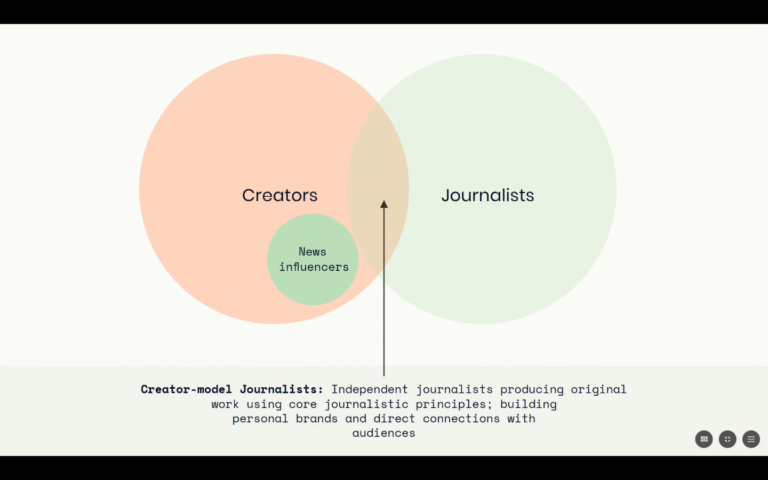
In an environment of abundant, often generic content, trust and brand authority become the only real differentiators. This trust is built not only through brand institutions, but increasingly through recognisable voices. We are seeing a shift toward more personality-driven journalism. Journalists become more visible, more accountable, and more distinctive. A journalist with 200,000 loyal followers does not necessarily need a media company anymore. Substack, YouTube, and podcast platforms offer distribution, monetisation, and audience ownership without institutional overhead.
Our question needs to be: what can a media institution offer that no solo creator can build alone? The answer is not distribution alone. It is the combination of reach brands that create awareness at scale, and depth brands that build the context where loyalty – and transaction – become possible. A journalist embedded in that ecosystem has something a solo creator does not: a system that converts attention into outcomes across multiple touchpoints.
The honest version of the “new symbiosis” is this: media brands that cannot articulate a specific, defensible value to their best journalists will lose them. Those that can will build something more durable than either the institution or the individual could alone.
Moving beyond content
At the same time, expectations around product experience are rising. Users compare us to the best digital experiences – full stop. If the user journey is fragmented, we lose the opportunity to convert intent into value. At the core of this system is data. With AI, we can better understand user behaviour and identify individual intent in real time.
Between intent and transaction sits activation – the moment where relevance turns into engagement. This creates the opportunity to move beyond content alone – toward activation and transaction. The goal is not just to inform, but to enable action: booking a ticket, attending an event, subscribing to a service, solving concrete problems in real time, enabling passions, or building communities. But we must be precise about the boundary. The transaction logic applies to service-oriented content – not to political reporting, investigative work, or journalism that addresses what users did not know they needed to know. Applying commercial optimisation to public interest journalism does not make it more relevant. It makes it less trustworthy – and therefore less valuable, even commercially.
This distinction requires structural protection, not just editorial intent. Efficiency gains from service and transaction portfolios must demonstrably fund the journalism that cannot pay for itself. Any media company that cannot show this transfer explicitly is running on goodwill – and goodwill does not survive a downturn.
The limits of subscription
The subscription era bought time. It did not buy transformation. Many companies that treated subscription growth as the destination – rather than as a bridge to deeper user relationships – are now reaching structural limits. The next move is not another revenue line. It is a fundamentally different relationship with the user: one where the media brand is present not just when news breaks, but when decisions are made. The broader opportunity lies in capturing value wherever intent materialises. We already see this shift: revenue from events, services, and partnerships has increased to 25.4 percent in 2025. Value creation is moving closer to action.
The media companies best positioned for this transition share one structural advantage: a portfolio broad enough to absorb risk, and focused enough to build depth. Conglomerates without editorial coherence will fragment. Pure-plays without ecosystem partners will commoditise. The window for building the middle ground – reach plus depth plus transaction – is narrowing.
Redesign the operating model
The real opportunity of AI lies less in efficiency and more in redesign. One approach worth testing: automate what can be automated – so that editorial capacity shifts toward what actually differentiates. This requires more than tools. It requires changes to the operating model and a cultural evolution. By reducing waste and owning the interface between intent and outcome, we decrease our dependence on external platforms and global tech infrastructures.
The organisations that thrive in the AI era will not necessarily be those who produce more content. They will be those who allocate their resources more effectively. The organisations best prepared will invest in journalists who build trust around specific user needs while holding the civic mission; in product teams who create experiences that convert intent into action; and in partnerships that extend the ecosystem without surrendering editorial sovereignty. External partners are not a threat if the architecture is right. They are proof that relevance can scale beyond the article.
Not every media company will make this transition successfully. The middle ground – too large to move at speed, too small to absorb platform dependency – is the most dangerous place to be. The organisations best positioned will be those who make sharp choices early, accept short-term pain for structural clarity, and resist the temptation to automate their way out of a strategic problem. AI is a powerful tool. It is not a strategy.
Because in the end, the question is not whether we adopt AI – it is whether we have the courage to redesign traditional patterns and turn attention into meaningful outcomes – for users, for society, and for the business. The question is not whether the media will survive AI. It is whether media companies survive their own operating model.