New Innovation in Media Report unveiled in Marseille
That structural change ranges from building sustainable revenue and getting paid in the AI ecosystem, to redesigning newsrooms for a fundamentally different production model.
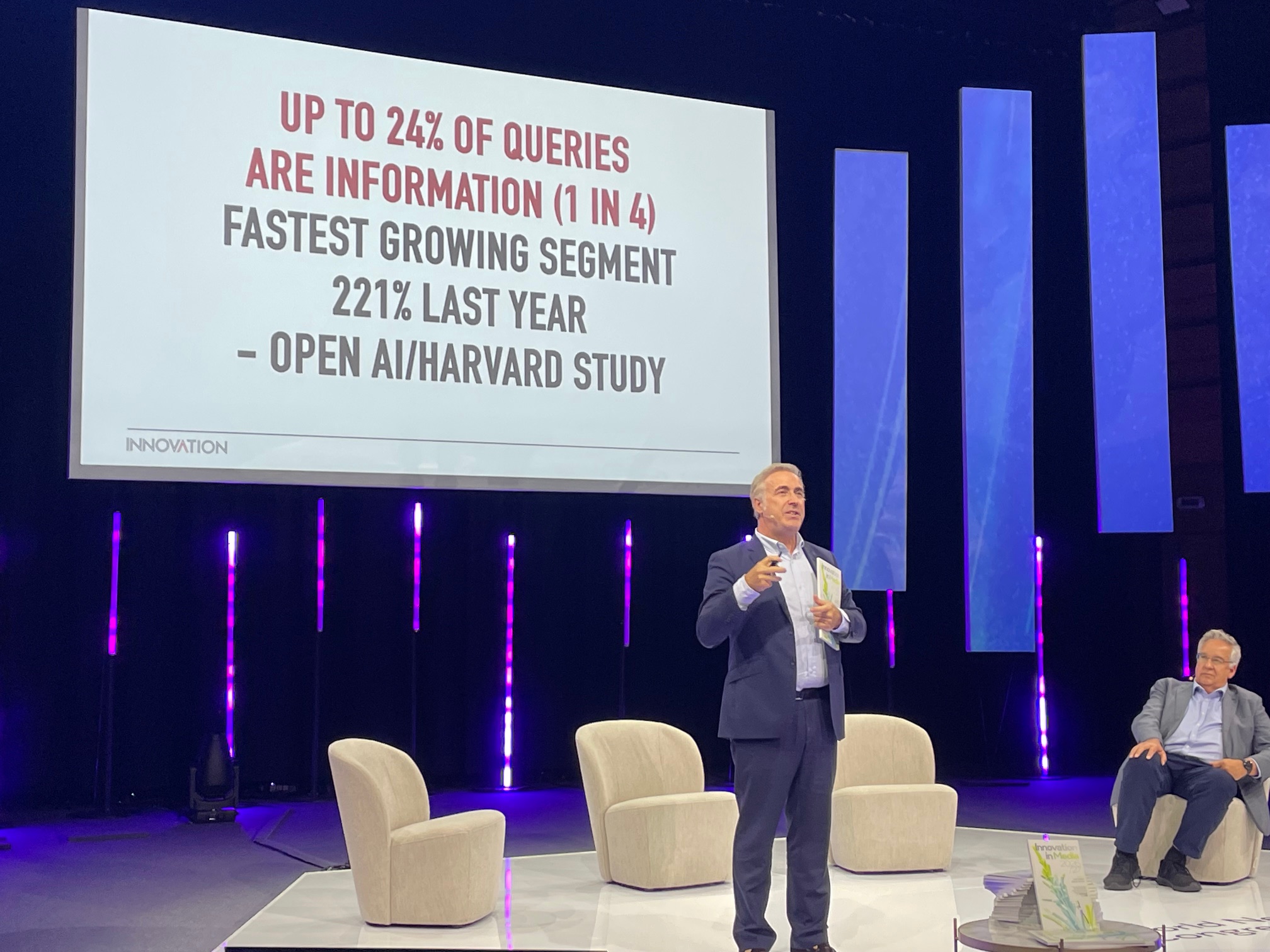
Drawing on global cases across five chapters, Juan Senor presented the strategic moves that matter most right now, focused primarily on AI’s impact on publishers.
WAN-IFRA and FIPP members can download the report from our Knowledge Hub.
Here is the Editor’s note from the report by authors Juan Señor and Jayant Sriram:
Written at a time of extraordinary speed, this book argues for something that may feel counterintuitive: the need to pause. Not to slow progress, but to reflect – clearly and deliberately – on what we now know with certainty, and what we must do in response.
The facts are now settled. Content supply is effectively infinite. Distribution is unstable. AI is not a tool; it is infrastructure. Economics are shifting from scarcity to abundance
and then back to scarcity, and from access to intelligence. In that shift, value is concentrating around trust, proprietary data, and direct relationships.
This creates a hard divide. Those who treat AI as efficiency will reduce cost and erode differentiation. Short gains leading to vanilla content and more of the same. Those who treat it as a revenue engine will build new products, new markets, and new forms of advantage. The question is no longer whether to adapt, but how quickly and how decisively.
The chapters that follow in the report are built for action:
Chapter One sets out how to make money in the AI age. It organises the core revenue models—licensing content, subscriptions, membership, intelligence products, events, commerce and data—into a clear framework for building durable income when content itself is no longer scarce.
Chapter Two examines how to ensure journalism is paid for within the AI economy. It explores licensing, data partnerships, AI-powered products, advertising models and enterprise services, with a focus on turning content and archives into active revenue streams rather than passive assets.
Chapter Three addresses how to sell human-made journalism in a synthetic age. It positions trust, verification and accountability as premium attributes, and outlines how publishers can differentiate, price and protect their content as human-created.
Chapter Four focuses on building an AI-native newsroom. It looks at organisational design, workflow transformation, the role of AI agents, and the redefinition of editorial roles, with an emphasis on integrating technology at the core of operations rather than layering it on top. AI were tools, now they are workflows.
Chapter Five examines how to own direct audiences. It sets out strategies to reduce platform dependency, strengthen first-party relationships, and build defensible ecosystems across newsletters, apps, (v)pod casts, communities and journalist-led brands.
These lessons apply equally to members of WAN-IFRA and publishers within FIPP. The distinctions between core news journalism and consumer, specialist or hobby publishing are narrowing. In the AI age, the underlying economics, technologies and competitive pressures are converging. The same strategic questions – and increasingly the same solutions – apply across both sectors.
Each chapter is grounded in practice, not theory. The intention is not to describe change, but to enable it.
Read them selectively or as a whole. Test what is relevant. Discard what is not. But act. The cost of delay is not neutrality; it is decline. This is 1998 all over again. Ignoring or denying our AI future can be as detrimental as it was to those who ignored or denied the age of the website and its digital permutations.
To pause, then, is not to hesitate. It is to choose where to compete, what to defend, and how to win—before moving at speed.
And so the argument returns to where it began: at a time of speed, the advantage lies with those who pause – briefly, deliberately – but then only to act with precision.