Check the 8: A lifeline to trustworthy news in sea of disinformation
The Trust Project’s Sally Lehrman shares how its ambitious new public campaign is geared to helping people “confidently choose trustworthy news” – and how the Trust Mark is benefitting newsrooms around the world and could soon help identify trustworthy news creators.
When The Trust Project was started in 2014, we’d only seen the tip of the iceberg with regards to the impact of mis- and disinformation online. What are your thoughts on the climate of trust in news media today?
I’m very concerned about the increasing amount of mis- and disinformation inhibiting people’s ability to access reliable information. Faux news sites with a hidden agenda are proliferating. Disinformation campaigns are growing more sophisticated. And AI tools enable far more convincing fakery than ever before.
In a state of overwhelm, some people give up the effort and start down the path of news avoidance altogether.
Recent research led by Oxford and Cambridge researchers found a small but steady decline in trust in news since 2015, with a lot of variability and up-and-down trends across and within countries.
‘In spite of so many forces causing perfectly reasonable scepticism about news, we really need to turn trust around. Global relations, strong communities, individual well-being and each person’s ability to help shape the world they hope to see entirely depends on it.’
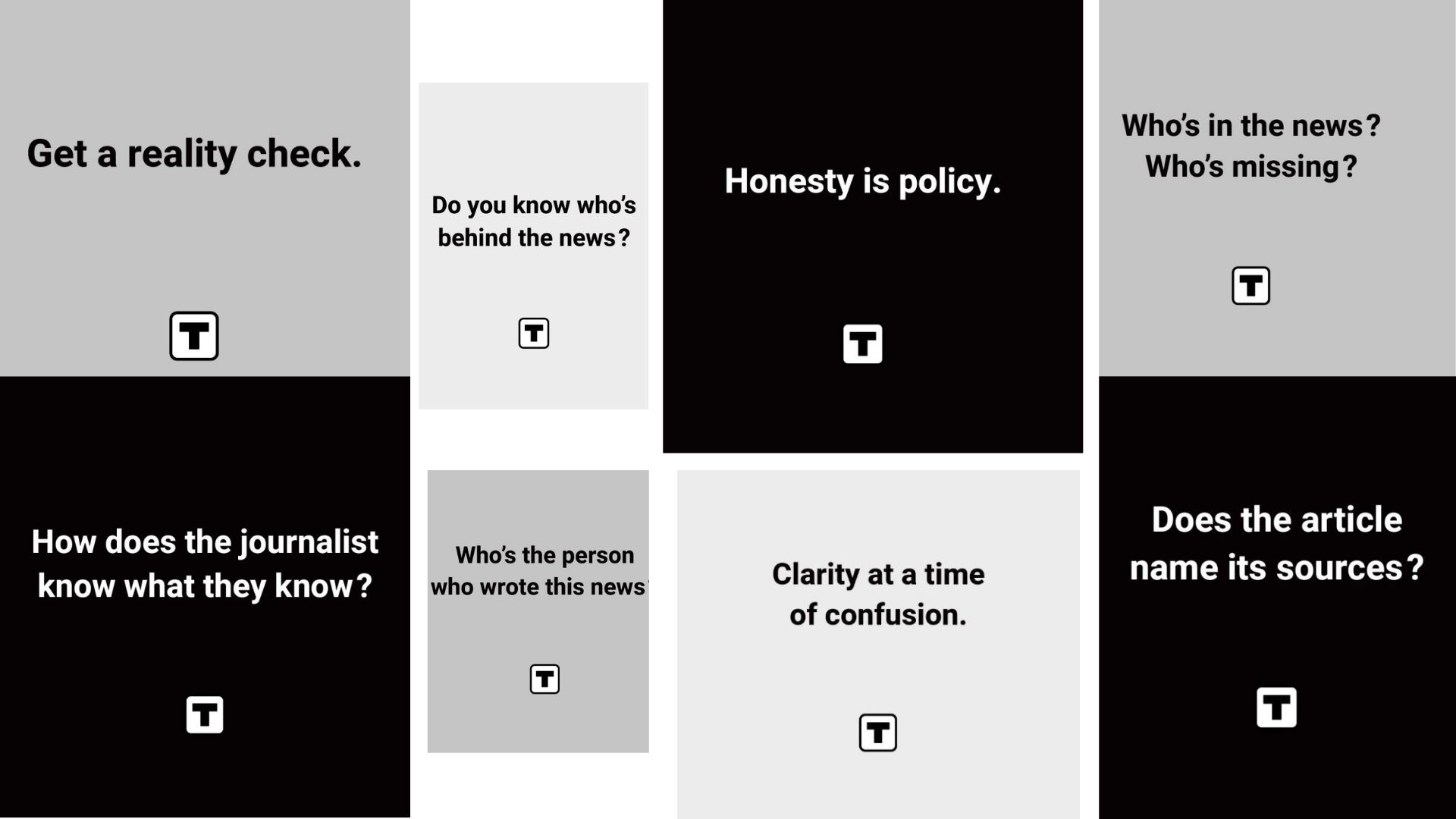
The Trust Project campaign’s social cards are available to download and share.
Have the trust indicators retained their relevance over the decade; is there any need to revisit or add any given the challenges of today?
We’ve been very pleased to witness the effectiveness of our 8 Trust Indicators over the years.
I could say they just make sense as the signature of journalism with integrity, which of course they do. But there’s more: they respond to what people say they look for in news, and people use them.
Early on they were found to be effective in research by UT-Austin’s Center for Media Engagement.
We have conducted our own user research over the years and find that the Indicators continue to resonate.
Other recent external research supports our findings. That said, we work closely with every incoming news organisation to make sure the Trust Indicators make sense in their news environment, and we closely watch developments like AI and news creators’ growing audiences.
We have added new attributes to the Trust Indicators, like better disclosure in podcasts and videos, and updated others, like our AI transparency requirements. So yes, they hold up very well, and yes, we continue to revisit them and test their effectiveness and relevancy.
How does this apply to this new news environment on social media – and how can trust indicators be extended to news creators?
We’ve focused a lot of attention on ways the Trust Indicators could be adapted for individual news creators. The original 8 Trust Indicators will remain unique to news organisations, but we are designing a version that will help news creators integrate clear standards and communicate them to the public.
I believe it’s important for the industry’s leading institutions to support news creators as they join in the effort to deliver trustworthy news. Recently we were pleased to participate in an advisory group for the Global News Gaps Project, led by FT Strategies, with WAN-IFRA an important contributor.
Regarding social media more generally, we’ve always thought the Trust Mark, which confirms full adoption of the Trust Indicators and the integrity behind them, should be accessible on social media.
We run social media campaigns to introduce the Trust Indicators and our news partners have found creative ways to express them in short videos, among other approaches. More could certainly be done and we’re continuing to develop new ideas and options.
Tell us more about your current #Check the 8 public campaign: Why now? What is the impetus and aim here?
Not only are the 8 Trust Indicators a great way for news organisations to showcase their integrity, they’re also proven to work well for news fluency.
By that term, I mean people’s ability to navigate our often-overwhelming information environment and confidently choose trustworthy news.
With dis- and misinformation spreading more widely and rapidly than ever before, we feel it’s urgent to help people gain that confidence.
We also want them to know why journalism is such a valuable source of information.
We decided to run the #Checkthe8 social media campaign after a successful Trust Indicator ad campaign supported by Microsoft.
In it, 60% of those who saw our ads and followed them to our learning page reported improved confidence in recognising trustworthy news.
For #Checkthe8, social cards provide simple messages about what trustworthy news looks like. For example, “Ethical news brings in many types of people and perspectives” and “Ethical journalism separates opinion from news with clear labels.”
Our tagline, “Trust Starts with You,” invites people to become partners in sharing trustworthy news. We offer example posts each month that point people to our Trust Indicator page. Anyone who registers can download a social kit in one of seven languages and dialects.
We encourage all WAN-IFRA Members to join the campaign in the lead-up to World News Day next month.
They don’t need to be Trust Project news partners to participate. We invite everyone to register and use the social cards with our suggested or their own customised posts.
WAN-IFRA Members also can promote audience participation in the campaign. People around the world are alarmed about the state of social media today and want to do something.
‘The entire news community must take advantage of every opportunity to show how journalism is unique and why it matters. With people drowning in a sea of disinformation, this campaign throws out a lifeline.’
Trust in News has long been on the decline; along with it, calls for news outlets and organisations to collaborate – how easy was it then, to get sign ups, and what is the general response now?
I was surprised and thrilled to see how many news outlets signed up in our first years, and how many contributed their ideas and expertise to the development of the Trust Indicators. Developers, designers and editors-in-chief all pitched in.
At that time, 2013-15, collaboration in our industry was very rare, especially anything beyond partnering on news stories. But globally we found a strong willingness to step forward to address the deep challenges we faced together.
Since then, we have to work far less on recruitment. We currently have a substantial waiting list for the next implementation cohort. With newsrooms under such financial duress, it’s great to see their recognition that earning trust is closely tied to loyalty and revenue – and sustained growth for the whole industry.
How many news orgs are partnered, and how rigorous is your verification process?
We have about 300 news partners from Europe, Latin America, Canada, the United States and Hong Kong. They all have completed our vetting, training, implementation and compliance process.
The compliance check is quite rigorous, although we are happy to work closely with qualifying news organisations to make sure they complete the process successfully and benefit from the training, peer exchange and outcome, including both the Trust Mark and our community of practice.
Download the Trust Indicators.