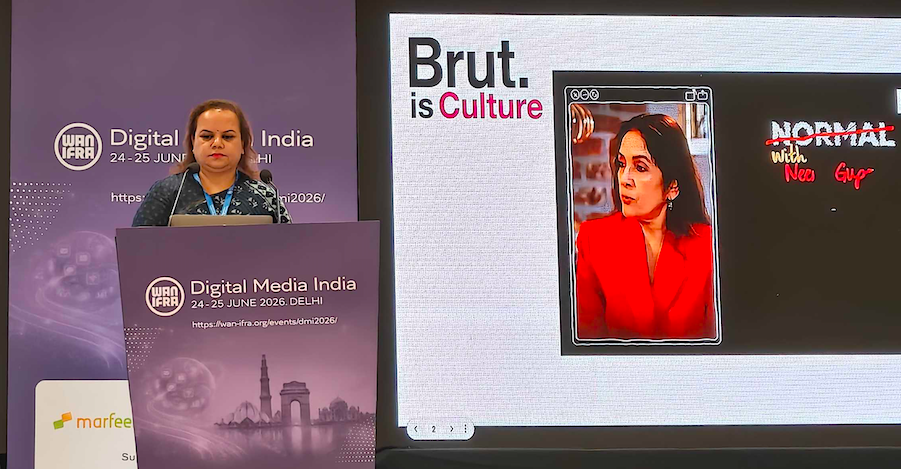
Brut India bet on platform users over news consumers – and it paid off
Speaking at our ongoing Digital Media India conference in New Delhi, Kasbekar framed this as a deliberate departure from her years in broadcast.
She was candid that the strategy had not been met with confidence from outside the organisation.
Brut was told, more than once, that betting entirely on social platforms, without owned infrastructure to fall back on, was a precarious way to build a media business.
Platforms as the product, not the funnel
Brut never tried to funnel social traffic back to owned property.
“The whole business model was social,” Kasbekar said.
Instead, Brut built on Facebook, YouTube, Instagram, and Snapchat, treating those platforms not as distribution arms for a core product but as the product itself.
The numbers bear this out: 18 million followers across platforms, over 8 million views last year, and a Hindi-language edition – launched roughly 18 months after the main outlet, in 2019 – that has held a top-two position among competitors since its second year and now ranks among the country’s eight largest publishers.
But Kasbekar was clear that views are not the metric she watches.
“Engagement is our oxygen,” she said: views can be inflated through boosting, engagement cannot be faked the same way. She pointed, too, to audience composition as proof the model holds on its own terms: 89 percent of viewers are under 24, split almost evenly between men and women.
Built for the platform, not the newsroom
Legacy newsrooms are organised around desks, beats, and expertise. Brut’s, Kasbekar said, was built around a different question: What does this specific platform want?
Instagram gets approached through what she called “model discovery.”
YouTube is built for depth. Shorts are built for reach. Snapchat is built around habit. Nothing is repurposed wholesale across platforms, and formats themselves are revisited roughly every two years, discarded and rebuilt based on what’s working.
Kasbekar traced this instinct back to Brut’s early production approach. Moving from television, where she was used to a three-camera setup before interviewing a minister, she found herself shooting on a phone with a single tripod, at a time when public figures still questioned the credibility of mobile footage.
The bet, she said, was that news had already moved to mobile, and that quality didn’t have to depend on equipment.
This extended to editorial posture, too. Brut’s approach, she said, is to withhold opinion deliberately: “We try and put out pieces of information with absolutely no opinion, and we let the younger generation take on the challenge… to give them all the information around it and let them make up their own minds.”
The same instinct shaped how Brut covered entertainment from early on: not through A-list celebrities, but through the actors and recurring figures who, in Kasbekar’s words, “will never make it to the front page of a magazine,” but who build the stories audiences actually return for.
‘Explain, don’t lecture’
Trust, for Kasbekar, is built through specific, almost bureaucratic mechanisms. Brut has maintained a 0.01 percent correction rate since launch, tracked in an internal log.
When a mistake happens, the producer who made it writes the correction themselves, and it runs prominently. “If we’ve made a mistake, we own up to it and we correct it,” she said.
This detail matters to how Brut frames its credibility: the correction process isn’t outsourced to an editor after the fact – it’s owned by the person who erred, as a matter of newsroom culture, and aids in cementing trust with the audience.
That culture, Kasbekar said, has to start internally before it shows up externally.
She described building a newsroom where reporters and producers feel safe disagreeing openly, on the theory that a newsroom that can’t tolerate internal dissent won’t credibly model openness for its audience.
The resulting house rule: “Explain, don’t lecture.”
The publisher-creator economy
Kasbekar rejected the publisher-versus-creator framing outright. The future, in her view, is “publishers plus creators,” not a competition between them.
She pointed to the rise of hyper-specific creators as a sign of how granular audience trust has become, and argued publishers need to find ways to work alongside that ecosystem rather than treat it as a threat.
On AI, Kasbekar was deliberately modest, framing Brut’s use of it as operational rather than transformative: an internal tool scans audience comments across videos and flags recurring questions or story ideas for producers each week, and separate internal tools support faster research.
Both, she said, exist to help journalists work faster, not to replace editorial judgment.
Kasbekar closed by summarising Brut’s model around five principles: audience-first, platform-native, data-informed, creator-friendly rather than creator-resistant and trust-driven.