Axios doubles down on local journalism and launches in more US markets
The company was bought by Cox Enterprises for $525 million in August 2022, but its co-founders – Jim VandeHei, Mike Allen and Roy Schwartz – have remained in the key leadership roles. All three were also instrumental in Politico’s success: VandeHei was a co-founder, Allen was Politico’s first hire, and Schwartz served as its chief revenue officer for eight years.
Axios specialises in Smart Brevity, a concept based on a concise writing style VandeHei, Allen and Schwartz developed to help readers quickly understand the essential parts of a major news story. Axios does this by focusing on elements such as “1 big thing,” and “why it matters,” while also offering a “go deeper” option for readers who want to learn more about a given topic. The trio also wrote a book about Smart Brevity and how it works.
‘We try to give you the big picture’
Axios’ tightly focused stories are delivered to readers via email newsletters. Axios offers dozens of them, some of which are topic based, such as their Media Trends weekly newsletter by Sara Fischer. Others are location/market based, such as Axios Chicago and Axios Charlotte. All of their topics and markets have related websites, but the main distribution channel is really their newsletters.
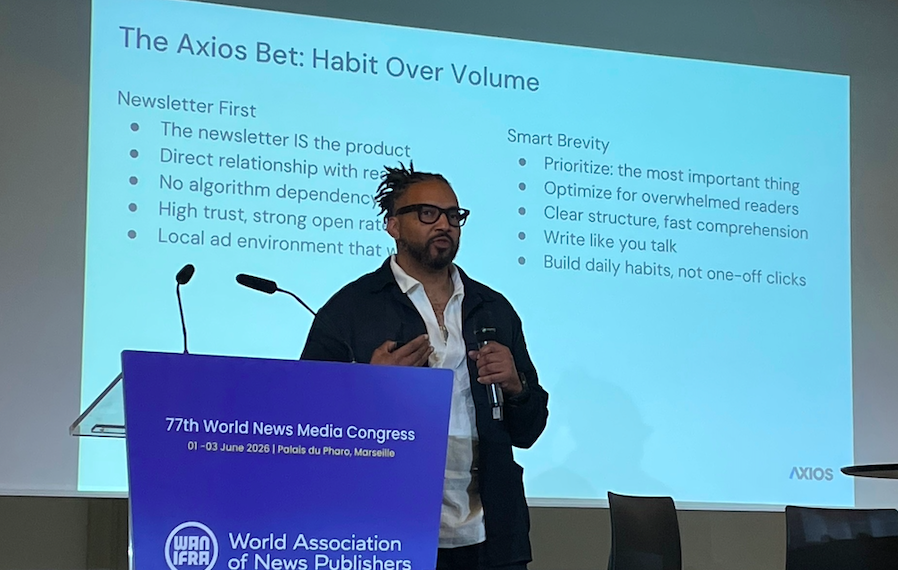
Axios uses the newsletter format because it is a primary vehicle for sending news content directly to a subscriber’s phone, “which is the first thing that many people look at when they get up in the morning,” Delano Massey, Managing Editor of Axios Local, told participants at our World News Media Congress in Marseille.
With these newsletters, Axios aims to give its readers the key news items they need to know each day.
“We try to give you the big picture,” he said. “The newsletter is 1,000 words. The big story that we have is probably going to be about 500 words or maybe less than that.”
The aim is to give people exactly the main information that they need each day within a given topic or market.
“This is not supposed to take up much of your time. And it’s supposed to be intelligent,” Massey said.
WAN-IFRA Members can view Massey’s presentation on our Knowledge Hub.
‘You should come away thinking you’ve gotten smarter’
In order to deliver on this premise, Axios employs the Smart Brevity concept across everything they publish, often using bullet points as well as giving readers a highlighted “Why it matters” element in every story.
“With every newsletter that you read, you should come away thinking you’ve gotten smarter about something, learned something that you can go share it with somebody else,” Massey said.
“We don’t cover sports, but we do cover the collusion of sports and culture. And that is one of the things that really works well,” he said.
Axios is also well aware that people today have hectic, busy lives and shorter attention spans, so they highlight one big thing and then smaller stories that might only be 150-230 words or so, Massey explained.
Getting the “why it matters,” line just right is vital for Axios. As are their newsletter subject lines: “we spend a lot of time with the subject line of the newsletter because that’s going to make you open it,” he said.
Also essential is providing readers with a lead headline that is going to get them to think about the story and talk about it.
“People didn’t really lose interest in local news: their habits changed, their appetites changed,” Massey said. “It’s a product and how do you connect to that product? We did not build the local apparatus with social media in mind. We knew that email would be gold, or the equivalent of it. Our entire model is basically built on that and not having to be dependent on third-party platforms that we don’t actually own.”
Adding two more markets this month
However, this approach has also meant that Axios needs a variety of revenue sources, and they have created several, including sponsorships and advertising for the local newsletters as well as encouraging reader donations among others.
They also operate very efficiently.
“We don’t have a newsroom of 20 or 30 people. We have newsletters that have two or three or four reporters working for them,” Massey said.
Currently in 37 US markets, Axios is adding two more this month (June 2026), he said. These were announced by Axios just days later as two markets near Miami (Fort Lauderdale and Hollywood), which will debut on 22 June.
Ultimately, Massey said Axios tries to make a difference by “paying attention to the community. Trying to be distinctive. And trying to make sure that we are not copying everybody else, because if four other outlets are covering a fire, we don’t need to be the fifth one.”
Go deeper: Watch Jim VandeHei’s TED Talk on “The Art of Smart Brevity.”