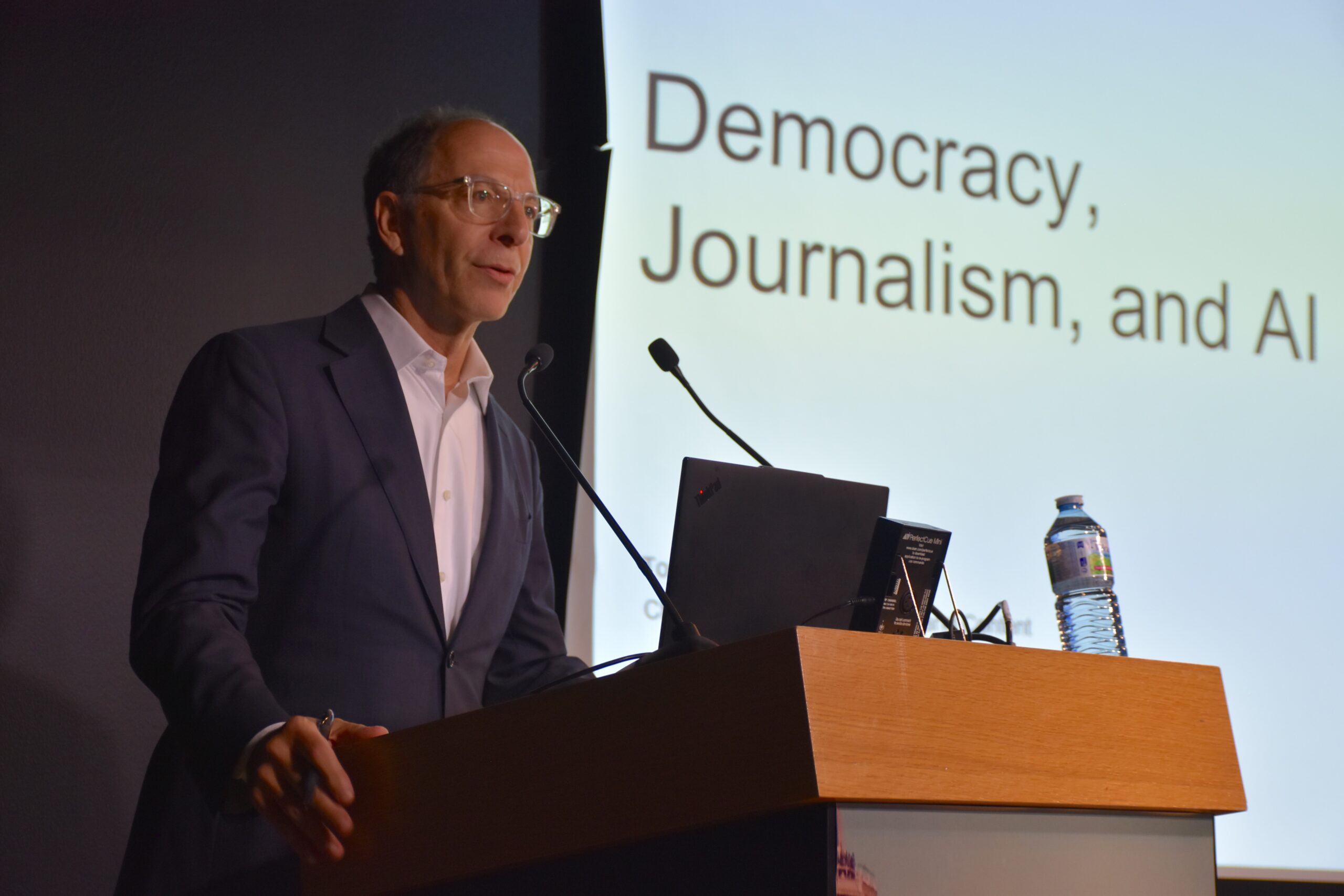
OpenAI’s Tom Rubin delivers keynote at Paris AI Forum
Rubin joined the event amid an ongoing new initiative between the Association of Independent Regional Press Publishers of Ukraine (AIRPPU), WAN-IFRA and OpenAI. The Ukrainian program launched in August with a masterclass series open to 40 newsrooms. The next stage kicks off tomorrow (17 September), with 12 weeks of intensive support for 10 Ukrainian newsrooms to develop projects tailored to their needs. The program covers both reporting and the business of keeping a newsroom going.
“OpenAI deeply values our longstanding partnership with WAN-IFRA. Over the past two years, we’ve worked together to provide practical AI training and support to 160 newsrooms around the world, helping them develop tools to strengthen their journalism and build more sustainable businesses.
At the board dinner at WAN-IFRA’s annual Congress in Marseille in June, I was fortunate to be seated across from Oksana Brovko, AIRPPU’s longtime leader and a fierce defender of an independent press. I asked her two simple questions that night: “What do you need and how can we help?” From that conversation, together with WAN-IFRA, we quickly developed this program to support Ukrainian newsrooms – because there is no time to lose.”
Rubin talked about his time as a journalist at The New York Times, Associated Press and CBS News, covering stories from terrorism and murder to the everyday affairs of communities and universities. Today, he also sits on the executive committee of the Reporters Committee for Freedom of the Press in the United States.
“That background gives me some understanding of your work. But nothing in my own journalism experience remotely compares with the reality facing our Ukrainian colleagues: keeping independent journalism alive while your country is fighting for its survival.
That’s what brings me here…
When darkness falls over a Ukrainian town, it can mean an air raid, a missile strike, or another attack on the power grid.
And somewhere, a journalist is finding a way to keep working: charging her phone, checking an evacuation route, preparing a newspaper for people the internet can no longer reach. Oksana has spoken of the journalists in small towns who “did not switch off the lights, even when everything around them was falling into darkness.
We are here because those lights must not go out.”
He spoke about how local, community, independent journalism must continue to thrive – especially through wartime but also in everyday life across the globe. And holding the powerful to account.
“Journalists earn trust by pursuing facts, analyzing information, listening closely, and challenging authority. And they need the freedom to follow a story wherever it leads, even when it leads to a political leader, a school superintendent, a local business, or a well-known company, including OpenAI.
That is the kind of independent journalism we want to help thrive.
Oksana has described how the question has changed since the first days of Russia’s full-scale invasion. Then, it was about getting through the day. Now it is also about remaining independent for years to come.
That word, independent, matters. A newsroom needs enough financial security to ask uncomfortable questions, even of people who could help pay its bills. Supporting it means helping it stand on its own feet.”
But he says newsrooms and journalists need practical support, and they have always found a way to use new tools to tell their stories – in the most trying of times. Like during World War II and the occupation of Paris, how the underground newspaper Défense de la France began printing in the cellars of the Sorbonne to reach readers.
“Technology keeps giving journalists more powerful ways to report and tell stories. The public’s need to know the truth endures.
The great war correspondent Marie Colvin, who wrote for the Yale Daily News just before I did, put it plainly: “War reporting is still essentially the same – someone has to go there and see what is happening.” She was killed in Syria serving that mission.
And in Ukraine, Pulitzer Prize winner Mstyslav Chernov, speaking about his reporting in Mariupol, put it this way: “I can only make sure that as many people as possible will see what I saw.”
Being there, gathering evidence, and helping people understand it: that is the work. Every useful tool should help journalists do more of it.
That is where AI can help. We see AI as a tool to support journalists, not a substitute for them.”
He pointed to WAN-IFRA research that revealed in a survey of more than 100 media leaders last year, three quarters reported efficiency improvements from AI. Just last week, he said data journalist Jacopo Ottaviani described his experience in a piece for the Reuters Institute, building a working prototype in hours with the help of AI: a searchable atlas helping people understand flood and landslide risks in Italian communities.
“For a reporter, time saved can mean time to make another call or visit a neighbourhood or tell another story that might otherwise never be told.
During war, that extra time and ability to investigate can matter even more. An overstretched team could use AI’s help translating urgent information, organising hours of witness testimony, finding leads in public contracts, and uncovering propaganda or disinformation claims for reporters to investigate. Human review will always remain essential, especially when people’s safety depends on the information. Used appropriately, these tools can help a stretched newsroom advance its mission.
The risks deserve the same practical attention. AI can miss context and produce answers that are wrong. It can also be misused to falsify images and voices. Newsrooms need to check outputs against evidence. Reporters and editors remain responsible for what they publish.”
Indeed, he said, journalism’s challenges were already immense before the arrival of generative AI. Falling circulation, lost advertising revenue, shifting user habits and declining trust in public media were all playing significant roles in the challenging environment within the industry.
“But that history doesn’t lessen our commitment to assist the news industry with new tools or our responsibility to address new risks AI may bring. It makes it more urgent to work with publishers to develop the technology in ways that help: supporting reporting and research, easing the administrative work of running a newsroom, and helping readers find journalism they value.
There is a lot that’s hopeful here for smaller publishers. Capabilities that once required a large staff and budget could become available to a local team. That can mean more original reporting, and more communities getting the attention they deserve. The size of a newsroom’s budget should not prevent it from investigating an important story.
We’re still early in this new era, but I expect AI will do the same.“
Group of Ukrainian journalists involved in the AI Accelerator.
He closed by talking about the partnership with WAN-IFRA and AIRPPU and how it will hopefully impact not only the newsrooms involved but also the country as a whole.
“Ukrainian newsrooms are already clear about where AI can help. Trudova Slava told The Independent it wants AI to help monitor online sources and find stories across communities scattered by war. The Kremenchuk Telegraph plans to use it to search public records for investigative leads.
We look forward to learning from the journalists doing that work and those leading the other projects. They know their communities best and understand the problems they need to solve. The editorial decisions remain theirs. Our support is designed to strengthen that independence.
This work is vital today, and it will matter just as much during reconstruction, as communities rebuild. Local reporters will follow rebuilding funds, ask when schools will reopen, and tell the stories of families returning home. They will help their communities remember what happened and have a say in what comes next.
That is a future worth working for.”


