Why the Penny Marvel still matters as editors worldwide face threats for telling uncomfortable truths
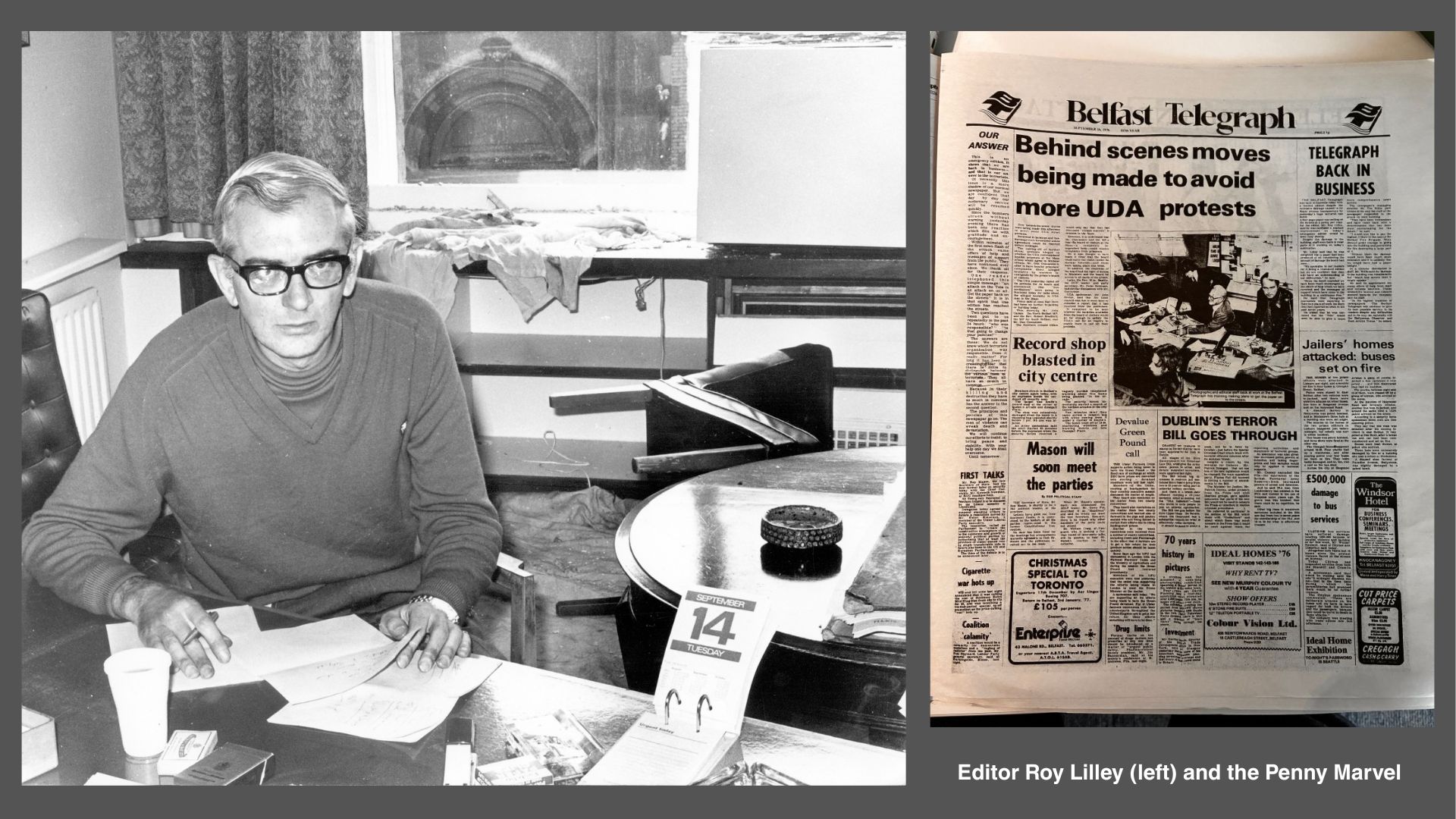
On 15th September 1976, in what was to be one of the deadliest years of the period in Northern Ireland known as the Troubles, the offices of the Belfast Telegraph were bombed. Over a dozen people were rushed to hospital, with 63 year-old printer, Joseph Paton, dying as a result of his injuries four days later. In the face of tragedy and destruction, the paper’s indefatigable editor in chief, Roy Lilley, determined the news would still get out. Despite the printing presses being out of action the Penny Marvel, a four-page edition of the Belfast Telegraph, appeared the next day.
————————————–
By David Walmsley
The four-page Penny Marvel special edition from 1976 was as severe a test for the Belfast Telegraph’s editor Roy Lilley as anything he had faced during the violence of the Troubles.
A bomb had ripped through the Tele’s offices the day before, with more than a dozen people rushed to hospital, one of whom later died of his injuries, and many others hurt in the blast. This forced desperate responses to ensure a paper in some guise would be published.
Bringing reliable news to the reader is the single biggest responsibility of the newspaper editor.
But reliability comes in two forms – consistent, fact-based work married to technology and deadlines that ensure you get the news to the reader when they need it.
Amid the glass and the rubble, the Penny Marvel stands as a tribute to all those colleagues who 50 years ago faced down threat and intimidation and got the news out.
In the centre of the photograph on the front page is Jenks, Norman Jenkinson, the Tele’s news editor. He coordinated the response, under Mr Lilley. Today’s reproduction provides a symbol of the mettle of editorship.
The following year, Mr Lilley received the Golden Pen of Freedom, still the only Northern Ireland journalist to receive this global award, which recognises the selfless work of a journalist in defending press freedoms.
The front page of the Penny Marvel which is reproduced in the centre of today’s newspaper The mid-Seventies were dangerous times and Mr Lilley’s stewardship provided a formidable contribution to the importance of the Belfast Telegraph in daily life. He took that role seriously and impressed upon me the responsibility of accurate journalism. Be brave and stand up for the facts, he would say.
I was the last reporter Mr Lilley hired, appointing me a junior reporter in 1992, the same year he stood down as editor.
His advice stays with me more than three decades on. It is immensely meaningful to me that today, as the president of the World Editors’ Forum, it is one of my duties to present the Golden Pen of Freedom, 49 years after my editor received it.
In Marseille earlier this year at the international news congress, I referenced Mr Lilley and thought of all those brave journalists who risked so much to get the news out.
The job of editor saw Roy Lilley squeezed on all sides, as he pursued the uncomfortable facts that led to the truth.
The Penny Marvel is a compelling message of determination that all of us must cling to today, where the storyteller is targeted as much as respected. Where the prosecution of the truth has become all too often a crime. Where those who dare to get the story out are threatened and attacked.
The Golden Pen has gone to other legends in the business.
The year after Mr Lilley, the award was shared by the South African journalists Donald Woods and Percy Qoboza.
More recently, Dmitry Muratov then Maria Ressa were recipients. These two journalists went on to win the Nobel Peace Prize. Jimmy Lai, another laureate of the Golden Pen remains incarcerated in a Hong Kong prison for the “crime” of committing journalism. All those who toil against totalitarianism and state sanctions are remembered.
But as you reflect today on the Penny Marvel, an accomplishment that went around the world, it is to the journalists of Northern Ireland who we salute. Not just Roy Lilley but those today who are falsely arrested and spied on for doing their work. Society needs their eyes and ears, and journalists need your support.
David Walmsley is a former Belfast Telegraph journalist and current President of the World Editors’ Forum, World Association of News Publishers (WAN-IFRA). This article, and photos, first appeared in the Belfast Telegraph and are reprinted with permission.