What’s changing in print: Takeaways from Indian Printers Summit 2026
In an AI-saturated world, information may be abundant, but confidence in what is real, sourced and accountable is becoming increasingly important. This was the focus of the opening keynote at the Indian Printers Summit by Ashwin Padmanabhan, COO, WPP Media (formerly GroupM) South Asia, who spoke about the changing news landscape and what it means for publishers.
“The future of news publishing is not just about creating more content, but it’s about creating more value to the audience they serve,” he said.
Turning audience insight into revenue
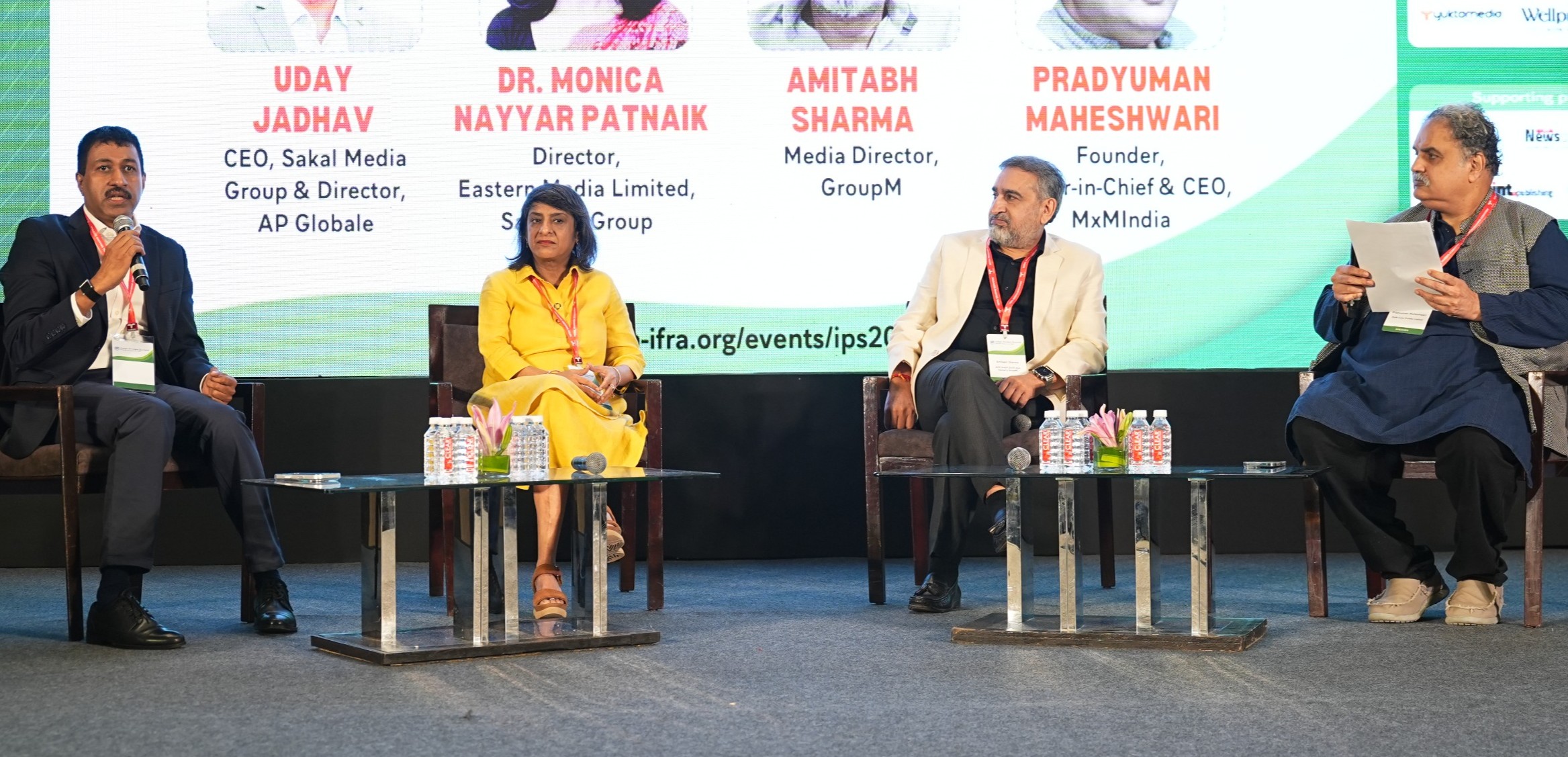
That question of value carried into the CEO Roundtable, where senior leaders from Sambad Group, Sakal Media Group and WPP Media South Asia discussed how publishers can better understand and monetise their audiences.
“Database is the new oil. If we know what the consumer is reading, viewing, listening to and surfing, we can monetise it,” said Monica Nayyar Patnaik, Director of Eastern Media Ltd, Sambad Group.
Uday Jadhav, CEO of Sakal Media Group and Director of AP Globale, pointed to the need to reduce publishers’ dependence on advertising.
“Today, 70–80 percent of revenue comes from advertising, while only 20 percent comes from subscription and circulation. We need to flip this revenue model so that 70–80 percent of our revenue comes from subscriptions,” he said.
The Summit’s two parallel tracks – one focused on advertising and distribution, and the other on printing – explored how these shifts could translate into practice.
Devika Shreyamskumar, Director of Operations, Mathrubhumi, discussed segmenting audiences by interests rather than traditional demographics, while Ashok Sharma, Head – Revenue, Business Strategy and Planning, Amar Ujala, said advertisers increasingly want solutions tied to relevance, action and measurable ROI.
At the Summit, Indian winners of the International Color Quality Club 2026–2028 and Star Club Awards received Certificates of Recognition for achieving reproduction quality that meets ISO 12647-3 and WAN-IFRA standards.
Putting AI to work in print production
On the production side, Debarshi Ray, Technical Director of The Times of India Group, discussed AI and Industry 5.0, stressing that adoption should start with a clearly defined business problem.
“Industry 4.0 has generated an abundance of machine data. The challenge now is turning that data into decisions. AI can help identify patterns and support those decisions, but successful implementation requires robust processes and clean, usable data before automation is introduced,” he said.
More than 270 participants from 36 organisations gathered in Pune on 9–10 September for the 34th edition of the Indian Printers Summit.
For consumer revenue and distribution, Deepak Bhatt, Assistant Vice President, Sales & Distribution, India Today, highlighted five factors shaping consumer decisions: value, reviews, trust, convenience and aspiration.
The latter is particularly relevant beyond metros, where readers in Tier 2 and Tier 3 cities increasingly expect access and pricing comparable with larger markets.
Rajeev Jalnapurkar, former CEO of Ramoji Film City and a veteran of the Indian entertainment industry, spoke about the growing importance of experiences in media and entertainment during his closing keynote.
For publishers, that could mean looking beyond the newspaper and finding new ways to bring audiences closer to their content and brands.