Innovation, AI and uncertainty: Key findings from the 2025 State of Asian Newsrooms report
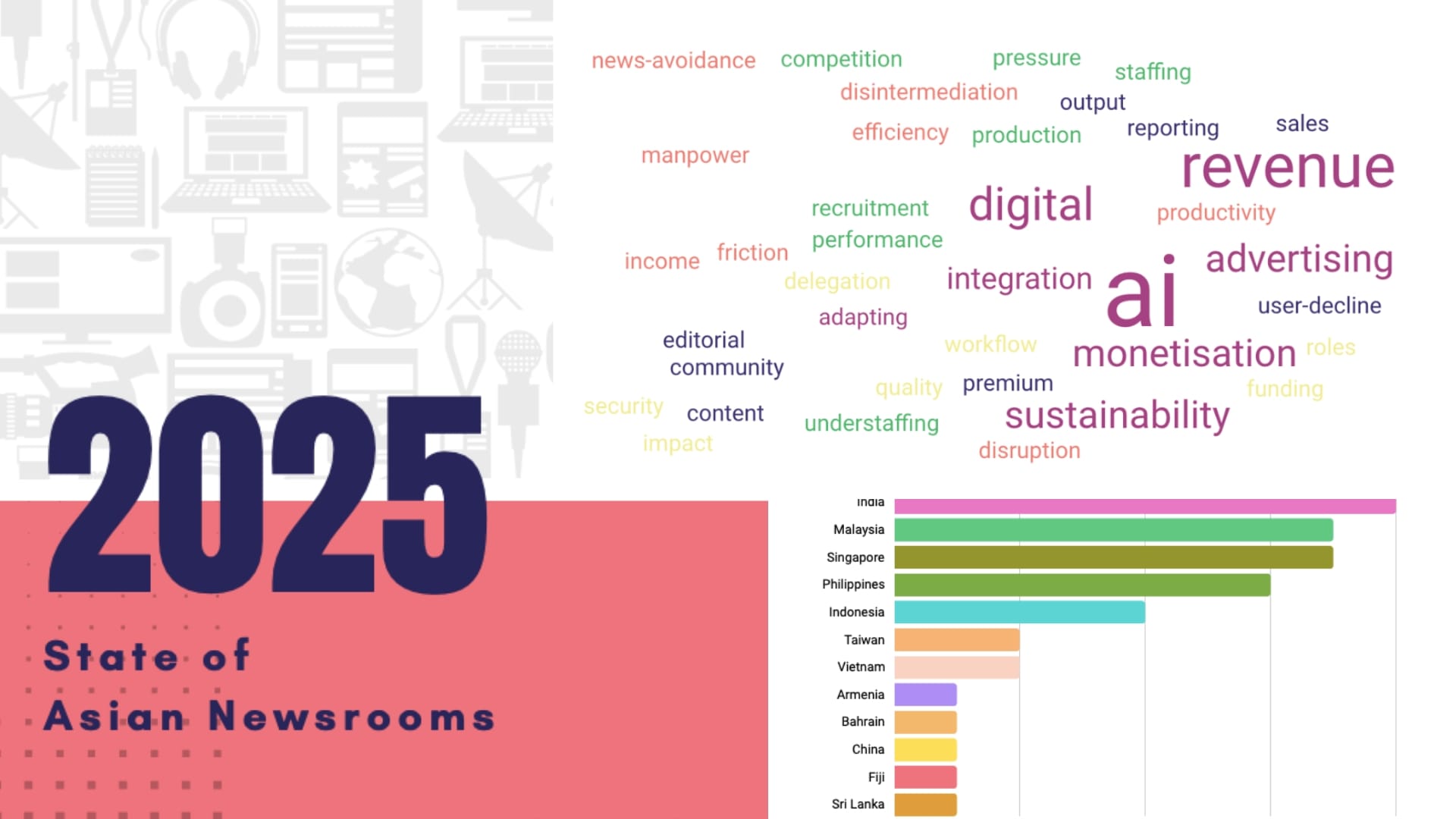
The findings are based on a survey of 42 media professionals conducted between September 2025 and May 2026. Respondents came from 12 markets, with groups based in India, Malaysia, Singapore and the Philippines. They ranged from reporters and editors to team leaders and C-suite executives. Most worked for national news organisations.
The survey was conducted by WAN-IFRA Asia in collaboration with the Centre for Information Integrity and the Internet (IN-cube) at Nanyang Technological University’s Wee Kim Wee School of Communication and Information. The report was prepared by Shruti Malviya, a PhD candidate at the school; Edson C. Tandoc Jr., Wee Kim Wee Endowed Professor in Communication Studies and director of IN-cube; and Goh Zhang Hao, a research fellow at IN-cube.
WAN-IFRA Members can download
the full report from our Knowledge Hub.
The small sample means the results should be read as a snapshot rather than a picture of every Asian newsroom. That said, five findings stand out.
1- Newsrooms are being asked to do more with less
Staffing pressures remain a defining part of newsroom life. Of the 42 respondents 19 said editorial headcount had fallen during 2024; 14 reported an increase, and nine saw no change.
At the same time, the skills editors want are expanding. Given the opportunity to hire, 54.8% would seek data journalism skills – and the same proportion would prioritise audio or visual experience. Experienced journalists remained in demand among 52.4% of respondents, while half wanted AI content strategists and 47.6% wanted social media expertise.
Newsrooms do not simply need more capacity. They need people who can combine strong journalism with data, formats, platforms and AI. Leaders must ask whether recruitment and training plans match this increasingly hybrid work.
2- The audience shift is now an off-platform reality
Print readers continue to skew older, while digital audiences are younger. Forty percent of respondents placed their main digital audience in the 26-34 age group. Print readership, meanwhile, is still declining across many organisations.
The strongest growth is taking place beyond publishers’ websites and apps: Some 77.5 percent reported rising audiences on off-platform services such as social media and Apple News. This creates reach, but can deepen dependence on intermediaries that control discovery, distribution and user relationships.
Publishers face a two-part challenge: make journalism work where audiences spend time, while turning that attention into durable, direct relationships.
3- AI use is growing, but it remains focused on assistance
Two-thirds of respondents said journalists in their organisations were allowed to use generative AI when producing stories, up slightly from 2024. Yet the most common applications remain supporting tasks: proofreading and grammar correction and transcription were each cited by 52.4%, followed by background research at 50%, translation at 47.6% and summarisation at 42.9%.
Only 11.9% used generative AI to produce written content. For now, adoption appears centred on efficiency rather than replacing reporting and writing.
The ambivalence is equally important. Although 77.5% agreed that AI helps journalists and 75% said it can perform some tasks more efficiently, 65% did not trust the quality of its output.
Governance is progressing, but unevenly: 57.5% said their company had ethical guidelines, while 25% said it did not and 17.5% were unsure.
4- Creators are becoming collaborators – and a challenge to newsroom identity
News organisations are increasingly open to digital creators. While 38.5% already collaborate with external creators, influencers or key opinion leaders, another 48.7% would consider doing so.
Editors see both value and risk. Nearly six in ten respondents said creators are more in touch with audience perspectives, but the same proportion viewed their content as less credible. A notable 69% said creators should be held to the same ethical standards as journalists, while 64.3% believed journalists should themselves become digital content creators.
The opportunity is to adopt creators’ formats and audience instincts while retaining the verification and accountability that distinguish professional journalism.
5- Business-model pressure connects almost every priority
Advertising remains the dominant source of funding, cited by 83.3% of respondents. Sponsorship and print subscriptions were each named by 54.8%, while 42.9% reported revenue from paywalls or membership. Donations and foundation grants played much smaller roles.
The outlook
When asked about priorities for 2026, participants repeatedly returned to AI adaptation, revenue and funding, print-digital integration, changing audience behaviour, understaffing and the need to build a lasting readership community.
These are not separate problems: Investment in new skills and responsible AI requires resources; stronger direct audience relationships can support revenue; and both depend on journalism that people find useful and trustworthy.
While the focus on finding new revenue streams remains, so too does the emphasis on finding stories that matter and better understanding the audience.