Can you stop the use of AI on opinion pages?
It hasn’t been a good season for the opinion page. AI-generated columns, fake bylines, hallucinated quotes – the problems facing publishers and editors are real and accelerating.
What we know
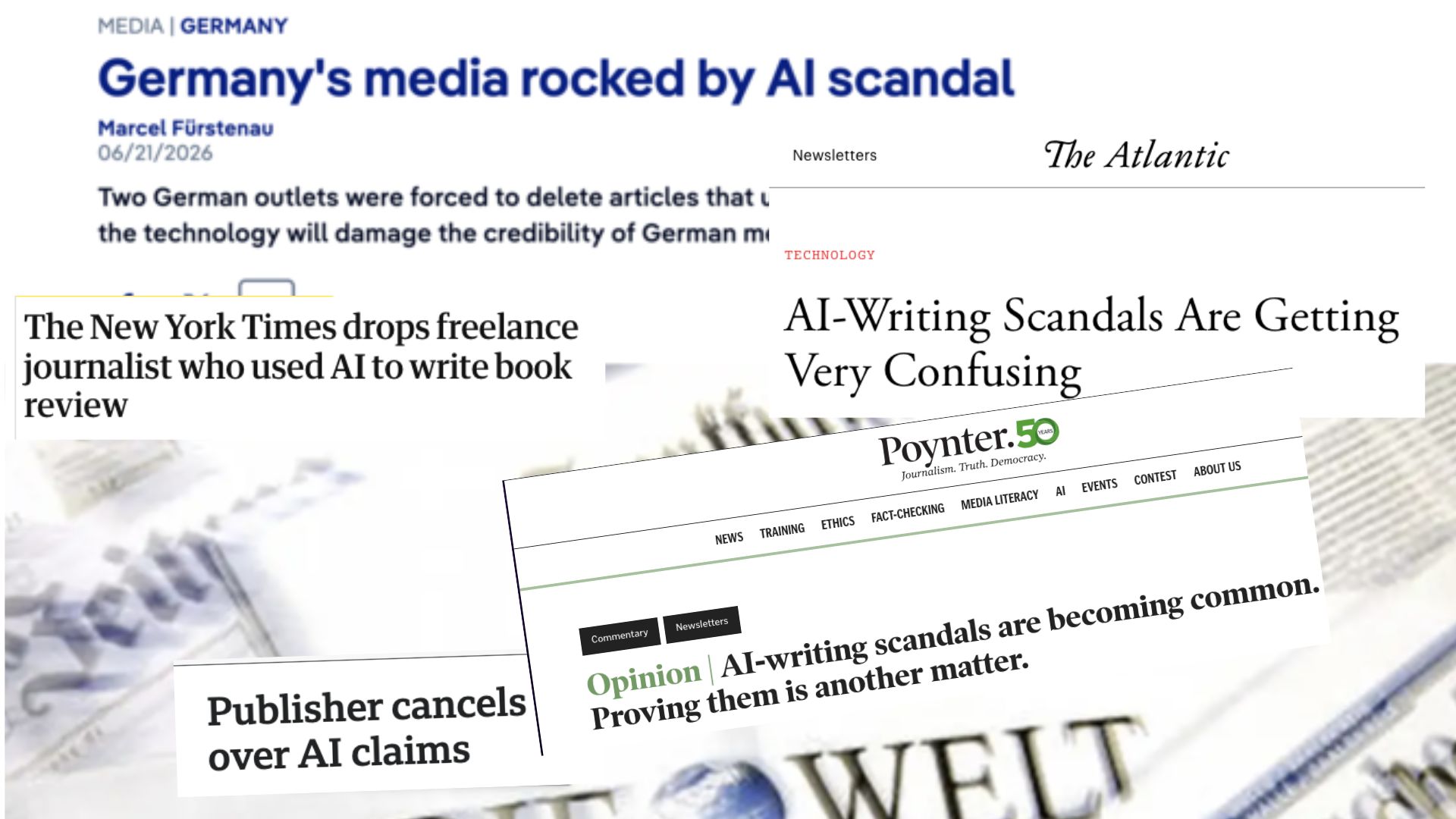
This week, Deutsche Welle reported on two high profile German news outlets which were recently forced to delete published opinion pieces that made undisclosed use of AI.
Berlin daily Tagespiegel said it had deleted op-ed contributions from its former publisher and editor-in-chief Stephan-Andreas Casdorff, “until further notice”.
A few days earlier the Frankfurter Allgemeine Zeitung (FAZ) said an op-ed piece published from the state premier of Thuringia, Mario Voigt, was also created with the help of AI.
In March, The New York Times dropped freelance journalist Alex Preston who used AI to write a book review.
In April, the Mississippi Free Press revealed that they’d unknowingly published an opinion column written using artificial intelligence, and that the author was fake.
Earlier this year, Peter vanderMeersch, retired CEO of Mediahuis Ireland, was found to have used AI to write several columns published on Substack that included hallucinations in quotes.
Also See: AI-Writing Scandals Are Getting Very Confusing
‘Language and thought are inextricably linked’
The opinion editors of Altinget – a politically focused news site with editions in Denmark, Norway and Sweden – were so concerned about the degradation of the quality of debate that they produced five guidelines for oped contributors (disclosure: translated by machine).
“The Althingi’s debate editorial team is increasingly receiving debate posts, comments and columns that clearly bear the hallmark of being written with the help of artificial intelligence. The human dimension of the debate has clearly been weakened, and with that, unfortunately, the quality of the debate has also declined,” wrote Ingrid Skovdahl, Christian Andersen, and Lukas Marklund.
“Debate posts written with extensive use of artificial intelligence are more uniform in tone, structure and language. The argumentation is often incoherent, impersonal and not very concrete,” they added.
A framework worth borrowing
The guidelines they have produced are:
1 “The role of the Altinget media house is to facilitate debate between people, not machines. We believe that language and thought are inextricably linked. In the work of formulating what one thinks, believes and stands for, language is an absolutely necessary tool. It is your thoughts and your voice that colour the debate and create engagement.
2 We encourage debaters to be critical about how they use artificial intelligence in the writing process. Artificial intelligence can be a good tool for brainstorming and research, and for checking spelling and grammar errors, but we expect that the reasoning, arguments, and formulations are your own.
3 Regardless of whether AI is used for research, all factual information and sources must be verified before submitting a manuscript.
4 Altinget wants to publish texts that are written by humans, and we want openness from debaters about the use of AI.
5 If a post is entirely or largely AI-generated, Altinget will reject it or ask post authors to reformulate the texts.
These five guidelines won’t fix opinion journalism. But they’re five more than most newsrooms have – and they were written by humans, which feels like a good place to start.


